
*the following contains spoilers for Midnight Mass*
What the fuck happens next? That question asked by Kate Seigel‘s character Erin Green in Midnight Mass as she lays dying in the final episode rings throughout the seven episode series. What the fuck happens next? What is there beyond all of this? How does the story end?
This question is asked by all human beings at one point or another. It is asked with curiosity, wonder, and more often than not, with fear. Actually, human fears are not all that complex, and usually they focus on what is unknown to us. By that logic, the most common fear that we all have is of death. It is that fear, and the lengths we go to avoid and understand death in equal measure that form the central idea of Midnight Mass.
The story centers on the fictional New England-esque Crocket Island which serves as home to approximately 127 people and was once a successful fishing port before a tragic oil spill tore the fabric of the tight knit community. At the center of this island community, is the church. I am Jewish, and growing up, my family and I were never really part of a community despite living in a small town with a very tight knit community (it wasn’t even because we were Jewish, we were just weird and anti-social). So I can’t relate to any church going experience as such, but what I can relate to is this: the experience of the type of rot that grows and thrives within small towns.
Small towns are ideal places for contagion, not just the contagion that we have become very familiar with during this pandemic, but the contagion of a hive mind. The hatred of anything different and the safety of sameness. Our story begins by following a few figures who stand out as strange within the isolated Crocket Island. Erin Greene (Kate Seigel) a pregnant woman with a troubled past, Sherif Hasan (Rahul Koli )and his son Ali the only Muslims on the island, and our main conduits, Riley Flynn (Zach Guilford) and Father Paul (Hamish Linklater). As well as town doctor Sarah Gunning (Annabeth Gish) and her ailing mother Mildred (Alex Essoe) standing in direct contrast to bible thumper Beverly Keane (Samantha Sloyan).
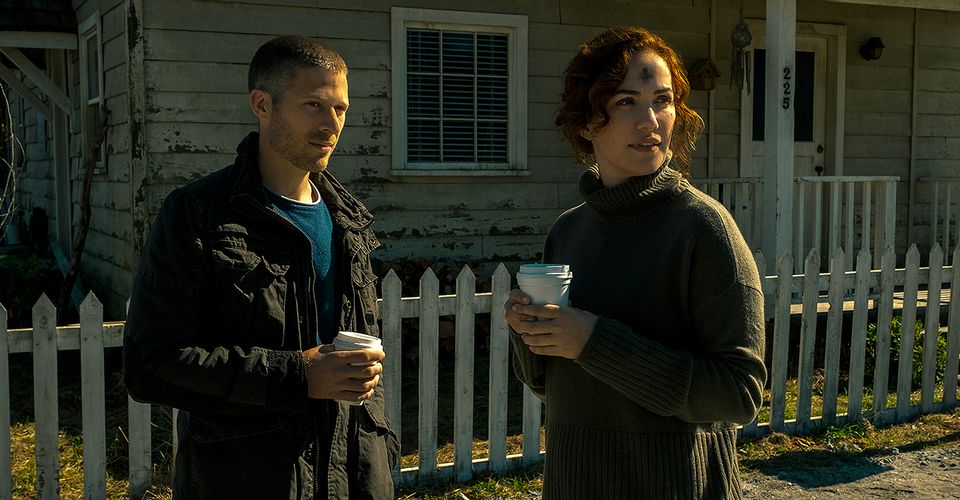
Riley is a former alter boy who returns to the island after spending four years in prison for murdering a young woman in a drunk driving accident. Haunted by his addiction, he is nevertheless clearly a truly good hearted and kind man who no longer believes in God because in his words, “a being who believes suffering makes you better? How monstrous.” It’s not the first time that the idea of God as a monster has been brought up in horror. It was sort of the basis of all of HP Lovecraft’s writing. And indeed, he sounds pretty monstrous doesn’t he? An all knowing, all seeing entity that created the world and regularly punishes its inhabitants, sometimes for the crime of rejecting him as deity. We blindly believe in this entity with no evidence of its existence and the very sight of him would kill us.
Riley discusses these thoughts in what are some of the best scenes of the entire show. The AA meetings he attends alone with Father Paul which play out like two man shows. Father Paul is the mysterious stranger who arrives on the island as a harbinger of change. The church’s original pastor Monsignor John Pruitt recently went on pilgrimage to Jerusalem. We never see him return but Father Paul, stepping in for the Monsignor, says that John is on the island and he is totally fine and Paul’s reign over the church will be temporary. It’s clearly a lie, though the truth is much more shocking than expected.
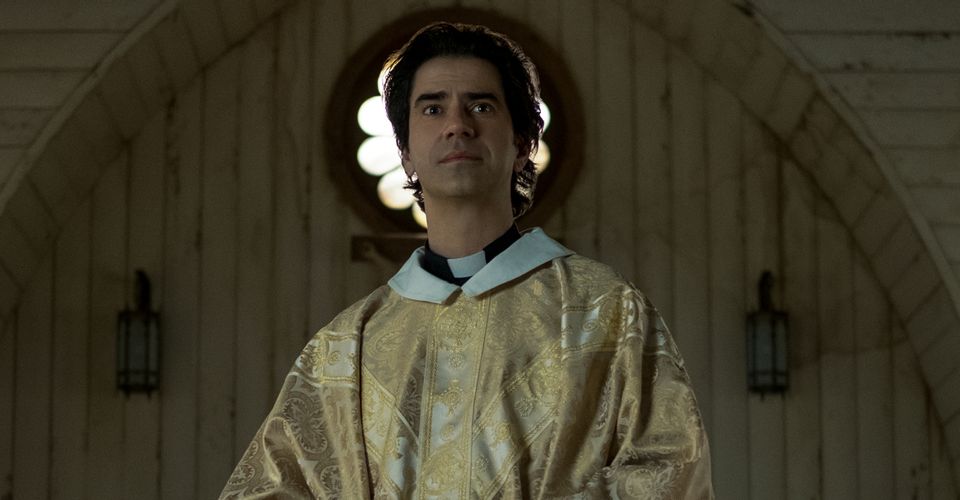
Very quickly, Father Paul’s arrival starts coinciding with inexplicable miracles. A young girl who is paralyzed from he waist down begins to walk again, several inhabitants of the island begin to regain their health and youth, and most notably, Father Paul himself literally fucking dies only to then be resurrected in a matter of minutes. Obviously the island begins to view the young, charming and charismatic priest as a bit fo a saint. As we discover, he is actually the opposite.
We find out in the third episode that Father Paul is actually Monsignor John made young and healthy again after an encounter with “an angel” on his trip to Jerusalem. Whether the angel is actually an angel or a demon is never explicitly said but the angel certainly bears a striking resemblance to a vampire. After meeting the vampire (it’s a vampire, let’s just call it what it is) Father John who is actively suffering from dementia at the time is drained of blood and then given the blood of the vampire which restores his youth and vitality. To him, having found this winged being with the ability to restore life in an ancient temple in Jerusalem, it can be nothing other than the work of God. And so he takes the vampire back to the island in order to share it with the rest of the community. He begins dosing the church goers unbeknownst to them by mixing the sacramental wine with the vampire blood. After his death and resurrection though, the sacrifice for the eternal life he is relying so heavily on becomes increasingly, disturbingly clear.
Even supposing that in this universe the concept of vampires doesn’t exist, once John starts burning in direct sunlight, is unable to eat real food, and develops an unquenchable thirst for blood that leads to him eating one the townspeople (the angel/ vampire has already eaten a couple others at this point) one wonders how he was able to keep telling himself that the path he was following was God’s plan at all. The truth is that Father John, once so elderly and sick and scared, needs to believe this delusion, because in the end, if the angel is not an angel, but a monster, then what is left for him but death?
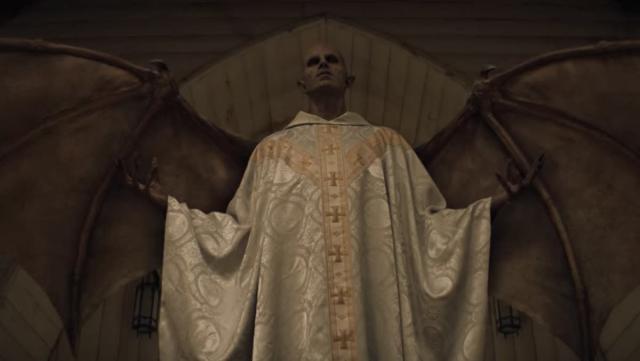
His delusion really falls apart after Riley is accidentally turned into a vampire in episode five. It is truly one of the greatest tragedies depicted on the show that Riley who has suffered an addiction that drove him to murder, was haunted by that act for four years and has actively worked to atone is now cursed with an even greater addiction that will force him to commit regular murder simply to prolong his life. John tries to tell Riley that vampirism (he calls it a blessing but we know what it is) takes away the guilt that comes with murder, but Riley doesn’t want that for himself. He clings to his humanity and his desire to be a better man because, unlike Father John, he’s not afraid of death. And he knows that immortality is not worth the sacrifice of innocent lives, something that John cannot come to terms with. In the end, Riley chooses to die rather than live life as a monster.
The weight of Riley’s sacrifice becomes even more clear by the time the final two episodes come to pass. With the entire town coming to the church for Easter services, Father John finally reveals his true identity and presents the angel to the congregation with mixed reactions. Now with proof of something other- worldly in their midst, the congregation (with some notable exceptions) feels comfortable drinking rat poison in order to be reborn immortal and healthy. Granted a few among us do seem to think drinking bleach will cure Covid so I guess we’re not really in a position to judge here, now are we?
It is at that moment when brother literally turns against brother and the monstrous gift that Father John has brought to the island comes to a boiling point that the audience, several townspeople and even Father John himself finally realize just what it is that he has done.
Oddly enough, I still wouldn’t quite call Father John a villain in this series. It is only in the final episode that he finally lets his delusions drop and is honest with both himself and the audience. He admits that the reason he brought “that thing” to the island (this is the only time he acknowledges that the angel is not an angel) was for one reason: so that he could be with the woman he loved. Apparently when Father John was a young man he fell in love with Mildred and they had a daughter together, Sarah the town doctor. However he was never able to be with her because he was a priest and she was a married woman. And as they both became old and sick, he realized he had run out of time and chances and he regretted his wasted life. That’s exactly how he says it too. His wasted life. He tells all this to Mildred, now cured of her dementia but infected with vampirism just like John, that had she come to him back then and asked him, he would have run away with her. She says that was never going to happen. But he so desperately wanted a second chance to try anyway. Because the tragedy of course is not to die, but to be wasted. He couldn’t bare losing her and losing the chance to make up for that wasted time.
More than anything, Father John is a tragic figure. He’s a priest who fell to the devil when he was offered everything he wanted . He’s a shepherd who sacrificed his flock for his own selfishness. He’s an old man with a young man’s naiveté and ironically, he still had a second chance but he didn’t spend any of it with the woman he loved or trying to get to know his daughter. He spent it lying and deceiving and suffering.
In the Jewish religion, we don’t believe in Hell. I’m not entirely sure what that means, except that by that rationale, nobody can be damned for their actions, which is rather comforting. But if there is no Hell, can there be a Heaven? If there is no punishment, can there be a reward? Maybe this life is all there is. And that is slightly less comforting.
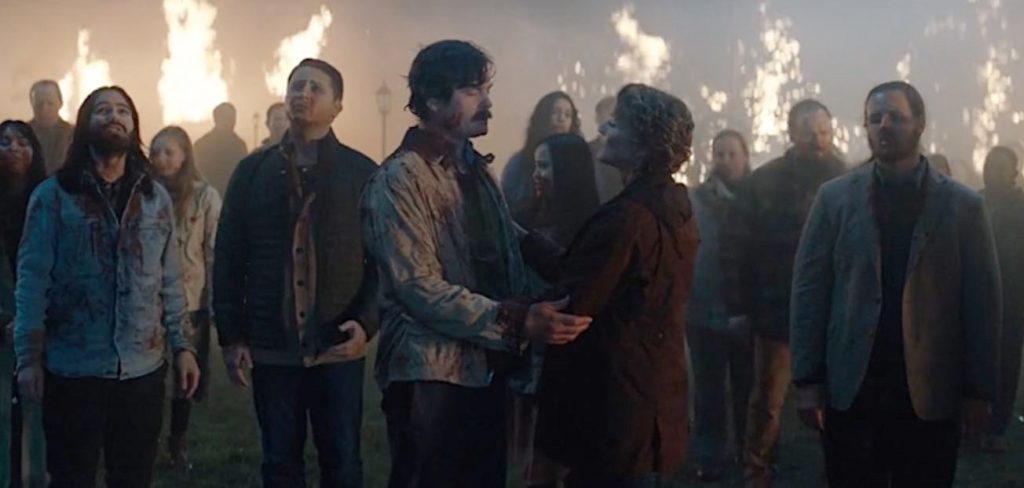
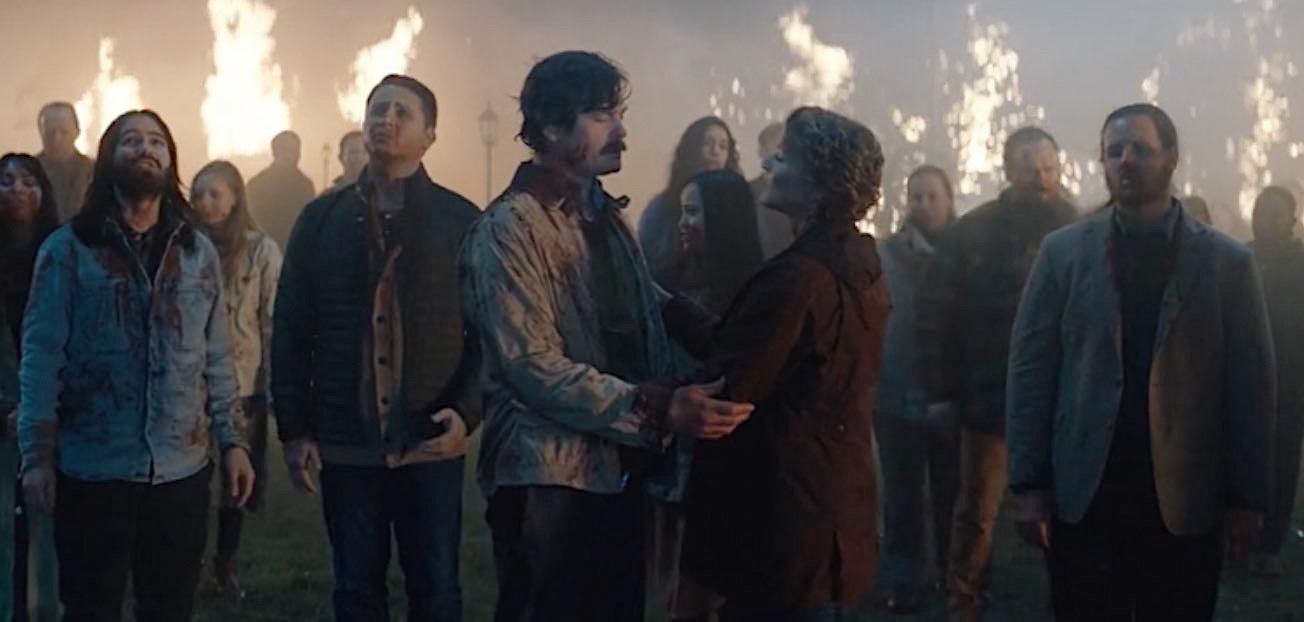
I don’t know much about the Bible, Hell I don’t know much about the Torah either, but here is a verse that stands out to me: “No greater love hath man than to lay down his life for a friend.” And this quote shows up in the finale of Midnight Mass during a long, dark and violent night. By this point most of the characters have killed someone who they love and everything on the island has been burned to the ground including the church. When the sun comes up, there will be nowhere left to hide, and every single one of them will die. And yet in that final moment, something lovely happens. The characters go to their death without fear. The community comes together to sing a hymn, holding hands with their loved ones. Sherif Hasan and his son perform a traditional Muslim prayer side by side. And Father John shares a kiss with Mildred, and takes off his collar to greet the sun. In fact an interesting detail is Beverly Keane, a very one note character who is probably the closest thing this program has to a villain and has spent the entire series being racist and bigoted and downright awful. She is the only one who goes to her death alone and frightened, and in the end despite her supposed faith in God, she tries to run from it. She dies screaming while the rest of the island dies singing.
That’s why I love horror so much. It’s about being frightened yes but it’s about realizing that amidst all the terror there is beauty and there is life and that’s what allows us to survive it all. That in the darkness, in the last dying breath, in the midst of monsters you are standing beside someone or something that is precious to you and it’s all the more precious because of what we face without it. Because that’s the point of all great horror I think, that in the end love is just so much more important than the violence and monsters and anger and all that fear.
So here is what I think: I think that the greatest mistake we can make, is to spend our whole lives, thinking about death. It will come in the end no matter what we do, and even if there were a way to avoid it, death is what makes life so special. This fleeting time that we have, to appreciate the people and the things that we love. So the question really isn’t, how does the story end? The question is, how does the story begin, and what do we do with the time we have?