
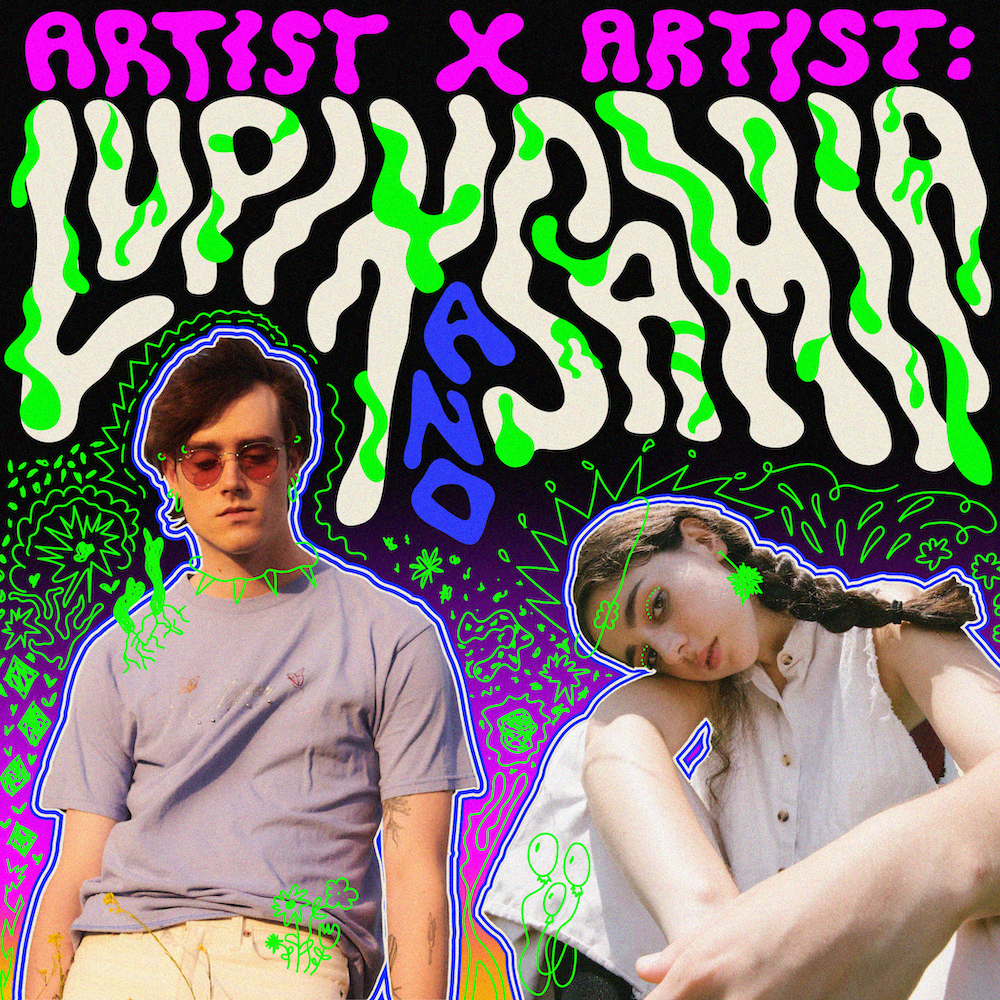
Art by Enne Goldstein, you can find more of their work here. Samia photo byJessica DiMento. Lupin photo by Graham Tolbert.
Jake Luppen and Samia Finnerty exist within the same tangled web, with their friendship dating back to sometime last year, when Samia hit the road for a short, but meaningful stint with Jake’s band, Hippo Campus. In the time since then, the two, recently label-mates, have intermittently crossed paths, most recently with Jake taking on a producing role (alongside HC bandmate Nathan Stocker and Caleb Hinz of The Happy Children) in the process of creating Samia’s proper debut record, The Baby (released August 28, 2020 via Grand Jury). Additionally, Jake and Samia, along with a handful of close friends, began crafting their very own project together, under the name Peach Fuzz (details pending!).
Independently, Jake has also been fairly busy. Despite years in the industry under his belt (both with Hippo Campus and with his collaborative effort with Nathan and Caleb, Baby Boys), he courageously embarked on his first solo venture under the moniker ‘Lupin’ this past year. His debut self-titled record under the project was released October 9, 2020 via Grand Jury, to much acclaim.
Subsequently, 2020 seems to have been a year packed with hard work, collaboration, self-discovery, vulnerability, and generally, newness for both Samia and Jake. Together and apart, the pair took a dive headfirst, into the unknown, and came out unscathed. With each of their respective debuts, they took on an unapologetically genuine, open-hearted approach, allowing listeners to possibly understand them better, and opening up a lane where they, themselves, might be able to look inward and understand themselves more intimately, too.
Currently, it’s been a few months since each musician’s respective release date. As of early December, Samia was holed up in New York, following a trip back home for the holidays, and on the brink of moving to Nashville to begin a new life. Jake, on the other hand, was over in Minnesota, having just moved into a new space with his partner, Raffaella Meloni (who publishes music under just her first name and happens to be one of Samia’s best friends).
Over Zoom, the two artists caught up to discuss their most recent work (respectively and together), reflect on fond memories, and even ponder throwing their phones into the garbage disposal.
Samia Finnerty: Hi Jake!
Jake Luppen: Hey dudddeee.
SF: What’s up?
JL: Not much, just chilling [laughs]. This is hilarious because I feel like we talk, like, every other day.
SF: Well, the thing about our relationship is that, my best friend [Raffaella] just moved in with Jake at the beginning of the year, so Jake and I had the kind of relationship where we would talk, like, pretty frequently but certainly not every day, while I was crying or in a fit of rage. But, now, Jake has to hear me cry and complain pretty much daily because he’s on speakerphone [laughs].
JL: I love it; it’s awesome. Oh, man. So how have you been?
SF: I’ve been good! I came home to see my parents for Thanksgiving.
JL: Oh, crazy. So, you’re in New York right now?
SF: Yeah.
JL: When do you move to Nashville?
SF: I’m gonna start moving in next week.
JL: Crazy. That’s so crazy. Are you stoked?
SF: So stoked. I’m so excited to not be flying back and forth all the time anymore. And, work is depressing a little bit right now.
JL: Yeah, that sucks. Are you sad to leave your homies there, or is it just, weird in general right now, so it doesn’t feel that much different?
SF: Everyone’s gone. I mean, I think the incentive to live here was, like, live music and the nightlife and going out and there’s always so much to do all the time. And, now that that’s gone, it just- it looks pretty industrial and sad and there’s not a lot to do in the daytime, other than walk around [laughs] in New York. So, I think everyone sort of made the decision to move back home or move somewhere where life was pretty, things were pretty around them.
JL: That totally makes sense. Can you, like, write songs in Nashville? Because I know, like, talking to Raff about the move to Minnesota, and one of the more difficult parts about it was just, like, her process was sort of changing, and I kind of imagine if I went somewhere new and was living with somebody, it would kind of be difficult to write, but-
SF: Yeah, I bet. I mean, I’m gonna have my own place and there’s gonna be a piano…all I really need is a piano and some privacy [laughs].
JL: Just a piano and a dream [laughs].
SF: But you’ve always just written- you have such a space for your music, I feel like. Has it been more difficult to find time to write?
JL: Yeah, a bit. Just because, being in this relationship, I’m just so happy. It’s kind of the first time I’ve chosen a person over writing, like, I would kind of rather be with a person than write music, which is the first time that that’s happened in my whole entire life. Usually, I’m like constantly escaping people by just writing, so that’s kind of been a thing to balance. But, yeah, I’m still kind of in my own spot. We just moved into a studio yesterday, so it’s way more comfortable. Before that, we were in this rehearsal space where there were just metal bands performing non-stop, so I couldn’t even have a moment of silence in there, to think or write. So, I’m excited to move into that new studio and work. It’s relatively similar; it’s not much different.
SF: Yeah, I’ve never had my own corner or my own space, that’s fully set up and available to me whenever I feel inspired to write music in. So, this is gonna be my first opportunity to do that, I think. I’ve just either been at my parents’ house or, like, subletting a room in someone’s place, or on tour for the past four years so, it’ll be nice.
JL: I bet having your own spot, too- like, I remember when I moved out of my parents’ house and started writing in a space that was mine, that I started paying rent on, I was just so inspired and it felt so cool. I imagine it’ll probably be a similar thing when you get out to Nashville and you have your own space. You’ll be like, “Ah, I’m independent. I’m free.”
SF: I’ll have a backyard….
JL: Yeah, exactly. That’s gonna be so cool.
After getting reacquainted and filling each other in on some current events in each others’ lives, the two began to take it back and reminisce about their relationship’s very beginnings, and how they’ve continued to exist in each other’s spaces since then.
JL: So, Sam, what was it like to tour with Hippo Campus? [laughs] What was your experience?
SF: It was amazing. It was probably my favorite tour I’ve ever been on. I feel like we were out for…was it, like, a month?
JL: Yeah, we did a month. It was crazy.
SF: I was just so inspired by what you guys were doing and the way you treated the people around you. And you all made us super comfortable and I just looked forward to the time we got to spend, like, shooting the shit and having fun as much as I did the performance experiences. And I think that’s pretty rare.
JL: Yeah, that’s so crazy. I think I got to know you, as an artist, kind of through Nathan. I remember he showed me “Someone Tell the Boys” and ‘the Josh Tillman song.’ I have such a vivid memory from the first time I heard it; we were in the rehearsal space, and he was like, “Oh, you gotta check out this artist, Samia,” and I was like, “Whoa, these [songs] are crazy!” I think my perception of, like, who you are was very different at that time. I was like, “Whoa, this person is really heady, and deep,” and we saw the first show and you were on the ground, thrusting [laughs] and I was like, “There’s so much more to this artist than I ever thought there was.” And just hanging out and getting to know you, it’s such a cool thing — to know you as an artist and then know you as a friend and then, eventually, work together, knowing both of those things. It’s rare when you get to work with people that you know that well and so intimately, like, after a month of spending everyday together.
SF: I mean, I think that’s what made the experience so valuable for me, working with you, was trusting you guys with my stuff and knowing that we were all on the same page and we all had similar tastes and inclinations. I think it took spending that kind of intimate time together, touring and just hanging out, to feel that confidence going into making the record [The Baby].
JL: Yeah, totally. Like, I remember hearing that you were looking for producers for the record and that you tried a lot of them, and I just remember talking to Nathan and Caleb [Hinz, of The Happy Children] when we were hanging out one night and being like, “Why don’t we just make the record? Like, we know Samia so well!”
SF: I remember when that happened! I was in LA, meeting with a bunch of dudes who were all really nice, but I just didn’t know, and it was hard for me to open up. I was just really shy and didn’t feel like I could be honest enough to write a song that I liked or say how I really felt about anything [laughs]. And then, you and Nathan FaceTimed me and were like, “Why don’t you just come here and do it here?” And I hadn’t even conceptualized that option [laughs]. I was just like, “Okay!,” and went.
JL: And neither had we, really! I mean, it seems like we were under qualified to do it, strictly on paper. But we were like, “Nah, who else is gonna do this record better?” Y,know? We know this person, we’re such big fans. And hearing what you’d done in the past and seeing how people had interpreted it, it was like, it’s so close to what it could be. So, making this record, just pulling back all the layers, it was just about your words and your voice and just making a record that doesn’t fuck that up.
SF: Yeah, I had spent so much time listening to Hippo Campus and The Happy Children and it so obviously influenced my songwriting and my taste, so it just felt like a natural move to lean on you guys for production and stuff, because it was just already in my creative sphere.
JL: Were you ever nervous at all? Were you like, “Oh, these guys are really fresh,” sort of, “I don’t know what these guys are gonna do?” Or were you just confident, the entire time, that it was gonna be cool?
SF: No, I knew it was gonna be good. I mean, we had a long back and forth with all the people that I work with, and, like you said, on paper, it was one of the first things you guys had done and so, they were like, “You gotta work with some 60-year-old dude who had like 17 Grammys.” And I was just like, “But that’s not gonna make it good?” [laughs] It was just such a long back and forth and, ultimately, everyone just trusted us to get in there and do it. I guess I was just nervous about going back to the label with all of these kind of weird elements that we were throwing in, that I knew with my whole heart that I loved so much and was so confident about, but it’s just a scary thing.
JL: There’s something cool about making a record like that, where everyone was like, “Oh, don’t do that! Don’t do it! You’re gonna ruin it!” or whatever, and it’s just like, “No, fuck that.” We’re gonna make this super cool thing. Everyday we went in like, we’re gonna prove everybody wrong and make something really cool.
SF: Did you feel like that with making Bambi at all? I know it was kind of a departure from the other Hippo stuff.
JL: Yeah, yeah, a bit. I mean, kind of every Hippo Campus record we made, we [would] pull it up to the team and they would be like, “No, no” [laughs]. Like, “What are you doing? You had such a good thing and now you’re making it all weird!” And every time, we’d just be like, no, we’re the people that know the music best; we know our fans better than anyone in the industry; we know what makes the band cool and we just have to trust that. When you let other people steer the ship, that’s when bands get messed up, I feel like. It’s better to really trust yourself when people come to you and are like, “No, that’s not right,” because you can be like, “No, it is right.” That’s when you know you made something really cool.
SF: I really feel like you guys taught me that; you held my hand through that whole process of having to say, “I like this and I’m not gonna change it.”
JL: It’s because we made mistakes, because we trusted the team and not liked something and put it out. And, y’know, we’re never happy with it. You have to trust yourself, above all. Because, y’know, Samia knows what’s cool.
SF: [laughs] I know what Samia likes.
JL: Yeah, what Samia says [laughs].
JL: How did it feel to release your debut record during quarantine?
SF: I don’t know! I mean, I’ve never done it before, so, I don’t know what’s different about my experience during quarantine, than it would’ve been in a normal-
JL: Wow, I’ve never really thought about that before. That actually blows my mind.
SF: Yeah, I mean, the thing that decidedly sucks is having so much time to look at numbers and the Internet. [When you’re] touring, it’s just so easy to humanize those connections that you’re making, like, seeing people at the merch table and connecting with people in the audience, and looking them in the eyes and being like, “That’s another human being and we’re connecting over this.” That’s so much more powerful to me than Spotify monthly listeners, y’know? So it’s been hard to have that as the only gauge of how this album is affecting people, but, I guess social media- I’m more thankful for it now than any other year because it’s the only way to see that.
JL: Yeah, like, promote things, too. It’s so weird, you really don’t get to see the human aspect of it, like you were saying. You don’t get to see kids singing your songs, and that’s why we do it — for that human connection, to see it resonating with real human beings — so it’s such a weird time to release music.
SF: How does that feel for you? You, like, unleashed a whole new project in a pandemic.
JL: I mean, it’s been cool. But just the thing that fucks me up is that, like you said, the only metric is numbers…Hippo Campus, we’ve never been a press band or a radio band; it’s always been shows. That’s kind of what Hippo Campus does and what we’ve been known for. So, it’s been particularly hard on us because, if we release something, we’re not really gonna get much press and we’re not gonna get much radio. But, in the past, we’ve been able to see humans pull up to our shows and love the music, so that’s made it all worthwhile. So, it’s been a bit of an identity crisis right now where it feels really good to put something out in the world and see how people react to it but it’s hard to gauge how well it’s doing because I’m not out there, touring it, y’know?
SF: Yeah, it’s hard not to look at that stuff, too. Even the good stuff, it’s kind of stressful because it’s like, “What am I supposed to do with this?”
JL: [laughs] I know! Sometimes, you get into depressed modes and go online and read comments and go down a hole, but I’ve tried not to do that. That’s been one of my goals in quarantine — to try to chill out and just focus on creating music and not really getting caught up in all the other stuff — because there’s no point in looking at that right now, because the world’s so weird.
SF: I kinda wanna just put my phone in a garbage disposal.
JL: Yeah, maybe we should. Me and Raff should just come out to Nashville and we should all put our phones in the garbage disposal.
SF: We can just sit at my little music desk and write songs all day.
JL: I’m down, that sounds great.
The conversation then shifted to the pair discussing Samia’s new project, The Baby Reimagined (set to be released January 15, 2021 on Grand Jury), as well as the daunting prospect of being vulnerable in general.
SF: Yeah, so we did a little remix album — I guess it’s not really remixes, it’s just…
JL: Redone?
SF: Yeah, new versions of all the songs from the record. And, yeah, it was just kind of an idea we had and I didn’t think it was gonna happen, and then I reached out to everyone that I admire — basically, besides Hippo Campus, because they made my record [laughs] — and I was just like, “Can you take a stab at this?” and, surprisingly, a couple of ‘em said yes. It’s one of the coolest things I’ve ever been part of, just to be able to hear people that I look up to, signing my shit.
JL: Wow, yeah, what did that feel like? Like, when you listen back to the album in its entirety? Did it give you any new perspective on the album in general?
SF: It made me hear the songs in a way that I hadn’;t approached them since I wrote them, because I’m just so accustomed to the versions that we did and the production is so much part of the identity of the songs now, that just hearing the songs as, like, chords and melodies — you know what I mean — it’s different; it kind of blew my mind. And I got to find new meaning in them, too, based on who was singing them and how they were singing them. It’s crazy.
JL: Man, that rules. So, production for me — working on other people’s music — is more fulfilling in a way that I’m not hearing my own voice singing something back at me. I have such a greater appreciation for things that I work on, production-wise, because I can actually love the song in a very pure way. Like, I’m just a fan of your music and working on it was just so cool because I could love the songs without thinking, like, “Oh, my voice sounds weird,” or, “I don’t like that word I used there,” so I could appreciate that. And I wonder if there’s a similar connection there, with listening to other people re-work your album. You could be like, “Wow, this song rules,” y’know, without thinking about you singing it. Or thinking, like, “Wow, I really love how Briston [Maroney] is singing this song right now.”
SF: Yeah! It makes me just hear the song and hear the story for what it is, on its own. But I kind of felt like that, even when we were working on Peach Fuzz [a top secret project!] in LA.
JL: Yeah, yeah, that’s another great example of multiple singers in the same band! Like, when I do the Baby Boys stuff, I can really get behind a song that maybe I’m not singing on. Like, we have a song called “Desperado” that Nathan sings and I just love… it’s just amazing, because it’s like, that’s my band, but I’m still removed from it and I can just really enjoy it.
SF: I feel that way when we’re touring because it’s a four-piece band and everyone plays a role and we’re all working off of each other. But, other than that, my project has just been me, basically; I just can’t separate it from myself. And the Peach Fuzz stuff was the first time in a while that I’ve been able to feel like a piece of something, like we’re all Tetris-ing this thing or making a greater puzzle and it doesn’t have to feel like- there’s just no ego involved in that, which was such a relief.
JL: Yeah, it was so cool to see all you guys as solo artists, like, come together in a band for the first time. I mean, you’ve been in a band before, but Raff and Vic, they hadn’t really, so it was really cool seeing you guys starting a band and embracing that dynamic. I’ve always done that, so, being a solo artist is so weird.
SF: Yeah, like, how has that experience been different, even just emotionally, from being part of Hippo Campus?
JL: I think I’m just learning a lot about myself, like, when I would do interviews for Hippo Campus, I would have to speak for all of us, so it wasn’t about my personal experience; I could only say things that were unanimously cool with the group [laughs]. That’s kind of the way Hippo Campus rolls, it’s like a democracy; we fight a lot and talk a lot to figure out exactly what our thing is, and then, we’ll take that out into the world and we’re all equal parts, that thing.
So, when I came out, doing interviews for this, it was really confusing, like, who am I? Who am I as an individual? Because, like, I’ve always known myself in this group. So, it’s been a learning process, but I feel a lot more confident in myself as an individual now, just speaking about my music — that was something I never enjoyed before and now I enjoy it.
SF: It’s so funny to me that- I think we talked maybe a couple weeks ago about, specifically, interviews, and how typical they are sometimes, and not knowing how you’re supposed to represent yourself or which version of yourself to be. And then, we got this email [laughs] to do one together.
JL: [laughs] I dig these kinds of interviews, where it’s artist on artist, where you can just really talk and you really understand each other and you know what kinds of questions to ask. Like, I’m not really the type of person who’s, like, bursting with personality in the way that I love to talk about music and I love to get up in a room and dance in front of people. I’m just not really that guy.
SF: I think you’re bursting with personality.
JL: That means a lot. Maybe, around you guys [laughs]. But, yeah, I just like making music in a dark room, and that’s what I’m good at, strictly the music part. And the image part, that’s the only part I really kind of struggle with because I’m not super into social media. I’m kind of like a grandpa when it comes to all of that sort of stuff, so, it’s weird to have to be out there and promote yourself when the part of it I enjoy is really the most pure part of it, which is just creating things.
Is that ever strange for you, to have to balance a sort of social media presence and personality?
SF: Yeah, my intention is always to be myself and try to connect with people the way I would if we were just having a conversation in person but it’s difficult! You’re seeing the version of yourself you’ve created and so many hours of the day are fixed with this caricature of yourself that you got to create, that you’re the pioneer or puppeteer of. And it’s overwhelming, sometimes, to have to pick which facets of myself I want to show and how I want to engage with people or what is the most effective way to do that and what is coming from a place of anxiety.
JL: Yeah, and if you get too vulnerable, if you really put too much of yourself into all that stuff, you get really depressed, or at least, I do. If I’m ever on tour and I’m just like, I am just bringing ‘true Jake’ to every performance, I’m just gonna be completely open, there’s no character or whatever, I feel like that’s a really scary thing to do. I feel like it’s good to have a little bit of a barrier, or sort of a character. Like, if people hate what you do, they can hate the character, and not you as a human being; I feel like that’s a lot harder. But you still have to balance honesty and vulnerability; it’s like walking a tightrope or something.
SF: Yeah, I think my stuff is just so specific and it’s totally biographical always, which makes it hard to separate myself from any criticism or judgement, just because it’s not a character. I should probably start writing from the perspective of someone else [laughs].
JL: It depends! Again, like, the difference between Hippo Campus and Lupin is Hippo Campus, which is the project I tour all the time, is us four so there is an easier deflection — there’s songs that are not about my personal experience — where I feel like with my stuff, it is more like that, it’s directly me. And I haven’t really had the chance to perform any of that stuff yet — I mean, doing livestreams and stuff — but I imagine that that would be a crazier thing.
The record that you wrote is so personal; I can’t imagine having that out in the world.
SF: Do you feel that way with the Lupin stuff, though? Is it more emotionally vulnerable?
JL: I do, yeah. I don’t really write in stories, usually; I kind of write over-arching things. I feel like a lot of the stuff with your music is a very direct account of a situation. Is that true, would you say? Like, you experience something and then you write a song about it?
SF: Yeah, I’ll write transcripts of conversations and just put them in the song as they happened [laughs].
JL: Which is sick! I’ve never been able to do that. For me, it’s more like, during this month, I was feeling this way, so I’m sort of gonna condense that all into a song. So, I think there is something with that where there’s a bit of a deflection, still. It’s not like, “I wrote this song about this particular experience,” y’know? But I’m fascinated by people that can do that; I always love that because that’s never really how I’ve written music. I’m very attracted to songs like that; they’re just so foreign to me.
SF: I think I’m very attracted to songs that are not like that, because I’ve consumed so much of it [laughs]. It’s hard to find the balance with telling the truth about your experience and not exploiting other people’s experiences, too. That’s the thing that I’m trying to figure out, going into writing new stuff. I’ve always been aware of it. I think it’s a really cool thing, to be that honest, but it’s also cool to present something in a way that’s totally artistic and not bringing anyone else’s experiences into your narrative.
JL: Especially when you release music so far from when you were writing it. So, like, things have changed, so by the time you release it, everything’s totally different and then it’s confusing and you have to sort of open old wounds. Like, I wrote a lot of Lupin stuff about a relationship I had in the past and when the record came out, that person was sort of hurt by it and reached out because, you know, a year had gone by since I had written the record and everything was cool and I think when the record came out, it sort of felt like things weren’t cool, even though they were. It’s just like, this is how I felt a year, a year and a half ago. It’s complicated, releasing music and being vulnerable but that’s why we do it! [laughs]
The conversation then shifted back a little bit, to focus on the nerves that might come with releasing content that’s so personal, too, and even the aspect of performing said content.
SF: It’s like, when anyone says anything bad about [your stuff] — which they’re totally entitled to not like what you’re doing, and that wouldn’t be a problem — it just wouldn’t sting the same way if it wasn’t a representation of who you actually are.
JL: Yeah, you instantly get turned into a little kid, showing their parents something that you wrote and not looking at them while you’re playing it and hoping that they like it [laughs]. Like, still to this day, whenever I show anyone my music, I do not look at them in their faces as they’re listening to it. I just stand straight, just like, “Please like this, please like this.”
I feel like, performing, though- performing, for me, I’ve never really thought about it that much. I don’t know what it’s like for you, Samia, but I’m like the least afraid when I’m performing. That’s where I feel really comfortable. I’m way more scared about showing somebody a song I wrote, intimately, maybe on a guitar with just them, or just playing them one of my songs that I’ve recorded over speakers. I feel like, performing, everyone’s there for you; everyone in that crowd, at least most of the time, wants you to win, in a way. Or, at least that’s how I conceptualize it.
SF: That’s totally how I feel, yeah. It feels so natural to be sharing that much with people who have paid to be there? So, they have to want to be there, y’know what I mean? You’re giving them what they asked you to give them. Or, even as an opener, I’ve justified it a lot as like, “They knew I was gonna be here.” So, they didn’t have to come early, they knew this was gonna happen, and if they didn’t want to be here, they wouldn’t. A lot of cases, that’s not true, but it’s more of a way to justify screaming my feelings at them, but when you’re just in a room with your friends and you take the leap of like, “Hey, do you guys wanna hear this thing I did yesterday?”-
JL: That is horrifying!
SF: You have no way of knowing if they want that [laughs].
JL: Like, “Do you like this? I don’t think you like this…” Man, it’s so funny. We have crazy jobs! Our jobs are crazy!
SF: [laughs] And the thing about the Hippo tour that was so amazing was- I felt really lucky to tour with my friend Donna [Missal] right before, and her fans and your fans are very similar in that they were so receptive to new music and wanted to like the opening bands. Like, as soon as I got out there, seeing people’s faces, it was just clear that they weren’t gonna be critical off the bat and they were open to hearing a new thing and that just doesn’t always happen. I felt really grateful to have that.
JL: There’s something cool about being the opening band. I feel like you’re the cool new kid. That’s the way I’ve felt whenever I’ve opened, it’s like, “Ooh, I get to walk out and no one really knows”… you’re like the cool new thing.
SF: Or you’re not [laughs].
JL: Yeah [laughs]. We did a Modest Mouse tour and we were not the cool new thing [laughs]. It definitely depends on the fanbase.
To finish up, Samia and Jake caught up on what they’ve been listening to recently.
JL: I don’t know! I mean, I haven’t really been listening to a lot of music. I gotta go into my iTunes to figure it out. Oh! Again, Samia and I were working in LA on this project called Peach Fuzz, that’s this new band that’s gonna be the coolest band ever, but we were working with another producer there named Sachi [Sachi DiSerafino, of Joy Again] as well as Caleb [Hinz]. He got me really into Harry Nilsson, so I’ve been listening to Harry Nilsson a lot. He showed me True Blue as well.
SF: She’s so cool.
JL: Yeah, so I’ve been really liking that sorta stuff. There’s also this dude Arthur, so I’ve been listening to a lot of that. I’ve kinda just been listening to a Sachi playlist lately [laughs].
SF: I miss Sachi! Yeah, I forgot about Harry Nilson until Sachi started putting that on.
JL: It’s so good! I’ve just been writing things on piano just because I like Harry Nilson so much.
SF: Do you know Another Michael?
JL: Yeah! They toured with Beach Bunny, right? I think so…
SF: They put out two new songs this year that, one of them, someone sent me a demo of when I was on the Hippo Campus tour and I listened to it the whole time and then sort of forgot about it because it was in my files on my phone. But they’ve just released it a couple months ago and I’ve been listening to it on repeat. It’s called New Music.
JL: That’s awesome. Send it to me! What else have you been bumpin’?
SF: Uh, Lupin…. [laughs]
JL: Oh, nice [laughs]. I also have been listening to a lot of Peach Fuzz demos, too; it’s been super cool.
SF: This band called Future Crib from Nashville — a lot of them play in Briston’s band, actually. They have this song called “You’re Movin’,” which is my favorite… the Tomberlin record that came out earlier this year… oh, and “Bardot” by Raffaella [laughs].
JL: Yeah, check out “Bardot” by Raffaella. I’ve been listening to Raff’s music a bunch since we’ve been working on new music. It’s been so cool. But that’s hard about whenever people ask me what I’ve been listening to because I’ve been listening to what I’ve been working on!
It’s clear that the camaraderie between this duo runs deep and it’ll be exciting to hear what they’ve got up their sleeves, hopefully sometime soon.
In the meantime, check out Samia’s new record, The Baby, as well as Jake’s record, Lupin, on any of your favorite streaming services. Additionally, keep up with them on socials to find out what they’re up to now.