
Words and Photos by Lulú Rodriguez
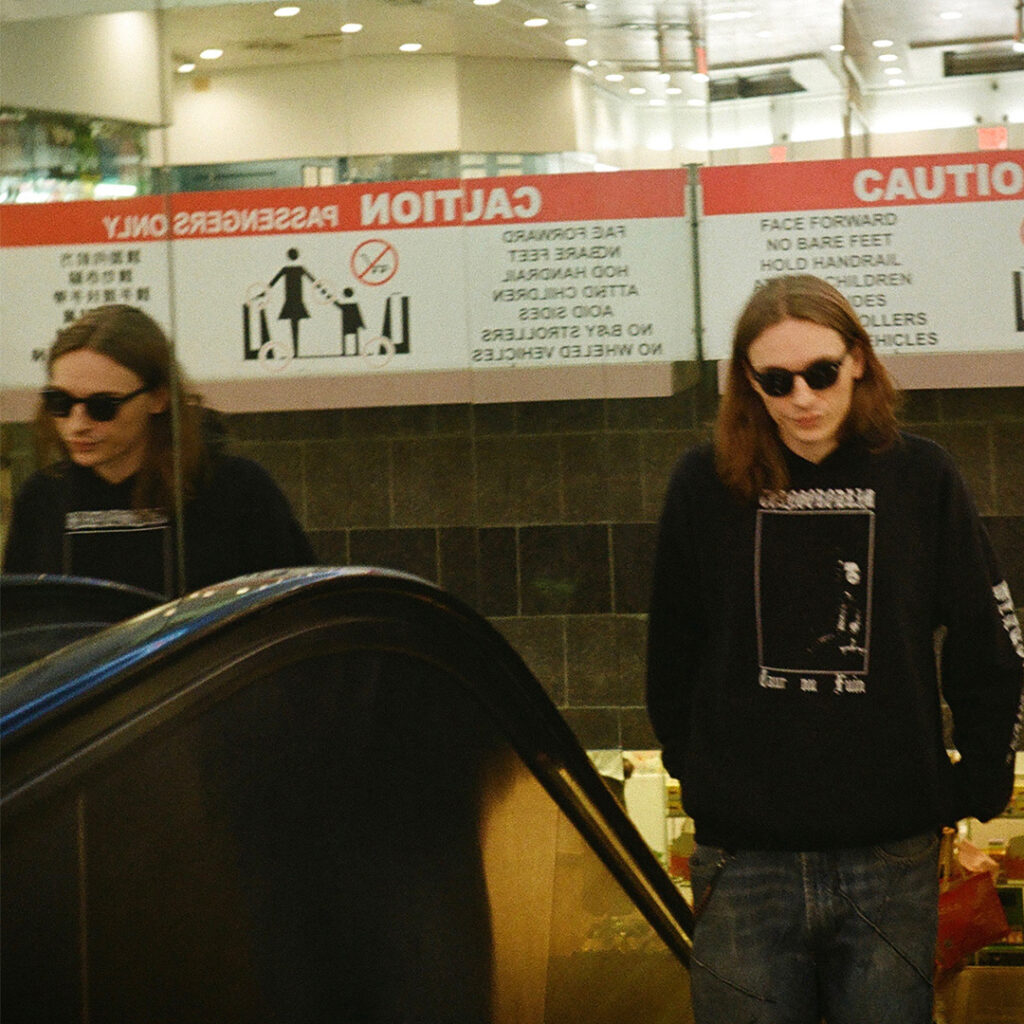
Welcome back to another interview! Following the release of his self-titled EP, I sat down with Grant Chapman, also known as Torture Methods. Together, we chatted about his new records, the evolution of his solo project, video games, touring with Body Meat, and building immersive worlds through sound.
Congratulations on the new record. What were you hoping to make with this album, and are there any songs you’re especially proud of?
Grant: It’s my solo project, and it’s all sample based, drum driven music. I started working on it around 2021, and it pulls together a lot of the heavier influences I’ve been listening to over the last few years.
One of my favorite tracks is “Grave Robber.” It goes in about sixty different directions. It’s probably the densest song on the record because it combines the more ambient, abstract side of my older music with the hardcore and metal influences I’ve been bringing into this project. It’s probably the craziest song on the album.
I also really love “Mortis.” That’s probably the most dance oriented track, and it has a really fun intro. I actually wrote it in about two days.
Originally the record opened with two completely different songs, but I ended up cutting them and writing “Mortis” because it felt like it brought together everything the album was trying to do. It made for a much stronger opener.
This is also your first record under the name Torture Methods instead of Grant Chapman. What inspired the name change, and what does it mean to you?
Grant: Well, my mom doesn’t like it. I stopped releasing music under my own name because seeing “Grant Chapman” on a show flyer made it sound like I was about to play “Banana Pancakes” or something. It didn’t really fit the music anymore. “Torture Methods” also made more sense with where I was headed sonically. Even though there are more metal influences in the music, the name isn’t really about that. It’s more about what everyday life feels like right now. You walk outside and somehow spend fifty dollars. The train isn’t working. Eggs cost twelve bucks. It constantly feels like you’re just trying to exist, and everything is making life harder. I remember living in Brooklyn and feeling like I was being punished just for leaving the house. At some point I caught myself thinking, “different torture methods.” Then I realized, that’s actually a pretty good band name. I’m not trying to be “the metal guy,” even if it might come across that way.
You also drum for Body Meat… at what point did Torture Methods start feeling like its own identity?
Grant: I met Chris back in Olympia, Washington around 2014 or 2015 when his band came through on tour. We hit it off, and later he moved to Philadelphia, where he was surrounded by all these really interesting bands like Palm and the Spirit of the Beehive scene. I always looked up to what he was doing. When he released Truck Music, it really stood out to me because it combined electronics with this punk sensibility. That felt very Philadelphia to me, and living there taught me a lot about writing music from that perspective. A few years later he signed with Partisan and released Starchris, and he asked me to play drums with him. That was a huge moment for me. Playing his music completely changed the way I approached drumming. Instead of leading with my hands, I started leading with my feet, which was a big shift because I’ve always had really fast hands. Touring with him took me all over Europe. We played Pitchfork London and Paris, Roskilde, Wire Festival, Broadcast, and a bunch of other places. I got to experience artists who weren’t just playing songs, they were completely overwhelming audiences through sound. I’d never seen anything like that before. Coming home from those tours, I wanted to bring some of that intensity into my own music. That’s really when Torture Methods became its own thing. I wrote most of this record in about two months, and it all came together surprisingly quickly. But it really grew out of everything I’d experienced touring with Body Meat, Model Actriz, and the other artists we played alongside.
Does NYC influence your music at all?
Grant: I think I’ll always write from a place that’s more influenced by my time in Philadelphia. Living there and being around all those musicians playing polyrhythms, and getting deeper into Chris’ music, had a huge impact on how I think about writing. That said, dance music has definitely influenced me, and that feels very New York to me. So I guess it’s a mix. And punk in New York has evolved into something different too.. More shoegaze-adjacent, bands that pull from Sonic Youth or My Bloody Valentine. Those influences are great, but I don’t necessarily relate to them as much. So if I had to choose, I’d say Philly has had the bigger influence on my writing.
Whenever you play a show, what do you hope people feel in the room?
Grant: Honestly, I just hope they’re not bored. Going to a show is a real investment these days. Everyone can stay home and sit on their computers or phones, so if someone decides to come out and see live music, that’s meaningful. Because my set is just me drumming on pads and triggering samples, it has to come from a different place than a traditional band. That’s why I make visuals too. Hopefully there’s enough happening that people stay engaged. You can really feel the difference between an audience watching a four piece band and watching one person performing electronic music. Especially when you’re not singing. As a drummer doing an electronic project, I just hope that energy translates. That’s really it. I hope people leave feeling like their time was well spent.
Do you have any funny stories from performing live?
Grant: Honestly, most of them involve gear problems. I’m constantly trying to find something to sit on, or dealing with my kick tower sliding away from me. If I don’t have a giant brick holding it down, it’ll slowly move forward during a set. There have definitely been times where I’m playing and my leg is completely stretched out trying to reach the kick pedal while I’m laughing at how ridiculous it is. So having a rug and a giant brick is pretty essential. Otherwise things get very funny very quickly.
Have you ever had a crowd respond to your music in a way that surprised you?
Grant: All the time. I don’t really talk on stage, so most of the interaction happens afterward. People will come up and ask if I listen to Aphex Twin or Burial, which is always funny because I don’t actually listen to that much electronic music. One of my favorite experiences happened in Philly. This older guy, probably around 65, walked up to me after a set and just stared at me for a minute.
Then he said, “Cecil Taylor.”
I was like, “What?”
He repeated it, “Cecil Taylor.”
I told him I’d listened to Cecil Taylor before, and he said, “World building. That’s what you’re doing.” Then he started asking if all the voices in my set were me singing. He didn’t understand that they were samples. I think he thought I had people hidden in the audience mic’d up or something. I love interactions like that. That’s something I experienced playing with Body Meat too. Since I’m usually booked alongside rock bands, people don’t always know what to make of an electronic set that’s being performed live on drums. People can be completely confused while it’s happening. Then afterward they’ll come up and tell you it was the craziest thing they’ve ever seen. Playing electronic music for rock audiences sometimes feels like doing a magic trick for a dog. During the set there’s no reaction, and you think you’re bombing. Then afterward people buy all your merch and tell you the performance changed their life. That’s always a great feeling.
What’s been inspiring you lately?
Grant: I’ve always been a huge fan of video games, especially horror games like Silent Hill. As I’ve gotten older, I’ve realized how much sound design influences me. If you play a game or watch a movie with really good headphones, it completely changes the experience. The sound design in horror games and films is unbelievable. That’s become a huge source of inspiration because everything I do is sample based. I’ll hear a sound, pause something, record a small section, and use it to build an atmosphere inside a song. Music only takes you so far. There are ambient records and black metal intros that I love, but there’s something about standing in a room in Silent Hill with headphones on and just absorbing the environment. That’s closer to what this music is about for me. It’s not really party music. It’s more music to sit with, put headphones on, and immerse yourself in.
Do you have anything you’re working on now that you’re excited about?
Grant: I have a show on July 8th with Andy Loebs and John Download, who are both incredible electronic percussionists. I’m really excited about that one. There are some other projects in the works, but I don’t want to talk about them yet and jinx anything. I’ve also moved about four times in the past year, so right now I’m mostly focused on getting settled into my new apartment and setting my studio back up. Once that’s done, I’m excited to start writing again. I also have a five song EP that I’m finishing up and hoping to release soon.
Listen to “Torture Methods”