
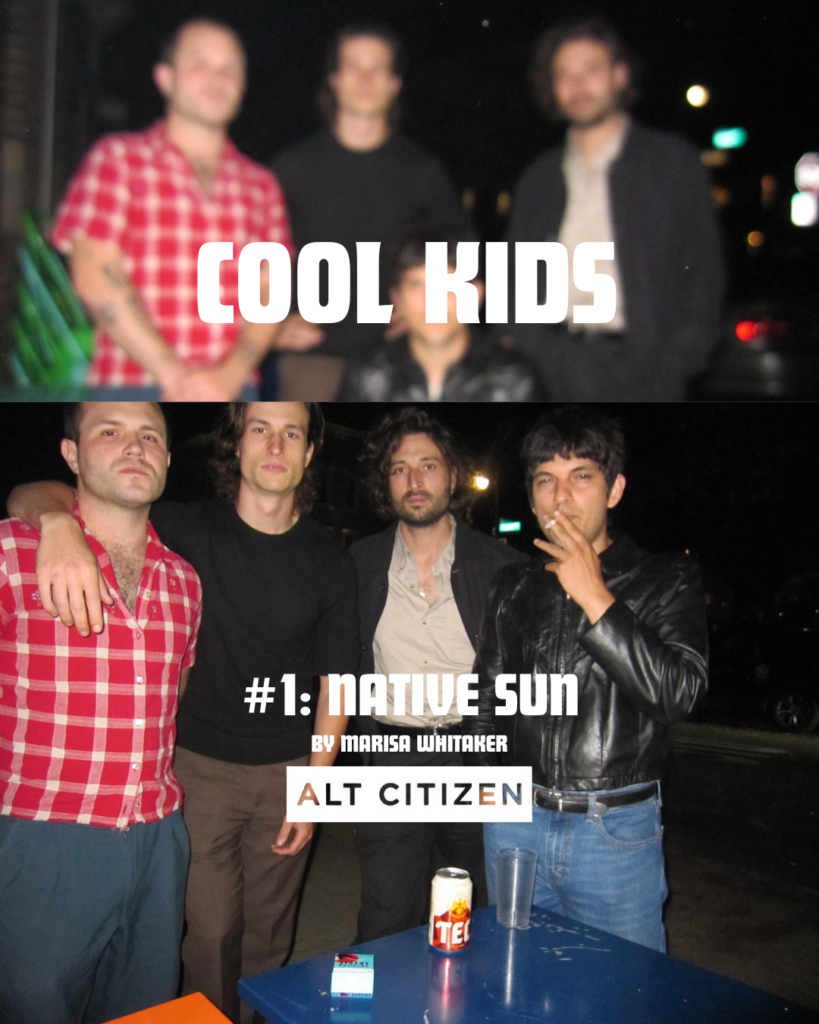
COOL KIDS
#1: NATIVE SUN
★★★★★★★
Welcome to COOL KIDS.
I was curious about all these new people I was meeting who could stay up for weeks at a time without ever going to sleep. I thought, “These people are so imaginative. I just want to know what they do, why they’re so imaginative and creative, talking all the time, always busy, full of energy … how come they can stay up so late and not be tired,” and pretty soon it would be four days later.
– Andy Warhol, The Philosophy of Andy Warhol (From A to B and Back Again)
Youth isn’t a luxury – it’s a necessity.
– Native Sun, Concrete Language Album Statement
I got into my second car accident with a guy in music. Am I bad news? As the guy from the first accident said? Should I be behind the wheel? Do I need to pivot and enter a new era of my life? Should I tell my crush that I like him? Change my whole wardrobe? Why haven’t I finished that book by now? Started this column? Why are women always to blame? Do men ever do anything wrong? Or are men in music accidents waiting to happen?
Native Sun is
Danny Gomez (vox/guitar)
Justin Barry (bass/vox)
Jack Hiltabidle (lead guitar)
Nico Espinosa (drums)
Newest release: Concrete Language, debut album, September 19, 2025
★★★★★★★
Marisa Whitaker: Concrete Language is a fantastic album. It comes out in two weeks. I’m sure y’all are very excited.
Danny Gomez: Yeah, definitely excited. I was talking about it with someone yesterday at the show. This thing we’ve been working on for the past year, with blood, sweat, and tears, is finally here. It’s no longer just yours; it’s going to the people. It’s the first time we’re ever doing that.
MW: And this was your project originally, right, Danny? You were in the band before everyone else here.
DG: Yeah. This lineup came together in 2023. This record is cool because it marks the chapter of taking that step, making an album. But it’s also the story of this family coming together, evolving, and becoming better. I started out writing some of the songs a few years before the pandemic, and had some friends who were helping out. When the pandemic happened, I was questioning whether to take music seriously or not, because no one knew if it would even come back. In our living rooms, we were dreaming of playing shows again. So we made this pact: We’re doing this. And here we are.
MW: I’m really impressed with all you guys have already done. You really put yourselves out there. You’ve done a ton of sick press, cool shows with Creem, I saw your pictures in Rolling Stone. It’s very cool.
DG: I think people are attracted to the sincerity of the chaos. What you see is what you get with us, and that’s something we’re proud of.
MW: Y’all make great music, and you are very outspoken about your views. It’s definitely reflected in the album. Something I was thinking about on the bus over here, your song, “Whose Kids,” reminds me of BJM.
DG: We love BJM.
MW: Both songs have that same call-and-response kind of thing.
DG: Probably coming from The Who and all those bands.
MW: I was just about to say. That song stood out to me because it’s almost like the antithesis of “My Generation.” That song remains a rock anthem that continues to resonate in music today. But y’all are almost anti-generation, which a lot of people are today, too. We’ve never been more divided, but we can unite over music and art.
DG: I’m glad you say that, because that is literally the point of the song. This last election really saddened us collectively, seeing the young white males and that vote really go back to such a conservative mindset. We can’t depend on the idea that new generations will always fix things because it’s not true. You have to stand by what you believe in the moment. Because if you go back to the 60s, all those hippie dippie boomers turned fucking conservative and started going for their taxes. It’s almost questioning all those songs that talk about, this generation is gonna be the one that changes things. It’s questioning that, and maybe more talk through action, instead of writing hippie-dippy anthems.
Justin Barry: I would say recently, there’s a lot of trends towards regressive thinking, like some of the Dimes Square stuff and indie sleaze. I’m like, why are you trying to go back to this early 2000s, white, male-dominated culture? That is not something I’m interested in. Whether it’s the nu-metal resurgence …
Jack Hiltabidle: You love the nu-metal resurgence! What are you talking about? You told me yesterday! You’re lying!
DG: Being a band in the city, there’s a certain lineage that upholds things, but at the same time, no one has ever been Jack Hiltabidle or Justin Barry, Nico Espinosa or Danny Gomez. We all have our own individual experiences, and it’s this filter that this whole lineage goes through. We’re trying to make our own statement of what 2025 would look like, and keep pushing the conversation forward. That doesn’t always have to be sonically; it could also be thematically, lyrically, or in terms of what you represent, as well as your ability to capture a modern state and environment.
MW: As I was saying, it’s divided and it’s weird. I have friends from all different walks of life. I went to college in Missouri, I’m from Texas, and now I live here.
DG: That’s important. You need to go and understand people. We were talking about it recently, knowing how different people are and their perspectives on things is the only way to understand.
JB: You always will find that you have more in common with people than you have differences. Especially with wealth disparity being at its highest of all time, class solidarity is super important to effecting change.
DG: That’s something the English understand more than Americans. That’s why they got good rock ‘n’ roll. They understand. They’re like, they’re all stacking against us. We should be fighting back against them, not each other.
MW: They party way harder over there. They have a way better time than we do.
DG: Well, we’re gonna find out.
MW: Yeah, y’all are touring Europe this fall.
JB: Yeah, it’s our first time. We’re super excited.
DG: It all feels right in the sense of timing. It feels like a moment that we’re lost in, this world of what this record will be.
MW: Absolutely. A lot of what you say on the record is profound. It speaks for itself. You have these intricate, stream-of-consciousness lyrics. And musically, you’re genre hopping. There’s one song …
DG: Thank you for listening.
MW: It’s what I love to do.
DG: Thank you for reading the lyrics. We’re a band with a lot of noise, but a big mission of Native Sun is lyricism. We’re all big fans of great lyricists, from Lou Reed to Leonard Cohen, things like that. That’s rarely represented in hard rock. Why can’t you combine lyricism and poetry with heavier music?
MW: Not a lot of people these days take the time to understand. To be able to put out an album with a message like Concrete Language, you should be proud of, in the sense that you’re going against the grain and not sticking with any hive mind of thought. I’m sure you have some different perspectives versus when you were still trying to figure out how you felt about things.
JB: I’ve always been socially minded, and I can’t speak to [Danny and Nico’s] experiences, but to be immigrants in the country, your existence …
DG: Our existence, our creative art, is a disruption in the system already. That’s what they don’t want us to be doing. Those ideals have been instilled through our background. I’m from Colombia.
Nico Espinosa: I’m from Argentina.
DG: We try to represent modern America because it’s 50/50.
MW: This is modern America.
DG: This is what America is. [Jack’s] got ancestors that came here from Ireland. We also have ancestors who came here. We’re first generation. It’s the meaning of what the modern world is.
MW: Going back to my earlier point of sound-wise, what I was trying to remember, you have “This Mess,” and then you go into “Squash.” The former is this very punk, hard ass song, and then you go into this alternative, almost Guided by Voices, bass line and aura. Danny, I love how you adjust your voice to match the song’s vibe. And the final track is very soft.
JB: What I’m very proud of is the sequencing of the album, where it feels like a complete experience throughout. Although we explore different genres, it still sounds like Native Sun.
DG: Making this record, it wasn’t trying to be conscious of peers or anybody, and instead, it was more classic albums that we love. That’s the only reason to do it, to try to make some as good as the best records we love. Not saying that you’re going to, but if you’re going to try to make a record, why not try to make it one you can hold up to something this is your favorite? Why not try to get that exile?
MW: Both the music and the lyrics are pretty timeless, in the sense that the album could have come out decades ago. I think it will still resonate decades later, as a present perspective and thought in today’s world.
DG: Were you mic’d in the recording session? That’s one word we use the whole time: timeless. That was our keyword for making this happen. Past, future, present, whatever, it’s got to sound good. That was the goal, never to have it feel dated.
JB: Part of why there’s a lot of variety and why it still sounds timeless is that ultimately it comes down to songwriting for us, and that’s what we’re most interested in.
DG: That’s why the record is like that. “I Need Nothing” was the first song we wrote. I came up with a vocal melody. It came into my brain in 10/20 minutes. I had a drum machine, and just put it down. Me and Justin were living together, and hungover the next day, when I think the best ideas come. He was playing something on the couch, on the bass.
JB: I hadn’t even heard the part.
DG: And I was like, Hey, you know what? Try playing that over this. You didn’t even have to change anything at all.
JB: It was the same. It was perfect.
DG: And then that dictated [Jack] writing guitars, [Nico] writing the drum part. We experimented with writing in different ways on the record.
NE: Throughout that process of writing the record, we grew as a band. Not only did we introduce Jack, but we were also touring a lot of the states and getting to know each other on a deeper level. There’s nothing like getting to know your bass player when you share a bed on tour. Rhythm section sticks together, baby, always.
DG: Jack snores the most. But I put up with it because I love him. I don’t complain about it. Or maybe I don’t have a problem with it because it’s music to my ears.
JH: I think it’s because you’re deaf.
★★★★★★★
MW: I’m generalizing here. We live in a city with many musicians, and throughout history, musicians have been some of those at the forefront of change and social justice. At the same time, the music industry is often dominated by suits with their own agendas. What do y’all think of that? What is your own experience?
JB: We’re beholden to corporate interests in a way that’s like, if you’re an artist, a developing artist, unfortunately, they tie your hands. The fucking model is Spotify streaming culture, which we’re not getting paid for. Spotify is investing in military AI technologies, while also updating its terms so that it can essentially sync your song out for life without any of your agreement. That happened today. So it’s like, what are we supposed to do? That’s the fucked up thing, and it’s changing day by day.
DG: It changes day by day against you.
JB: These are people who are not interested in creating good art or facilitating that. They’re interested in making money off of your art.
JH: The underground has become co-opted by these corporations. The music I really love and am connected to is the late 80s, early alternative, hardcore, post-hardcore, that kind of stuff. It was all very roots-organized. People were making cassettes. It was very community-based. The internet has given everyone the ability to connect with more people worldwide, but it’s filtered through all these corporate entities. You got YouTube, you got Spotify, you got Apple, you got the internet – all of those things. It’s all just filtered now. With this administration, they are now trying to filter it even more. It’s very challenging.
JB: Especially with tech companies being so ponied up with the government. These companies, like Spotify and YouTube, are essentially relative monopolies. Yes, there is Apple Music, but artists are taking their music off Spotify, and that’s a really difficult thing to do, because how else do you reach people? It’s fucked up. There’s no real outlet other than people coming to shows.
DG: It’s shortsighted thinking.
JB: And now there’s fucking AI bands.
DG: Well, I’ll tell you what, an AI singer cannot jump into the crowd.
★★★★★★★
MW: What’s the significance of the album title and artwork?
JB: The artwork is of a pair of shoes that Danny got when he first moved to New York. We had come up with the name of the album, which we can talk about in a second, but the photo itself was by our friend Adam Powell. We wanted to get something that captured New York City in a certain way – both the constructed element of the city and the actual lived-in element, which is the shoes. A lot of the single artwork has a natural element and a constructed urban element. They reflect how those things are always playing together back and forth. For the album cover, we were trying to capture something that would fit the thematic element of the album.
DG: It kept with the whole theme of sincerity. I never pictured my boots were gonna be in it. Originally, we were gonna put them in cement. Just grabbing the boots that these songs have been written in felt very real and honest, and it didn’t happen until the last minute. That’s when the best moments in art happen. It wasn’t really contrived, but they were like, anybody got any beat-up boots? And I don’t know why I’ve kept them for 10 years. Those are the first rock and roll boots I bought. At No Relations, 13th and 1st, for like $15.
JB: We were just talking about technology – the photo is so disorienting that it looks like it could be AI. It’s a real photo. I threw them up, and Adam was underneath them. We were standing in the middle of an intersection, outside Margaritaville or something in Harold Square; not actually, but close enough.
DG: His work is very surreal. He also did the Cameron Winter cover. He’s done press photos for Water From Your Eyes and stuff. He’s a really great photographer. We’re lucky that he loves our band this much.
JB: It’s disorienting. It’s cool because it is a real person taking a real photo that’s interesting.
NE: The photos on the back [of the album], are analog, digital photography, and polaroids from when we played SXSW. That just goes into the organic play that we talked about – having those organic elements, from the recording of the music to tape, all the way to the artwork. Keeping it as pure and organic as possible.
JB: Also, it’s working with with real people who we like and want to support and who want to support us. It’s a beneficial exchange.
DG: It’s community.
JB: As far as the actual title of the album, Concrete Language …
DG: There are songs about real people, real stories while living in the city. In my 20s, that’s when I lived this album. It’s about us going through that transitional period in life. We wanted a title that reflected how the city hits you. There’s a range and a fluidity. Concrete is a heavy substance, but it’s also very soft when it’s first forming, a reference to the sound of the record. It’s not just one sound. It can hit you, but then it can also be soothing. We came up with the name while we were on the roof. When we were mixing the album, we were on the roof having a smoke break, tossing around ideas, doing wordplay.
JB: We just came to it.
DG: One thing that is interesting that I found out is that concrete language can resemble literature that is about real stories. What I like to say is, we don’t write songs about dragons or made-up bullshit; they’re real songs, real accounts of people. Some may not be something that happened to us, but they’re stories, and they’re just my telling. That blurred line between personal and everybody else is important.
JB: It’s also the directness, straight to the point.
★★★★★★★
MW: I have a note about one of the songs, “Squash.” It’s about afters. Waking up the next day. Very New York. I left afters this morning.
DG: Did you see a squash broken on the sidewalk?
MW: Is that what happened to you?
DG: Yeah. I was going home very early. Might have been like seven, eight a.m. I saw on the sidewalk a squash that was squashed. Probably thrown from the roof. That’s what my mental state felt like in that moment. Life crashing at you, and making you realize that.
JB: If you know that feeling, then you know. It explains itself, really.
DG: There’s nothing more New York than you going home when other people are going to work. Not saying that in a debaucherous kind of way. It’s reality sometimes. These two worlds are interchanged. There’s a whole world going on that you have to understand is part of the same ecosystem.
MW: This morning was, I think, the seventh time I’ve run into my preschool teacher roommate getting ready for work in the bathroom.
DG: Marisa Whitaker, good night. *Salute*
★★★★★★★
MW: During my first week of living here, I saw Scott Lipps eating dinner outside. I was walking on the street and went up to him. That’s how I started working for him.
DG: That’s that New York energy. It doesn’t happen in LA, I’ll tell you that much.
MW: I could never live there.
DG: I like it for a week to tour.
MW: Meeting people and spontaneous opportunities like that only happens here. It’s really cool. Y’all have all lived here for a while.
DG: I definitely feel like a part of the city in that way. I always appreciate hearing stories of people. Once a couple told me, We met at one of your shows, and we’re married now.
MW: How was it growing up here? Having those formative years within music, and pre-pandemic.
DG: Those years were a lot more about starting a band, doing something. It was more about living the experiences that became the songs and music, at first, than trying to force a connection with people. It happened naturally. A lot of what we’re able to express in the music is the lived experience that has come to this point. I do agree with what you’re saying. I’ve been here a minute, and right now feels like a very exciting moment, the past couple of years, post-pandemic. It’s crazy how you need these global catastrophes to shake up the system and inspire some kind of music and noise. When I started going to shows here, it was in that mid/post-pandemic. There had been that period with bands like Dive and Shea Stadium. New York was in a drought for a bit. Now, people are just excited to create art again. We’re all here for a reason. Fucking living for nothing. Might as well do that.
★★★★★★★