
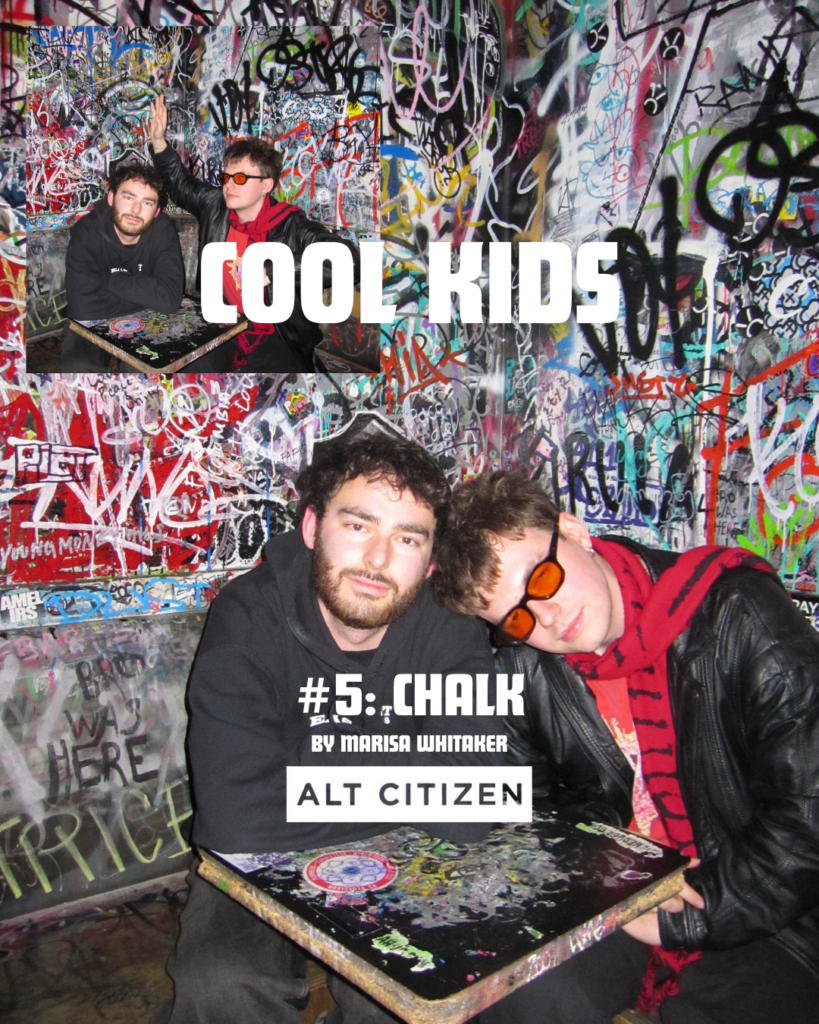
COOL KIDS
#5: CHALK
★★★★★★★
And these children that you spit on
As they try to change their worlds
Are immune to your consultations
They’re quite aware of what they’re going through
– David Bowie, “Changes”
Searchin’ for somethin’ to do
Just to keep myself right
What’s your truth?
What’s your fiction?
– Chalk, “Static”
I’m not a big astrology gal. But I do believe in the power of a full moon. On any past full moon, I could look up the timestamp on my camera roll, and more likely than not, that night was a crazy one. The most recent, Dec. 4, was a Gemini full moon. I am a Gemini. And that was a wild night, to say the least. I’ll spare you the details. But now my Insta algorithm is filled with astrology b*tches and reels who are really hyping me up for 2026. I think we Geminis are in for a breakthrough year. Some end-of-cycle and rebirth shit. I really need that. I bet most of us do. I’m always looking forward to a new era. My lil brother would tell me every summer when I came home from college, I was a different person. I dig that. Fuck singular. It’s cool to do different things. Be different people. Maybe that’s the Gemini talking. Like I said, don’t know too much about astrology, but I f*ck with being a Gemini.
Chalk is
Ross Cullen (vox/production)
Ben Goddard (guitar/synth)
Newest release: “Can’t Feel It,” single, October 22, 2025
★★★★★★★
Marisa Whitaker: Y’all are sick. I loved the music immediately. One of my first big interviews was with Joe Talbot of IDLES back in the day. They’re obviously amazing, and y’all have opened up for them. There’s a resurgence of post-punk right now. Electronic music’s at a high, rock is coming back in its own way, and y’all play around with all of it. What do you think of the music world you’re in right now?
Ross Cullen: We wanted to do something that felt new to us but still proudly referenced our influences. Not pretending we’re inventing something brand new, but melding punk and rave in a way that excited us to explore and for people to listen to. We never wanted to pigeonhole ourselves either. We want to explore different sonic paths and take inspiration from wherever we find it.
Ben Goddard: It’s an exciting time for music. A lot more alternative stuff is bleeding into the alt and indie consciousness. Things aren’t as genre-strict anymore. Even huge artists are blending sounds. The world might be a hellscape, but people seem open to being pushed creatively. It’s an exciting time to be a musician.
MW: Totally. There’s so much good music right now. The band got started during the pandemic and then just … took off. I don’t mean to minimize the work – everything takes time and passion – but it feels like y’all gained traction pretty fast. What helped you hit the ground running?
BG: Being so deep in it, it hasn’t felt fast. But looking at our timeline, we’ve released something every six months. Consistency early on helped. It took us so long to release anything as a project because we took a while to figure out our sound. When we did figure it out, we weren’t scared to release it. We haven’t really sat on music for a while; we never overthink it. We write toward deadlines and release what we’re happy with.
★★★★★★★
MW: Talk to me about the Conditions EP trilogy. I love that format – three EPs over three years. It’s cohesive as a whole, but you’ve gotten to take your time. Was that rollout the intention from the beginning?
BG: No. We made the first EP. Then, while working on the second, we realized we were still in the same universe. Ross pitched calling it Conditions II. Pretty immediately, we said, Then we have to do Conditions III. The trilogy idea came before the second EP even existed. It felt right and exciting. Releasing them close together made them feel like one body of work, still exploring the same themes in different ways.
★★★★★★★
MW: We had Cole Haden of Model/Actriz on the podcast I work for. Y’all’s music feels similar; out-of-the-box, leaning into the electronic moment. Tell me more about back home, the local scene in Belfast, and the UK. Is electronic stuff as popular there as here?
RC: There’s a big DJ/electronic scene in Belfast. For the last 30 years, and in the ’90s, the rave scene in Northern Ireland was massive, and that carried through. People from that era now run nights for our generation. David Holmes runs God’s Waiting Room – a curated electronic night with dancers and projections. Ulster Sports Club is another great venue. We’ve played there a few times. There’s an energy in the city toward electronic music and toward bands that play punk, rock, and pop-punk. Belfast has had waves of everything over the last 20 years.
MW: What do y’all think about underground vs. mainstream electronic? Do you think the mainstream gets anything wrong?
RC: It’s exciting. I love 2hollis a lot. Maybe that influence came through on the new stuff we’ve been working on. Even Charli XCX, there are hints of that that crept in, all that electronica production. I love deep house music that’s on the top 40 back home, even though it’s like the same thing every time. Growing up, I enjoyed that stuff a lot. Pop music in general, some of its recycled … garbage …
BG: Everything is recycled in every genre. Even the indie stuff people worship is recycled. I’m trying not to be snobbish – if you like what you like, that’s cool. Gatekeeping is pointless. Charli collaborating with John Cale is amazing. Bridging worlds is cool.
MW: We love The Velvet Underground.
RC: We were walking through Lexington talking about doing an autotuned cover of “Heroin.”
BG: Every six months, we talk about doing a “Heroin” cover. John Cale’s newer solo stuff is nuts, so it would actually work.
★★★★★★★
MW: How inspired are y’all by American music?
RC: Some of my favorite bands are from here – Protomartyr from Detroit, Preoccupations from Canada. They influenced many UK bands over the last decade. We’ve been listening to Wednesday, MJ Lenderman, Geese.
BG: There’s so much unbelievable music coming out. People love to say they don’t make music like they used to, but that’s not true. We’re not running out of genius and creative people. It’s all there if you want it. You are probably listening to some kid’s favorite band, the best thing they’ve ever heard. There’s a lot of cool New York influence we’ve taken on.
★★★★★★★
MW: Your film backgrounds really show through your music work. Your music videos are incredible, and you have so many of them out. That’s rare for a newer band. Do y’all want to do more film-related things? A Chalk movie someday?
BG: Yes. There will definitely be a Chalk movie, and we’ll absolutely do an original soundtrack at some point. That’s always been on the cards. We have so many music videos because that was the one thing we actually knew how to do better than playing the music industry game at the start. We’re very visual thinkers, so we’ll always be tied to that in our music.
MW: How does that visual mindset impact your music-making?
RC: I try to visualize how certain songs would feel live, and imagine performing them in Belfast, like picturing how the crowd reacts or how it would feel on stage. That informs things sometimes. But Ben, who takes the visual lead on the music videos, is more equipped to talk about that side.
BG: The song does most of the work, and visuals are in service to it. But thinking visually helps, like imagining an image that could exist while listening to something. And drawing from great music video history, film references. If you can visualize something strongly, it probably means you can feel it strongly as well. And that usually means you’re onto something musically.
MW: My last interview was with the band SKORTS. The singer talked about having visions before writing – like Davy Jones’ ship or her body being pulled in different directions – then making songs from those visuals. Does Chalk ever work like that? How do your songs come to be?
RC: There’s a song called “Pool Scene.” When I was really young, I saw a film with a scene where a kid went missing at a swimming pool. That image stuck with me for 20 years. I kept trying to figure out what movie it was. Then one night, I was watching Minority Report, and that exact scene appeared. I’d been searching for it my whole life, and suddenly it was there. “Pool Scene” felt like a cool title, and that image stayed with me. The song itself is about something else, but that memory sparked it.
BG: I had something similar. When I was 13 or 14, I saw a horror compilation on TV. There was this weird puppet running toward a guy. Not Chucky, something way stranger. It stuck with me. Back then, you couldn’t Google, weird puppet running at man, so it just lived in my brain. Years later, when I was 21 or 22, I saw the movie Deep Red, and that scene came on. It shook me to my core. It awoke something deep in me. Those early visuals really burrow in. If we were 10 years older, we’d probably have unresolved mystery scenes forever, but now you can just look everything up.
★★★★★★★
MW: Tell me about Belfast. I’m from Texas and moved here because I thought I could do music industry work only in LA or NY. I got here and found all these kids making music, especially post-pandemic; there’s this explosion of creativity. There’s a great show every night of the week here. What’s it like being your age in Belfast? Shows? Community? What’s happening around you artistically?
RC: Belfast feels like it’s playing catch-up in a lot of ways. For years, bands didn’t really come through. They’d favor Dublin and skip the north. But that’s been shifting in the last five years. Promoters are getting better, alternative music is drawing more, and people are listening better to what the scene wants. But practical stuff matters too. There was never any nighttime public transport. You’d have to walk an hour home after a show. This past year, they finally started a late bus trial, so you don’t have to leave shows early. I lived in Belfast for a few years. There are great pubs, free music nights, and a lot of potential. I’m out of the loop now because I moved a bit away, but I have hope. I want more day festivals, more big acts coming through, more infrastructure, more funding, the kinds of things we see across Europe when we travel.
BG: Yeah. It’s not fully there yet, but the faith is. There are so many talented people. The culture just needs to shift; hopefully, we’re heading toward more funding and more support. We’ve gotten a lot of public funding and wouldn’t be where we are without it. It’s very important. There should be more of that.
MW: Where are y’all based now?
RC: I live in Lurgan, about 40 minutes by train. Not far, but it feels far.
BG: I’m pretty much in Belfast still. But if you’re not fully in it, it really can feel like a million miles away.
MW: I’ve only been to Dublin and Killarney.
BG: Dublin has that guitar-band thing and the dance thing, which we’ve taken a lot of inspiration from. Tons of shows, clubs, and a huge scene. I lived there for six months and had a beautiful summer. Lots of love for Dublin.
★★★★★★★
MW: Tell me about opening for Fontaines D.C. and IDLES.
BG: We opened for Fontaines twice, and we’ve done five shows with IDLES. We’re doing another with them next year in Belfast. We’ve spent more time with IDLES, and they’ve been big inspirations, especially in professionalism and the love they put into their live shows. It’s a huge guiding light. No one prepares you for the music industry, and seeing how they operate is invaluable.
MW: Those are two bands that’ve broken big here in the States. All the music kids in NYC love them. What was some of the best advice those bands gave you?
BG: Lee from IDLES gave us one really practical piece of advice: Spend as little time in the green room as possible. That’s coming from someone who is playing 150+ shows a year. Walk around the city instead. Otherwise, you live your whole life in vans, backstage rooms, venues, and hotels. It’s a mental-health thing – get fresh air, don’t sit in a room all day, see the place you’re actually in.
RC: Joe also said: Just keep going. There’s a lineage – IDLES took Fontaines on the road with them, and Fontaines took us out. Not saying we’re anywhere near those guys right now, but we want to be that for the next ones coming up. Share what you know. Be nice. Go with your gut. Support the next generation. Joe has a great podcast about music, and it’s essential to share that information and pay it forward. It’s a little bit of luck that you need, but it’s surrounding yourself with people around who are all as in as you are.
BG: Don’t gatekeep information. Share the love. It always comes back.
MW: I love that. You don’t rise alone, you rise together. Sharing advice and connections doesn’t take anything away from you.
BG: Exactly. There are enough people who love music. No one’s stealing fans from anyone. People like more than one band.
★★★★★★★
MW: You dropped the third EP this year, plus two new singles. While I was listening to all three EPs, I heard growth in the musicality and in your confidence. I read that you don’t love talking about specific meanings behind songs. Is that a conscious choice? Do you avoid explaining so fans can take what they want from it?
RC: Sometimes we write something and know exactly what it’s about. Other times, we have no idea until later. Back then, we didn’t want to box anything in. We wanted listeners to take whatever they needed or wanted from it, a bit like the David Lynch kind of way. But lately we’ve been more open because we went into the new songs with clearer intentions.
MW: There’s this theme of human condition across all three EPs. Amongst other things, it feels very reflective of the pandemic. There was so much isolation, and music is so human. Why was that important? Why keep running with it?
BG: Once the idea came up, it was the only thing that made sense. It allowed us to create a cohesive world. And a lot of themes in general can’t be summed up in one three-minute song. The trilogy gave us space to explore bigger ideas over a longer period of time.
MW: And the new songs – “Pain” and “Can’t Feel It” – are those part of something bigger? A new phase? A new vision?
RC: We saw them as a fresh start. We’d lived in the Conditions world for so long, so we wanted to get out of our comfort zone. They still sound like us and have a lot of ourselves in it, but they push into new territory. There’s a David Bowie interview where he talks about getting out of your comfort zone. That was always something that felt appealing to do when going into writing the new songs.
★★★★★★★
MW: How do you want to expand the Chalk world musically?
BG: In a lot of directions. We’ve allowed ourselves to explore different genres – more traditional rock, harder techno, ambient drone, pop-leaning stuff. We realized, as long as it’s coming from us, it’s still Chalk. We’re not limiting ourselves to, Well, that doesn’t sound like Conditions I. We’re letting ourselves take bigger swings.
MW: I, too, often remember something that Bowie said – that people forget how smart kids are. Y’all are young lads. Kids have something to say. Young kids are not just recycling. What do you think about being part of this wave after IDLES? You toured with them, but you’re also the next generation. What does that mean for you?
RC: For some of the new songs, we wanted to create a coming-of-age story, a document of what it’s like growing up where we’re from, especially Belfast. Seeing younger people at shows, and people of all ages, is beautiful. We want to spread a message of unity and self-expression – through clothes, opinions, the stage, whatever. There’s so much division where we’re from, the UK, the US, and in the world in general. We want to wave the flag, represent Ireland, be good, and put out something positive.
BG: Exactly what Ross said. Everybody makes it differently. Nobody’s trajectory is the same. All you can do is try to make what you want to make. It will have been the right thing to do whether you succeed or not. If you really want to make something, someone else is gonna like it. It’s a very big world, so there’s no point trying to be something you think will work. That never works. And someone’s already doing it anyway. Just send it.
★★★★★★★
MW: I read in an interview that y’all like to think ahead a year or two. Do you already have goals or plans mapped out for 2026?
RC: We want to build, travel the world more, release new, good music, meet people, see new places, eat good food. We’re very privileged to be in a position where we get offers around the world. We want to enjoy it.
BG: And try to be present. With even a tiny bit of success, you start gripping onto it too tightly. Early on, we took everything so seriously. Now we’re trying to find joy in it, remind ourselves it’s just music, and share good times with good people.
★★★★★★★
MW: Why Chalk?
BG: It’s simple and to the point.
RC: It’s whatever you want it to be.
★★★★★★★