

COOL KIDS
#13: HIGHWAY DEMON
★★★★★★★
Life should be blissful, and blissful doesn’t mean just a small happiness. It’s huge. It is profound.
– David Lynch
We can smile for today knowing what tomorrow holds
– Highway Demon, via Instagram
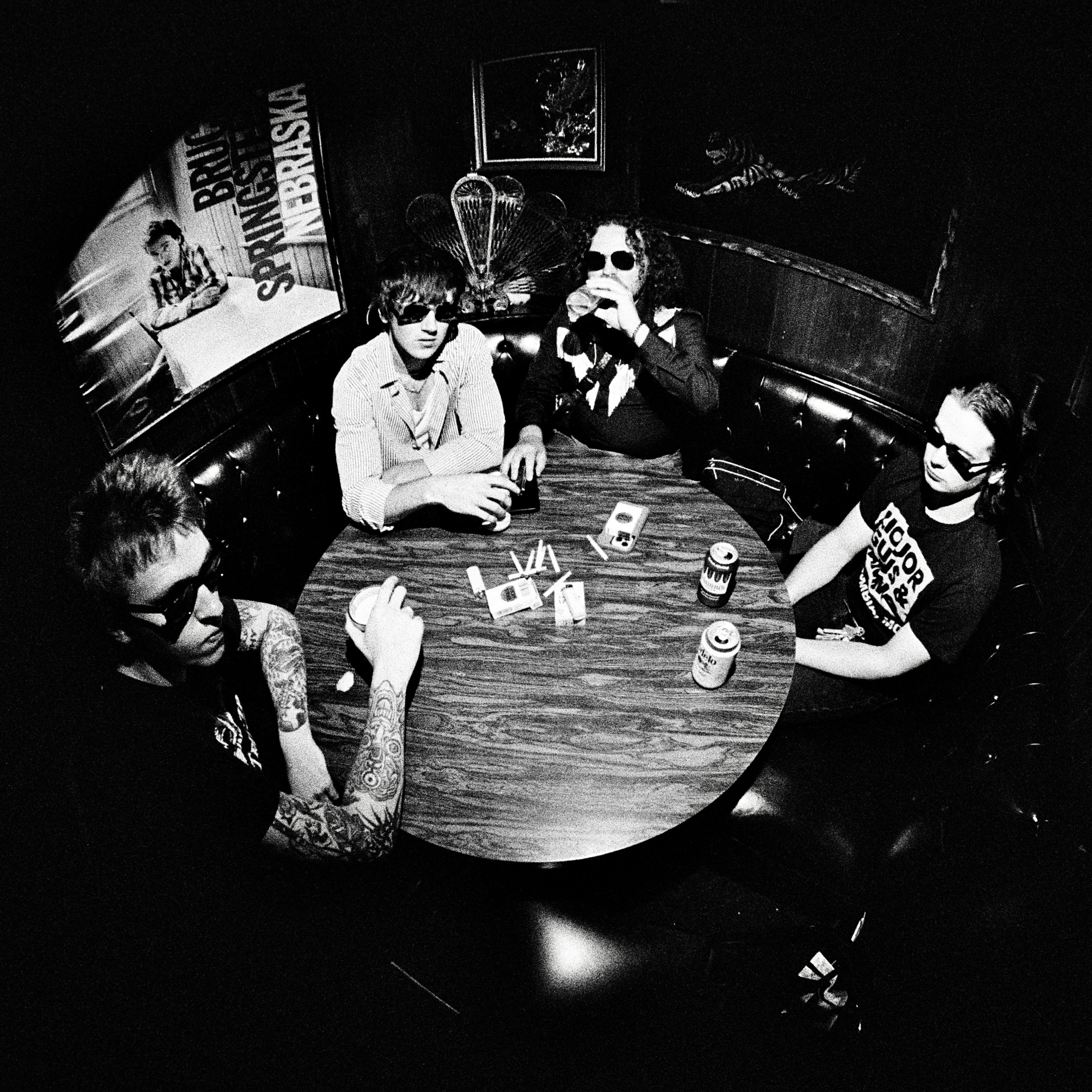
I <3 Highway Demon y’all. We did this interview way back in March, and while I feel horrific about this delay, I’m happy it’s out now. Sometimes I just get really uninspired doing things I once loved. It sucks. But doing this one made me remember how fun and cool it is, and how much I enjoy these conversations. We sat at Kellogg’s Diner a day before the guys played Hart Bar and then Nightclub 101. Long live Highway Demon and long live Columbia, Missouri.
Ross Menefee (vox/guitar)
Quintin Menefee (drums)
Will Tuckley (bass)
Tim Goretti (synth)
Georgie Sarafianos (guitar; former member)
Newest release: “What Hasn’t Happened Yet,” Single, June 26, 2026
★★★★★★★
Marisa Whitaker: Have y’all ever played here before?
Ross Menefee: Never. Never played in New York.
MW: Why did y’all want to come?
RM: It’s New York! Our friends hit up Will forever ago to come and play in New York. And here we are, months later.
MW: I know. This has been so long in the works. I’m so excited. I always call Columbia the Bushwick of Missouri. It’s so similar. The same shit. You know what I mean? Coming from Dallas, I didn’t really have music people around me. When I moved here, I had friends in bands from the get-go. Same when I lived in Columbia during college. Very similar scenes, dress, happenings, all that. Y’all are from Columbia. What is your experience being a band there?
RM: I got started with Eric and John, who run Tell ‘Em Tapes. Me and Quintin have always been going to Hitt Records and keeping up with Kyle and Taylor, the owners. We started seeing familiar faces. Lots of bands at PDM (local punk/ hardcore DIY space). When we were coming up, there were a lot of shows at Gay House and places like that. I feel like it all used to be a little bit more active. I mean, there’s still quite a bit of good stuff going on. It’s just different, I guess. Our friends in Find Fiona are really cool. There’s also Deglover, and Orphan Source is fantastic.
MW: I worked at Hitt Records for five years. And I still do every time I go back to visit. Kyle told me he’s known you since you were a baby.
RM: I’ve known Kyle since I was 16.
MW: Okay, kind of a baby.
RM: Yeah. As soon as I got a car, we were driving there all the time. I was spending all my summer job checks going there.
MW: That’s what I was doing. I remember seeing your record, It’s Me: Ross, in the store since I started working there. Have you always made music?
RM: Yeah, for sure. I was in this band called Guilty Party when I was a little kid. It was a kids band. My dad and his musician friends got the kids together to play shows in front of the Columbia Mall and shit like that. Then I played in a punk band in high school called Pregnancy Test with some buddies. It’s Me: Ross was more so in college, and now it’s Highway Demon.
MW: How did Highway Demon begin?
RM: As a concept. I was listening to a bunch of Charlie Megira and was digging the Western sound. I had just hiked the Colorado Trail and had this vision of a ghostly, highway-traveling apparition kind of thing. I made the concept album in 2021.
MW: I love it. That was all you, right?
RM: Yeah, that was all me. We formed the band some years later. We pretty much pivoted directions and have been doing this heavier rock-shoegaze kind of stuff. We’re still kind of trying to keep an aesthetic with the original vibe somewhat, but we’re letting it take its own direction from there. We released Healing Water about a year and a half ago, and we just released two more tracks the other day.
MW: I love them. I was jamming out earlier.
RM: Thank you.
MW: Who does all of your design and graphics?
RM: Will does most of ‘em.
MW: That’s all you? They’re so sick.
Will Tuckley: Yeah. For the most part. Thank you.
MW: I think they’re so rad because I feel that visually, the aesthetic, there’s a through line. But y’all have dabbled with different genres musically. As you said, it started country-heavy, and then it went more alternative. And the new songs are pretty pop. Do y’all have a vision going into a new body of work? Or do you do whatever you want right then and there?
WT: With Highway Demon, it’s an ever-evolving process because our influences have changed over time. Ross’s early influences were very much like Dirty Beaches, Charlie Megira, stuff like that. Over time, while we still like that stuff, it’s bringing in current things and what else we’re listening to now. Record to record, it’ll always change. We all listen to different stuff and come from different musical backgrounds. Tim is in an industrial techno group, and Georgie and I have done numerous hardcore punk bands together, and so on. Some of our influences aren’t even musical. This band kind of becomes the melting pot of influences for all of us in one way or another.
RM: I’ve been reading a book about David Lynch. I’ve also been listening to a lot of drum and bass music.
MW: Where are y’all’s heads at day to day, and how does that influence the music?
RM: I don’t think it sounds like this at all, but I keep thinking while writing: Smash Mouth, fun, the early 2000s. I don’t know, just fun shit.
WT: Not too much thought going into it. I guess we all work and live in the middle of Missouri; there’s not really that much to do. When we’re bored, we play faster.
MW: I feel like you (Ross) have an early 2000s voice.
RM: Do you think so?
MW: I do think so.
WT: Since you’ve been goooone …
[Laughs]
★★★★★★★
MW: Ross and Quintin are brothers?
RM: Yeah, we’re brothers.
MW: And Will is your cousin. What is it like playing with family?
RM: It’s chill.
WT: We all live together, too, so that makes band practice really easy.
MW: [Laughs] Do y’all hate each other?
WT: No, I love these guys. It makes the band enjoyable. It really makes it authentic. It’s like, Oh yeah, this isn’t like a once-a-month thing; it’s like every day, we’re at it in some form & has been that way for basically the last two-ish years without any breaks, but it doesn’t feel like a chore by any means. The band is always, in some regard, actively being worked on, even when we’re not all in the same room, whether that be us as a collective working on music, me working on a flier, Ross working on a riff, or planning a show for the future; we’re always at it.
★★★★★★★
MW: I can point my finger anywhere, and there’s a photographer in this town. Y’all have Max Young back in CoMo. He shoots y’all a lot. Outside of Kyle and them, who else is helping the project?
WT: For the most part, it’s just us doing our own individual thing. Max understands our vision, so we trust him to push it in a more professional way.
RM: He shot a music video that we did. We’re releasing it soon.
MW: What song? That’s sick.
RM: “Life is So Beautiful.” Yeah, it’ll be cool.
MW: What would you say are the limitations of being a band in Columbia?
GS: It’d be cooler if there were more bands. Given the size, I would say that’s the biggest drawback. You’re not necessarily in a “metropolitan hub.” But in that same breath, like you were saying with Find Fiona, you develop closer relationships with other bands. You genuinely want to see them succeed because it reinforces the idea that a rising tide lifts all ships.
★★★★★★★
MW: How has your songwriting and making process changed from when y’all did Healing Water?
RM: I think we’ve been able to take our time with it a little more, and really flesh out how we like to play those songs so that they’ll more easily translate over onto the record. As a project, it’ll be a little more cohesive. It’s been more collaborative in that way. But generally, I still just start by writing on an acoustic guitar. I’ll have a line come into my head. Maybe there’s a general riff that we don’t really know how to figure out, and then we collectively brainstorm, have an Oh, this works, moment, and I’ll write lyrics on top of it.
★★★★★★★
MW: What all else do y’all want to do as a band? I even think coming here is a huge feat.
WT: Keep playing, write new stuff, evolve.
RM: Keep taking pictures, keep making videos, keep making cool shit.
TG: Quit our jobs.
GS: Seduce a Rockefeller.
WT: Yeah, seduce a Rockefeller.
GS: That’s my plan. [Laughs]
WT: Pushing each other to be better musicians and better people. Maintaining a good band that we’re all satisfied with, that is really all we can ask for. I feel like we’ve been doing that pretty well so far. So we’ll see what happens. I’m enjoying it.
★★★★★★★
MW: The art page, Dope For Guns, is that Will?
WT: Yeah. It’s a multi-form art collective sort of thing, all under one name. It’s all visual art I’ve done to complement music & events I am associated with in some regard. There’s sometimes collaboration, but for the most part it’s just me. It has a musical side & a visual side.
MW: The visual is very fitting to the music.
RM: I’m a big fan of film and black-and-white photography, too. For the debut cover, I had a few concepts for the pictures I wanted to shoot. Quintin, my buddy Nathan, and I used a whole roll of film. Mostly double and bulb exposure. We’d hit a flash to get these ghost-like effects with all these streaks. I’m a big fan of the real grainy, black-and-white look, so we’ve used that on some of our single covers.
★★★★★★★
MW: I’ve talked about this before, but I interviewed a band once that said, I can’t write music when I’m happy. I can only write music when things are bad. But it seems like things are looking up for you in your writing.
RM: A lot of people say that. It’s really easy to dwell on your negative emotions. I think it depends on what you’re drawing influence from as well.
MW: And what about the other one, “Want To”?
RM: That was just a demo I threw together a couple of months ago. When I was mixing “Life Is So Beautiful,” I played “Want To” right after that, and I liked how they went together. I just threw it on there as a little bonus.
MW: Are you going to be intentional with sequencing on the new album?
RM: Yeah. Each song kind of happens randomly, so when it comes down to it, we’ll sit down once we have everything we need and see what flows, so it’s not just a bunch of random songs put together. You want people to listen to your album front to back, make it a whole experience.
MW: I really enjoy the interludes on Healing Water. The instrumentals, the voicemails.
WT: With that whole thing, it was showing where we were at that time. Partying, going to the river. Painting a scene for the times; on record. We were definitely focused on textures and sequencing for Healing Water, as Ross was saying before.
MW: The first album I really loved. I’m a country girl, so I loved the undertones. Every song felt relatively long-winded, in a great way. It’s a lot of instrumentals and repetition throughout it. It’s 11 tracks, but it feels like a thick album.
RM: There’s a lot going on.
MW: It’s cohesive, and it’s long. Whereas Healing Water was pretty snappy. It’s six songs. How are you approaching the new album?
RM: We were talking about this … just leave people wanting more. Some people will try and stress, I gotta get all my ideas down, or, we need more of this, because you like it so much or something like that. Oftentimes, in most cases, don’t even give the audience everything. Give them a sniff. If you know it’s something that’s on fire and memorable, leave them wanting more. They’re gonna come back and listen to that. I think about that kind of stuff.
★★★★★★★
MW: Anything you want to add? Anything the people should know about Highway Demon in 2026?
RM: Good things coming.
GS: Be kind.
WT: We’re doing good.
★★★★★★★