
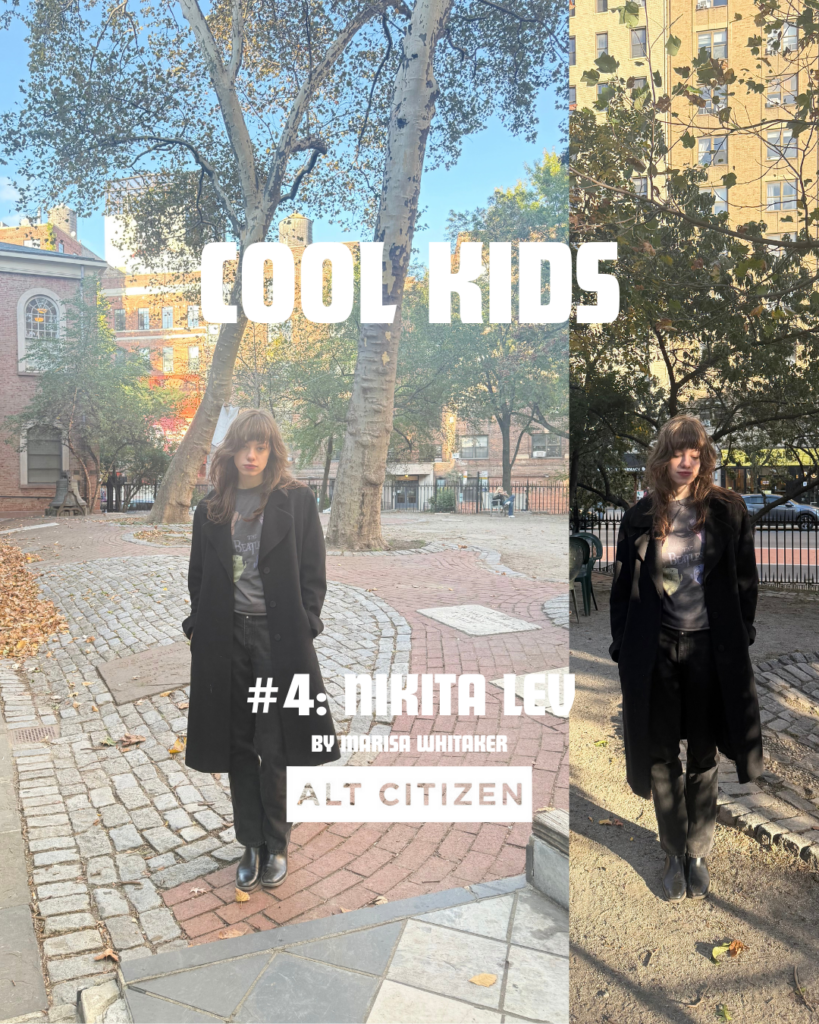
COOL KIDS
#4: NIKITA LEV
★★★★★★★
This world is bullshit. You shouldn’t model your life about what you think that we think is cool and what we’re wearing and what we’re saying and everything. Go with yourself. Go with yourself.
– Fiona Apple
This is not a breakup record in the traditional sense. It’s about the moments where you don’t have resolution yet – where you’re still sitting with the weight of something you can’t quite name.
– Nikita Lev, Suspend album statement
I’m texting Nasa right now telling her I’m almost done with this piece but grasping for words for this lil part here and she goes lol I’m useless today and as am I because we both woke up in my bed today at 11 a.m. because we stayed out and up past our bedtimes but it was worth it because Tuesday’s are the best night to go out in New York City and since I don’t have your standard 9-5 gig I tend to often abuse my free will that I more often will validate with a quote I once heard that goes something like time you enjoy wasting is not wasted time which I just read aloud to my roommate who was also a hooligan with us last night but sucks for her she actually has a 9-5 but we’re about to pop on an episode of SVU anyway because yolo and sometimes you just gotta remember life is like a box of chocolates or whatever and you just gotta take it easy and not everything is that important and ease your soul drink water go to sleep take of yourself drink wine and enjoy the ride.
Newest release: Suspend, EP, October 17, 2025
★★★★★★★
Nikita Lev: Can we move over here? The sun is pretty bright.
Marisa Whitaker: I wish I had extra sunnies for you.
NL: I didn’t prepare.
MW: Well, lucky for both of us, I prepared for this interview. When I saw you at the Nautics show at Mercury Lounge, I remembered you called the SPIN journalist who interviewed you, so nice and prepared. And I was like, I’m going to be prepared. So, was that your first big interview?
NL: Officially, yes. I’d been in newspapers before, which was cool, but I’d never been interviewed so professionally. I wasn’t expecting pointed questions, like referencing lyrics or things I’d done years ago. I was scared, thinking, oh god, what did you find? Stuff I never thought would be looked at.
MW: I’ve never released music, but I imagine it’s intense to create something and know it’ll be interpreted. Musicians know that’s part of the deal.
NL: Exactly – that’s the goal. But when someone brings up something you made two years ago, it’s like, I don’t even remember who I was then, so how do I explain it now?
MW: Writers pull the wildest interpretations out of music. I get nervous going too far because I don’t want to make up a narrative for someone I barely know. But I guess that’s the point sometimes. There’s a fine line, but that’s also the fun of it. Also, I love the EP. She’s wonderful. Truly. And honestly, you surprised me – in a beautiful way. I’d heard your older stuff, seen you play, met you out, got your vibe. But the EP caught me off guard. It’s poppy, ’90s, electronic, all that. You really leaned into it.
NL: I’m glad it surprised you. I love surprising people and giving them something to think about. Not shock value – I don’t want that to be the basis of anything I do. But I was exploring. I collected new influences while writing this, so I’m glad that came through.
MW: I saw in the SPIN article you referenced Aphex Twin, Imogen Heap, Nine Inch Nails …
NL: Yes, Imogen Heap. When making this EP, I was listening to and delving more deeply into stuff I had heard before, because I was more curious about it while trying something new. And Radiohead is a huge influence, even just in writing style. I was allowing myself to be more abstract. In the past, I’ve been very specific and literal, especially in lyricism, and I’d end up contradicting myself. It made me confused about my own writing – like, do I even mean this? Now I’m allowing space for uncertainty and interpretation.
★★★★★★★
MW: I love the sequencing of the EP. You’re telling a story with the order. I know you said it’s not a traditional breakup album, but there’s still that progression. “Kill Her Mind,” the first track – it’s the sound of overthinking. You’re in a chaotic state. And then by the end, “Your Dove” feels like surrendered clarity. No matter what you’ve gone through – love, heartbreak – you end with this stamp of, I’m your dove, your person. That’s how it read to me.
NL: Yeah. I put “Your Dove” last because it felt final. It felt like a decision. The first three songs are: this is happening, this is how I feel, this is the confusion. But “Your Dove” is full of nuance – feeling used, caring anyway, not knowing what to do. So, therefore, here I am. It’s a little masochistic. But I loved ending on something explosive, dramatic, and angry.
MW: Yeah, the synths were heavy – really heady. I loved it. It solidified what you said: how you truly feel at the end of that journey, musically and personally. And the symbolism of a dove – peace, fidelity, devotion – it’s beautiful.
NL: When I wrote it – not to get religious, even though we’re sitting outside of a church right now – I kept picturing the story of Noah’s Ark. After the flood, a dove brings back a branch – there was proof of land, proof the chaos ended. That imagery stayed with me. Even if it’s not the literal end of that story, it was the end of my narrative. It was a decision – maybe not a happy one – but it was: This is how it is. I feel this way, and I can’t not. So, might as well.
MW: I love that. I’m fascinated by musicians – how in tune you are with your emotions. Not everyone can say that. Letting yourself be vulnerable in music is brave. Even being vulnerable in conversation is hard, let alone releasing it publicly. Some musicians are open; some are guarded. What allows you to be this vulnerable in your work?
NL: I was talking about this earlier today. I’m not embarrassed or ashamed or scared of vulnerability – it’s my job. My obligation. If I’m going to make art, I might as well be fucking honest. What’s the point, otherwise? When I’m writing, I’m not thinking about who will hear it or how it’ll affect anyone. I’m writing to understand myself. Vulnerability is the point, so I’m never worried about it.
MW: Nor should you be. Back to “Kill Her Mind” – the first note I wrote was poppy. I love that you’re steadfast that the love you had was real, but you’re questioning how it all went down, how it ended, and how to move forward.
NL: I wrote that during a spiraling moment in my life. I wasn’t unsure about what happened – I was unsure about what I was supposed to feel, how to take control, how to move forward. It was heartbreaking. Writing it was me taking control.
MW: What made you take the pop route with the sound – those upbeat, bright elements – against such emotional lyrics?
NL: I love pop music. I grew up on it. It’s what I want to dance to, feel sexy to. I learned how to write hooks and couldn’t stop. When I write, I’m usually alone, so the song doesn’t feel pop until the production choices happen in the studio – the guitar here, the chord change there, the chorus placement. Suddenly it’s a pop song. I never sit down thinking, I’m going to write a pop song now. If someone gives me a prompt like write this type of song, I struggle. I’m very bad at writing that way.
MW: I love that you’re hands-on with production. You work with others, too, right?
NL: Yeah, with my guitarist Richie [Quake] – he’s an incredible producer. Just me and him in the studio. I loved the glitchy, weird drums we came up with. I referenced Radiohead a lot, especially Hail to the Thief. I love that record. This song doesn’t sound like that album, but the great drum sounds inspired me. I wanted to do something new. I’d never done an electronic or dance feel before – not a club track, but something that moves.
MW: You could make a sick remix of it.
NL: Exactly. A friend told me she feels sexy listening to it – that’s exactly what I wanted. It’s a sad, unhinged song, but underneath it, you can still dance. You can still feel good.
★★★★★★★
MW: The next one – “No One’s Gonna” – really hit me. I think some of the most profound things are told in the simplest words. I saw the opera La Bohème, and the lyrics were so moving; so few words, but deeply emotional. That’s how this song felt. Your imagery is vivid, but the writing is concise. The opening line – You rest your head between my ribs and my hips – is so strong.
NL: Thank you. I was really proud of that. This song means a lot to me. It feels like a statue – not something holding things up, but something built to commemorate a moment that’s gone. I wrote it right after spending time with the person it’s about, while I was still in the feeling. It came out naturally. It’s proof that the moment existed. So much in love feels like trying to hold on to air – people come and go, and you want something to stay. The more you’re in love with someone, the more you’re afraid they’re going to leave. This song made me less afraid because it captured exactly how I felt.
MW: You immortalized it. And something I’ve been thinking about recently – when you randomly think of someone from your past, maybe you’re walking down the street or passing a place … do you think they’re thinking about you at that exact moment? Sometimes it feels like that.
NL: I hope so. I’ve heard people say if you dream about someone, it means they’re thinking of you – no idea if that’s true. But when someone says, Oh, I was just thinking about you too, it feels crazy, like, you were thinking of me? Like we barely exist to each other, yet somehow we’re connected.
MW: Or when you think of someone and they text you immediately – it’s wild. There has to be something in the universe. And you referenced that idea in your song.
NL: Right – the bridge. When you go home, you move across town, walking alone, hands in your pockets / Call me up just to hear my voice / How’d you know I was thinking of you? That’s really funny, I forgot I said that. But yeah – that was the point. It’s like: I think about you constantly, so whenever you call, the odds are, I was probably thinking of you. I saw a tweet that said: What if we were thinking about each other at the exact same moment today? I love that idea.
MW: Maybe it’s not every time – but sometimes?
NL: You can never know.
MW: Exactly. But I swear, sometimes, I feel it. Like, if I’m thinking about someone that much, they have to be thinking about me. Even a little.
NL: There has to be some symbiosis, especially when it’s someone you had a real relationship with. You’re the only two people who lived it, so you’re the only two who know what it meant. You have to be thinking about it. I know I’m not crazy.
MW: We’re not crazy [Laughs]. Maybe a little, but not fully.
★★★★★★★
MW: The third track, “So Clear.” The title is ironic, to me, because the lyrics felt the most ominous, the most layered. There was a lot of hidden meaning. Break it down for me.
NL: This one’s a little raunchy. It’s about sex. It’s about how intangible some things feel. The hook – so clear it became air – is abstract on purpose. It’s like when someone promises something you know they won’t follow through on, but you want to believe them anyway. This song is about that feeling, when you go home in the morning, and you’re thinking, that’ll never happen again – a fluke, an out-of-body moment. It’s also about being so overwhelmed in an experience that you’re remembering it while it’s happening. Almost like post-concert depression – when the emotions are so intense you can’t fully hold onto them afterward.
MW: Yes. Or when you’re at a show or with someone, and something in you knows it’s the last time. You’re in the moment, but also already looking back on it. Your brain is memorializing that moment instead of just experiencing it.
NL: Exactly. You’re so in the moment that you slip out of it. That’s why the first line is, I’ll have to sleep off the proof. The proof that you’re exhausted, delirious – that’s the only concrete evidence that the moment happened. Memory feels flimsy, and you’re trying to cling to anything real.
★★★★★★★
MW: I love the way you tell your story across the whole EP. It’s raw and feels immediate, like you were writing the songs right as the feelings were happening. Has that always been your process, or has it evolved? Is there someone who influenced the way you write now?
NL: I find it hard to write by just sitting down with no ideas. My writing is sacred to me – almost too sacred. If I’m in writer’s block and have no ideas, I’m like, I’m a terrible artist, because I can’t just force something into existence. And when something is coming out well, I get scared to continue because I’m afraid I’ll ruin it. That’s where trusting yourself comes in. Art is a balance between craft and intuition. It’s really hard. You can’t be all one or all the other. If it’s only craft, there’s no soul. If it’s only intuition, it’s chaos. I used to lean too heavily into intuition – it was messy, but unique – and thought that’s what made it valuable. But I also want people to actually listen, not just decode my brain’s word vomit. I don’t even journal anymore. I should, but I stopped because it felt self-indulgent.
MW: I get that. I’m the same way. But that’s a mature self-critique – to realize you need both structure and intuition. You’re young – you’re 21 – and I think people forget how emotionally tuned-in young people can be. The highs and lows are so heightened. People dismiss young artists, but in reality, younger folks sometimes feel things more deeply. I’m impressed by everything you’ve done – your music, your shows, your drive. Your manager, Annie, told me how determined you are. How do you feel about where you’re at, personally and musically, at your age?
NL: It’s so weird to think about it like that. Sometimes I worry I’ve only gotten where I am because I’m pretty or something, and people are lying about liking my music. I know that’s not true, but the anxious part of my brain says it anyway. Recently, I’ve been super anxious, wondering if I’m even good. I want to be so good. I want to grow, evolve, improve. Then I remind myself that desire is the important part – the willingness to evolve. A new friend asked how old I was, and when I said 21, she was shocked. I entered the scene at 19, and back then, it was even more surprising. She said, Oh, you’re going to be fine. Hearing that calmed me so much. I needed it.
MW: That sounds like imposter syndrome. It’s weird to be young and doing things we spent years looking up to – things we’ve seen in movies or documentaries or dreamed about. Then, suddenly, you’re doing them, and you’re wondering whether people are being nice or actually mean it.
NL: Exactly. You end up getting the things you wished for. But when you actually achieve the things you used to dream about, they don’t feel as big as you imagined. Like, I used to think headlining Baby’s All Right would mean everything. Now I am – and instead of feeling triumphant, I’m stressed. But it’s awesome. I also used to dream of strangers telling me my music is good. Now people do, and I brush it off instead of letting it sink in. It’s never enough, but honestly, that keeps you going. If we ever felt done, what would we do?
MW: Right. You hit a goal, then immediately ask, Okay, what’s next? That’s how you grow. You get comfortable and forget how badly you once wanted the thing you’re doing right now.
NL: Totally. But you also have to step back and say, I’m proud of myself for getting this far. That same friend asked me how I got into the music scene, and I didn’t even know how to answer. You just start doing it, and suddenly you’re surrounded by people who are doing it too. But when I think about starting something new – like acting or painting – I’m like, how would I ever break into that world? It takes effort, intention, time. It’s so cool that, now, I don’t even think about that. It’s what I’m surrounded by.
MW: Same. When I moved here, my first friends were musicians. You meet one person, then another, and suddenly you’re surrounded by people who want to collaborate, support, share ideas. In Texas, it’s not like that. Here, it feels like a privilege. It’s so sick.
NL: We’re all so supportive of one another. I lived in LA for a while, and no one does anything for free there. Here, no one expects constant favors, but there’s a spirit of mutual benefit. When you’re a baby artist, you don’t have money for photos or videos, but friends help each other because they believe in each other. You build relationships, and eventually, or when you can, you pay each other properly, but the foundation is collaboration.
MW: Exactly. I do so much for free because we’re all building toward something bigger. We rise together. I help them; they help me.
NL: Yes. It’s an investment in each other. A trust. It’s validating when talented people want to work with you. Real recognizes real.
MW: It’s amazing here. There’s no shortage of any kind of artist. Anyone you need for any art, they exist here.
★★★★★★★
MW: When and how did you land on the EP title and the cover art?
NL: The title changed a few times. Originally, “So Clear” was called “Waiting,” because I’d written a different bridge, and I wanted the EP to be called that. Then The Cave put out a song called “Waiting,” and I was like, oh, fuck. I don’t know exactly how Suspend came to me. I didn’t write a song called that, but all the tracks felt open-ended, full of questions. Suspend has lots of connotations – suspend belief, suspend from school, suspend, like hanging. It felt right. Sometimes saying titles or lyrics aloud feels awkward in regular conversation, but I wanted to stand behind this one. My dad helped. He said he liked that it felt suspenseful, and that clicked. The cover art was a shoot with my friend Marcus. I was wearing a very sheer dress in my apartment and said, Can I get in the bathtub? He took a bunch of photos, and one of them felt perfect – sexy but vulnerable, a little scared, very intimate; Sky Ferreira-type energy.
MW: I love the cover. It’s sick.
NL: Thank you.
★★★★★★★
MW: What might surprise people about you, as a person and as an artist? We all have sides people don’t see.
NL: Interesting question, because it assumes I know what people think they know about me. Recently, someone asked me which artists people would be surprised to hear that I listen to, and I had no idea. I listen to everything. I’d like to think I present myself as an open person. But I know I’m a snob about a lot of things.
MW: You don’t come off as a snob at all.
NL: Ok, good. I’m a snob about art. If something’s not good, I won’t listen, which I think is fair. I’m judgmental about people who make art for the wrong reasons. When it’s disingenuous, you can tell immediately. I’m not judgmental of people still figuring it out. That’s different. But when someone’s being fake in how they present themselves, I’m like, get out of here.
MW: I get that. Everyone in New York – we’re all judgmental. You kind of have to be. But it often comes from a good place, like seeing potential in someone and wanting them to push harder. Or when a great musician puts out a bad song, you’re like, What the fuck are you doing?
NL: Exactly. You want more for them. You’re like, Come on – really? What are you wearing?
MW: Like, you had the balls to put that on, look in the mirror, and say, This is it!
NL: I’m all for bold choices. If it’s wild, go off. But if it’s inauthentic, anyway that you present yourself, get the fuck out of here. Journal. Go to therapy. Talk to somebody. Figure yourself out.
[Laughs]
★★★★★★★
MW: Your music and lyricism are deeply personal and raw. You’re clearly talking about somebody. When something is that personal, it also becomes universal. People relate to the feeling even if the specifics differ. You said you’re not writing for people, but what does it mean to you to put something out that resonates so broadly?
NL: There’s the saying: the personal is the universal. It’s strange to write about something specific, but if it happened to you, it probably happened to many others. Even the emotions – loneliness, yearning, missing someone – are truly universal. That is how we feel when we love somebody. No matter the details, people can relate.
MW: Do you ever hope your music makes listeners feel less lonely? Is that ever a goal?
NL: Yes. That’s the dream. Music builds community. If people understand where you’re coming from emotionally, they’ll want to support you. You have to get people on your side. When you go to a show, you’re just an audience member until you understand the person playing. And then you want them to succeed; you want what’s best for them. That’s the objective of making music: to create that connection. It’s easy to get distracted by everything else. People say it’s all about trying to get famous, but really, it’s about building a community around your work.
MW: Different artists draw different crowds. Marcus King fans aren’t the same as Lady Gaga fans, but both artists give their people something meaningful. They’re giving their like-minded communities their own ways of hope, love, and happiness.
NL: That’s why it’s futile to compare yourself to others. The people they’re drawing aren’t necessarily the people you’re drawing. Fiona Apple said in her famous speech: Go with yourself. People want someone who voices how they feel. The more you’re yourself, the more people whose experiences are close to yours will relate.
★★★★★★★
MW: What does love mean to you?
NL: How do I not sound dumb and cliché and stupid with this question? Love is the reason people do things. Whether it be a friendship, romance, wanting people to like you. We can’t move alone. We can’t live alone. It’s the most important thing. Especially in New York, we get caught up trying to be so cool and so important in other people’s eyes. And not needing love, not caring about it, being above it. But that’s bullshit. It’s so cool. Love is awesome. If you want to be cool, just fall in love. It’s also the worst, but it’s the best.
★★★★★★★
MW: You’re from here. You know New York’s bullshit and its good things. It’s easy to get up your own ass. The scene can make you grow up fast. It can be a lot. But there’s also so much good.
NL: I didn’t realize how New York affects you until I left for a bit. I grew up uptown, so I wasn’t around any scenes or downtown much. You said it – everybody’s so up their own ass. I was just in Paris for a week. I did a music video and a mini-showcase thing, which was fun. People were so sweet and genuine there. I was so flattered by everything they’re saying. It reminded me how different it can feel. Back home, people here are like, Oh, yeah. That was cool. [Laughs] It’s so hard to have perspective on the work you’re doing here. Everyone around you is doing a similar thing, hustling and trying to get ahead. Everyone supports one another, but it’s so hard to feel like you’re moving forward when you’re in this chaos. You have to leave and come back, and remember why you love it.
MW: Perspective is huge. You’re trying your best like everyone else. No one really has it figured out.
NL: Exactly. It’s so easy to forget that everyone’s insecure. But the one thing about New York that I’ll always love and never give up is the fucking walking. If I feel like absolute garbage, I put on headphones and a playlist called “songs to walk to (varying paces),” and I walk to the beat. Like, I’m the shit. [Laughs] It’s my goddamn runway. Friends or people I know text me, like, I saw you walking, I called your name seven times, and you did not hear me, and you looked like a bad bitch. Maybe it’s a little embarrassing, but who cares? Who gives a fuck? You are giving your steps meaning. You put on a good outfit, a long coat, sunglasses, and you’re like, Everybody’s looking at me. Undeserved confidence, right there.
★★★★★★★