
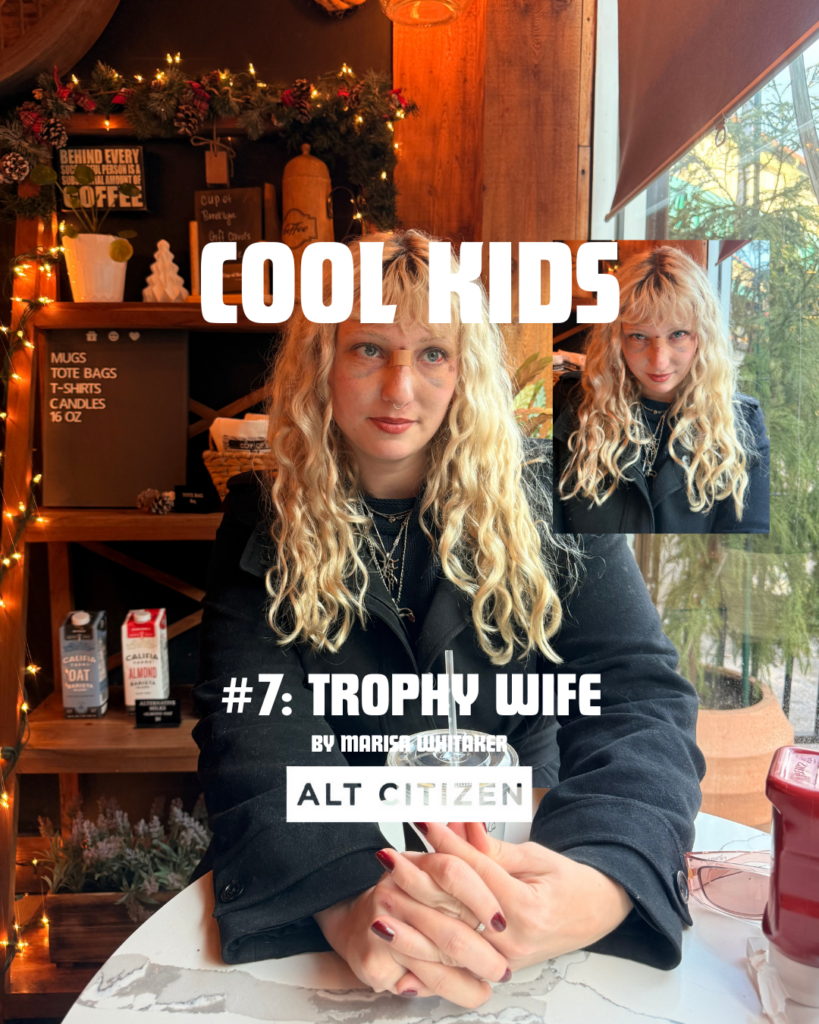
COOL KIDS
#7: TROPHY WIFE
★★★★★★★
Find out who you are and do it on purpose.
– Dolly Parton
And I guess life’s full of bartering
And I bring myself to a knife fight
Only to find you waiting with a sword
And I’ll let you spill my guts
I just hope this is love
– Trophy Wife, “Knife Fight”
Happy 2026 to all you COOL KIDS! I love new things. My mom hates it when I buy new things all the time. But new things make me happy. Excited to harness my Gemini energy and steer the reins of the horse that is my life. Make moves. Be happy. Love. Dance. Party. Enjoy the ride. Act with intent. Create art. Be well-spoken. Put my freshly developed frontal cortex to work. I interviewed 60! NYC-based artists! in 2025. And four others who are based elsewhere. Stoked to learn about more music, artists, people, and life stories over the next 12 months. Hone my craft. Ask better questions. Read more music-related books. Put pen to paper. Manifest. Be confident. Try something new. Try many somethings. Fuck around. Find out. The city keeps you young … so young I shall be.
Trophy Wife is
McKenzie Iazzetta (vox/guitar)
Christian Pace (bass)
Michael Martelli (drums)
Mena Lemos (guitar)
Newest release: “So Hard,” single, October 24, 2025
★★★★★★★
Marisa Whitaker: When did the band start?
McKenzie Iazzetta: Our first rehearsal as a band was probably December 2020.
MW: You were still in school then. How old are you?
MI: I’m 25.
MW: Same.
MI: Christian and I graduated in 2022. Michael, our drummer, graduated in 2024. He was driving back and forth. Christian was, too. I moved here right after I graduated, but we’d only been a band for about a year and a half at that point. Before that, I was doing stuff by myself, but not seriously. It was under the name Trophy Wife, but it didn’t sound like what I wanted. I didn’t know how to play guitar. I was 19. I went to school for music, for voice, at Berklee, and once I got there, I realized I should learn guitar.
MW: When you moved here, did you realize how many people come through that pipeline? Especially from Berklee?
MI: Yeah. Berklee is kind of the school where a lot of kids go, and then there’s this waterslide straight to Brooklyn.
MW: The first time I met you, Makenzie Correll, of Hipsy Gap, was there too, and telling me about that whole Berklee-to-Brooklyn thing.
MI: Berklee is one of the only contemporary music schools for vocalists. When I was looking at schools, I wanted to study jazz. The other jazz programs were mostly places like Manhattan School of Music, but you couldn’t really study jazz undergrad the same way. Miami had vocal jazz, USC sort of did, but if you wanted to be a contemporary singer, most other schools were opera or musical theater. I didn’t want to do musical theater. Berklee is very jazz-centered, but many kids start rock bands. People branch out. I always say Berklee is just college. You meet your friends and learn to be a person outside your parents’ house. I’m glad I went.
★★★★★★★
MW: Did you grow up singing?
MI: Yeah. I always sang. Around 12, I started taking it more seriously. I did choir and musical theater because that was kind of the only option. I sang for fun, to start. And I didn’t like sports. My parents put me in everything – every sport, every music lesson. In middle school, I did Beauty and the Beast. Then a friend told me about stuff outside of school, and I did Godspell. I just kept going. Started taking voice lessons. Later in high school, I focused mostly on jazz. I still did some musical theater, but I studied jazz more. I also sang operatic arias in choir for competitions.
MW: Did you grow up in a musical household?
MI: Not exactly. My parents weren’t musicians, but they really wanted my sister and me to have something we cared about. We were always like, Be careful what you wish for. They ended up with two little art kids. My sister goes to art school. This is their fault. [Laughs] They loved music, but they never made music themselves.
★★★★★★★
MW: I read that you were part of the Berklee crowd, but also really involved in the local scene that wasn’t attached to the school. How did that happen?
MI: I was way more involved in the local scene than anything school-related. I never did school-sanctioned performances. Berklee is in Boston, but a lot of people lived in Allston because it was cheaper and kind of worse, not as nice. I lived in this huge, overgrown frat house with eight people. A lot of people threw shows in their basements. All the houses were old. We bought equipment, drum kits, PAs, and everything. In my sophomore year, everyone moved out of the dorms, and I moved into that house. We un-fratted the basement as much as possible. There was this industrial freezer down there – unplugged, full of piss, waiting for us. We had to drag it up the stairs and dump it outside. Something only a 19-year-old could do. We just started having shows. The house next door had shows. A few streets over, more houses were doing the same thing. This was right before COVID. Every house felt like a concert venue. We booked bands and had touring bands come through. It was really fun. It taught us everything – the other side of being in a band. Not just playing, but booking, setting up, learning how to talk to people, how long it takes to set things up – all of it. All my friends formed bands. We played together constantly. I’m glad we started there because bands from that scene are really considerate. Everyone’s on time, prepared, and helpful.
MW: Why do you think that is?
MI: Because we had to do everything ourselves. You couldn’t just show up somewhere where everything was set up, and there was a sound guy. The sound guy was a 19-year-old who was drunk. Sometimes he disappeared, and you had to put the guitar down and run behind the soundboard yourself. Now, we’re spoiled. You show up, and there are microphones and lights. It’s not a basement. Nothing’s leaking from the ceiling. It’s very luxurious. [Laughs]
MW: So was it Berklee, or the DIY scene, or both, that made you want to start your own band?
MI: It was both. I was living in that big house, but it was after the shows slowed down that I really started focusing on my own project. I already had the name. I’d released a little EP that sucked. [Laughs] I’d written a bunch of songs after I’d gone through a 20-year-old breakup. One of my roommates, Micah Rubin, told me I should record them. We grabbed people we knew – you play guitar, you play bass – and went to a friend’s farm studio. We had one rehearsal and recorded the first Trophy Wife EP, Bruiser, there in 2021.
MW: Were you already with the same people you’re playing with now?
MI: Christian’s been there from the beginning. We needed a bass player and thought, Christian’s nice, Christian’s good at bass. Micah played drums on the recording, but he’s never played a live show with us. Michael – our drummer now – played our first live show and every one since. Now we have Mena on guitar.
MW: Is she new? She wasn’t on the Get Ugly album cover.
MI: She’s been playing with us for about a year and a half. She had just started playing with us when we began recording our debut album, Get Ugly. Our friend Rowan (Martin) played all the guitar on the album and on “So Hard.” He’s in the band Paper Lady, who are our good friends from Boston. That was after our old guitar player left, so we’ve kind of been a three-piece ever since.
★★★★★★★
MW: Why the name Trophy Wife?
MI: When I chose it, I thought it was funny. I was 19 and loud and annoying and abrasive – everything you’re not supposed to be.
MW: I love band names where you don’t immediately think about the literal meaning. I didn’t even clock what it meant at first. And when I was researching the band, I found a couple of other projects with the same name. But you are the Trophy Wife.
MI: Same. I was scared when I realized there were other projects with that name. I thought I might have to change it. But as we made more music, the name started to make sense.
MW: In what ways?
MI: A lot of what we make is about the struggle between vanity and ugliness, loudness and insecurity – opposing forces; a contrast. Almost everything I write is almost directly opposing the last thing I wrote. When the guys write the instrumentals, they do the same thing. It feels like a struggle with yourself.
MW: I have to ask … Who are some of your favorite trophy wives?
MI: Anna Nicole Smith. I watched a clip of her recently in which she says she doesn’t know anything about cars or engines, but she knows everything there is to know about the backseat. She was so funny. I love the image of a beautiful, kept, put-together, sought-after woman, where everything that comes out of her mouth is disgusting. Just horrible. I love that contrast.
MW: I would love to be a trophy wife one day. [Laughs]
MI: I don’t think I could actually be a trophy wife. I’d be too combative.
★★★★★★★
MW: I love that first EP. One of the songs on your first EP is one of your most popular tracks, “Knife Fight.” That was the first song you ever wrote, right?
MI: Yeah. Oh my god. Let’s talk about it.
MW: I love your lyrics. If y’all aren’t famous by next year … I want to know about your writing process. Tell me about writing that song.
MI: I wrote that song in college, in my dorm room. I played the easiest chords possible – cowboy chords. C, G, D. I had just learned them. I still had some teenage angst left in me. I wanted to write something violent. I had an open mic, songwriter night coming up, and I wanted to sing at it with my boyfriend, who played guitar. I didn’t know how to play yet. I somehow figured it out. I remember feeling really embarrassed and uncomfortable. I wrote four songs in three days because I needed fifteen minutes of music. I was like, I have to write them all right now. They were terrible. I’ve taken all of them down except “Knife Fight,” which was called “Guts” at the time. I wrote it in 2018, released it in 2019, then took it down. The version that exists now is from 2021. Same lyrics, same structure – just reworked. The original was with MIDI drums and my boyfriend playing fingerstyle guitar. I only did it because I felt like I needed something. I needed to sing at this show. I work really well under pressure. I always need pressure to do anything.
MW: And you still feel that way now?
MI: Honestly, it’s kind of the same. It’s like, Oh my god, I have to write a song now. I wrote “So Hard” in 2024 in one afternoon, probably an hour. Then I was embarrassed by it for a few days before coming back to it.
MW: When I first heard that song, the first line hit me immediately. I wrote about it for The Deli without even really proofreading. Just my off-the-dome thoughts.
MI: It’s embarrassing because it’s real. Usually, I write about things after they’re over; friendship and life-wise, too. This was happening while I wrote it. By the time it came out, it was over – but still, there was nowhere to hide. I was still here, and the song was out. I’m happy with it, but it feels like taking your nipples out.
MW: That vulnerability is what you do best.
MI: It’s terrifying.
★★★★★★★
MW: Comparing where you were writing “Knife Fight” to where you are now – what’s the difference when you’re putting pen to paper?
MI: When I was younger, I wrote by summarizing. I pulled from high school, middle school, and past experiences. Even up through Get Ugly, I was mostly writing about things that had already happened and looking back on them through my current lens. Now I’m writing about things as they’re happening, through who I am right now. That’s the biggest difference. I’m also more sure of myself as a songwriter. I still get embarrassed, but not enough to stop me. Just the healthy amount. If you’re not embarrassed at all, that freaks me out. If you’re writing about your life and don’t pause and think, Oh, shit – that’s really weird.
MW: You should always be uncomfortable. Embarrassed. Cringy.
MI: Exactly. It means you care. It means you’re authentic. It’s not cringe if you’re authentic.
MW: Have you ever written something and thought, That’s too much, and cut it?
MI: No. There are definitely lines I’ve written where I’m like, That’s not even what I mean. I was just upset. It resonated in the moment, but not with the rest of me. Those things usually don’t make it into finished songs. It’s never because something feels too personal. It’s more like, this doesn’t actually say what I want it to say.
MW: Do you prefer writing in the heat of the moment or sleeping on it? Like those moments when you have an intense feeling about a situation, but when you wake up the next day, you’re still upset, but you’ve simmered down.
MI: I write songs in my phone. I don’t have a notebook. My shoes are on, I like to say. I’m not so cool and hip like that. There’s no candle, no tea. [Laughs] I write in my Notes app. Whenever I feel something, I write a paragraph or a sentence. When it’s time to write a song, I pull from all of that. I don’t think, This situation happened, I’m writing a song about it. I take lines and figure out what I meant. “So Hard” came together like that. The opening line – Can’t you get pathetic for me? – was written way before the rest of the song. The chorus came from a completely different moment. Another part, I think the third verse, came from being on a bad, fuck ass date. I was sitting in a shitty bar with no cocktails, drinking a Miller Lite, reading a sign that said no limes or cherries. My skirt was tight. I’d eaten too much. Everything was wet. The coaster kept sticking to the beer bottle. I didn’t want to be there. The stool’s too small for my ass. I try to make it all feel like one story.
MW: Your lyrics are so tangible. I want to make a poster with stickers of all the little details you mention – cherries, limes, bars, Miller Lite. It’s so real. Said so simply. I was telling Nikita (Lev) this during our interview, too, but your lyrics are often so all-encompassing in just a few words. Straight to the point, yet capturing such a large image and feeling.
MI: I don’t like being verbose for no reason. Simple things don’t need to be overly flowery. Sometimes they do, but not always. There’s nothing flowery about the bar.
MW: I read something you said, what “So Hard” is about: How much you’re willing to compromise to get what you think you want. Sometimes it just seems everything should be simpler than it is, and it makes me feel that some people just like to be sufferers.
MI: Do you ever wish you could be in control of someone else’s life, in the least asshole way, but maybe in the most asshole way? You watch someone make a decision and think, Why did you do that? This could be so simple. Some people don’t want simple. I don’t know if I want that; I don’t think I’m better or more evolved than them. It’s what I want for them. Sometimes you’re in a relationship where you don’t even like how the person is acting, but you’re holding onto an idea of who they could be. You’re suffering for a version of them that doesn’t exist. Maybe some people just like to suffer. I don’t know.
MW: I think everyone does that at some point.
MI: Totally. I was joking with my friend about this recently. When people talk about chasing someone who isn’t clear about what they want, it’s the worst feeling in the world, but you’re still there. Maybe you’re perfect for each other because you’re both liars. You’re saying it’s fine.
MW: That’s why I listen to music. Someone gets it.
MI: Exactly.
★★★★★★★
MW: Your videos are incredible. “Swamp Song” I loved.
MI: Thank you.
MW: His bass strings were so loose. I dig it. Did you work with the same people on all of them?
MI: Yeah. Our friend Gia. She lived in Philly and went to school for film. We lived together in the big house in Boston. She lives in LA now, but we’ve done almost all our videos with her. We did “Knife Fight,” “Keep It,” “Swamp Song,” and “Spit.” We completely trusted her and her taste. We like the same movies, the same music, the same kitschy, horrible shit, and gross stuff. I told her to do whatever she wanted. For the first video, we made fake intestines. For “Swamp Song,” she put us in a field, made us sweat, and put Christian in the swamp.
★★★★★★★
MW: You mentioned building a team around Trophy Wife. Who’s involved now?
MI: Georgia manages us. We’re on the phone constantly; FaceTime, calls, all day. I’m never not on the phone with Georgia. We met in Boston when she first started the Indie Hourzz sessions for IndieSauce. She invited us to do a live session in her apartment back in 2021. We stayed in touch, and one day she asked if she could manage us. We tried it out for a year before signing anything. As a band, we weren’t making money then, so we just figured it out together. After that year, we made it official. When we were planning the album, we were talking for, like, six hours a day. Now we have a booking agent, which is life-changing because I’ve never booked a show myself. I just wait until someone asks us to play a show. We used to say yes to everything. The first year we moved here, we played 35 shows in New York and about 30 outside the city. For two years, we played that much. We were lucky to have people to ask us to play. I loved it. It was exhausting but fun. Our agent planned our summer tour. It went so well. That was our first real tour. We jokingly called it our humbling tour, thinking we’d play to empty rooms. But people actually showed up. We didn’t lose money. It was wild. We were like, we were supposed to be humbled on this tour. We came back worse. [Laughs] We also started distributing with AWAL. Nicole Feldman, our A&R, helps us with marketing and budgeting and will help us with the album. That’s basically our team, plus me, Christian, and Michael.
MW: You’ve been together a long time. What is it like learning about one another as friends and bandmates?
MI: They’re like my brothers, in every sense of the word. I don’t know if you have siblings, but sometimes they breathe too loudly near me. [Laughs] But I love them. Trophy Wife is like a car, and we’re all tied to a rope on the back of it. It’d be ridiculous to stop. It’s what we all went to school for; what we all want. Christian has his own side project, too, called Horse Material. They’re family to me. We all know what Trophy Wife is supposed to sound like. I bring in the skeleton of a song – lyrics, chords – and they turn it into a real song. Sometimes it clicks immediately. Sometimes we fight with it forever.
MW: You’ve had a pretty consistent sound, but it has definitely matured, and you’ve honed it over the years. Was your sound the intent from the beginning?
MI: It’s what we’re all influenced by. We like heavy, intense stuff in different ways. We pull from our different influences. Christian went through a black metal phase, but also loves The Rolling Stones. Michael loves deconstructed sounds, like those of Björk and Joanna Newsom. I love Tori Amos, Violent Femmes, and Arthur Russell. We never sat down and decided what we should sound like. It just is. We wear our influences on our sleeves. We aren’t trying to act as if no one has ever played a guitar before, but we don’t want to sound like a copy of another band.
★★★★★★★
MW: Y’all are opening up for Quarters of Change at Irving in April. That’s incredible, congrats.
MI: We’re so excited. It’ll be so fun. We’re also playing with them in DC and North Carolina. We’ve never played Irving. We love Quarters; we’ve known those guys for a while. We can play outside of New York. And we have time to write. We’re going to SXSW as an official artist, and we’re hoping to plan a tour around that. It’s nice to take a break from playing. This is the longest we’ve ever gone without playing a show; it’s been a month and a half. It’ll be nice to see what all we’ll do in this time, but it also feels a bit purposeless.
MW: I can’t sit still either. But when I have a break, I try my best to indulge.
★★★★★★★
MW: Are you inspired by other kids and bands in town? Or bands popping off right now, like Wednesday? Whether their music or trajectories?
MI: Yeah. I listen to a lot of music from right now, and some older stuff. I loved the new Wednesday album. The YHWH Nailgun record was really awesome. They’re crazy. A lot of friends’ bands, too. Paper Lady came out with an album this year, and it’s really, really good. We played with two awesome bands in Nashville, Baby Wave and Sewing Club. We met a lot of cool people while on tour. I loved Audrey Hobert’s album.
★★★★★★★
MW: 2026. Time off. Play with Quarters. What are your plans for the rest of the year?
MI: We have more music that we’re gonna come out with. In a few months … there’ll be more music. Prepping for new releases. Hopefully, more touring outside of New York. We did the Midwest already, so likely the South. Doing the business wife thing, as I like to call it. The not-music side of things that we have to do.
MW: Do you have goals for the band? Is there a place you want to be at this time next year?
MI: A big thing for us is we love playing shows. We’d love to go on a larger tour and really be on the road for a while. I’m not terribly moved by the online chunk of being a band. I’m not above it; I’m not gonna act like an off-the-grid, old soul about it. We love touring, writing, and recording. If this time next year, we can be touring, writing, and recording, as our real full-time job, that’s what we want. And meet more people. It’s the coolest thing ever when we play shows and people care. It’s awesome and weird. We all feel like we’re 13 when it happens; we’re like, What the fuck? Why do you guys know this song? It’s beautiful. [Laughs]
★★★★★★★