
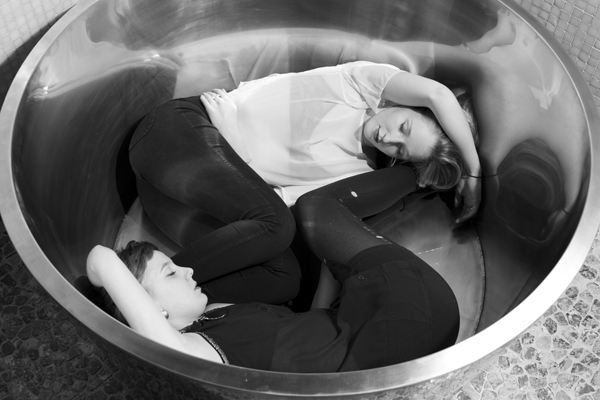
I’ve been living in New York City for about a year and a half now, and one thing that never ceases to amaze me is how cultural icons live and walk amongst us. I begin to imagine all the important people I must see and not recognize. Nowadays, I find myself walking around the city amazed by everyone, wondering what they could possibly be doing with their lives, believing it must be very important. But they can’t all be doing important stuff because some guys are just yelling about stupid terrible stuff. One thing is for sure – I wouldn’t recognize Gracie and Rachel on the street and know for sure that they were amazing if I didn’t hear them play music together.
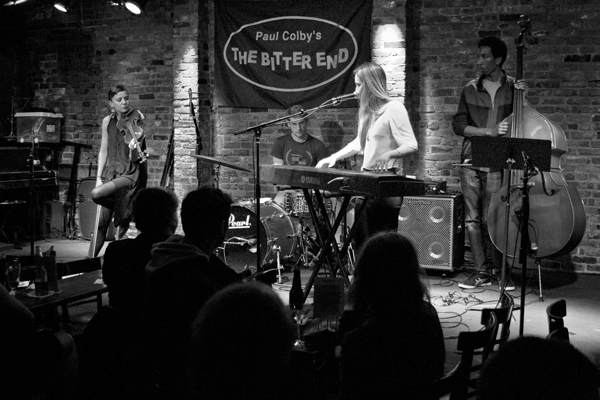
Gracie and Rachel moved to New York City a few months ago, and they aren’t established in any sort of record label way, but they are both getting closer and closer to the 10,000 hours that Mr. Gladwell calls mastery. A musical duo made of two girls is nothing new; and neither is the violin, nor the piano, nor the malleable voice of a lovely lady – but who cares, because good music will never go out of style. The hard part – maybe the line that separates us from them – is the ever-changing media outlets and the format in which people consume culture. The great musicians and artists we hear about today are doing the same classic stuff, but they have to be flexible in reaching out to a progressive audience.
Okay, let’s begin.
Gracie: Let’s begin.
Rachel: I heard lesbian.
Great, I would love to talk about that, but let’s just do an introduction.
Rachel: I’m eating a cracker so you can go.
Gracie: We’re both 22, born in ’90. Our names are Gracie and Rachel – we dropped the last names, and we’re from Berkeley, California.
So tell me some stories from your childhood, the beginnings of your romancing the sound.
Rachel: I started playing violin in kindergarten, and I did well, so I started playing in the higher orchestras in the elementary school system. This meant I had to get to school before everyone else, and in kindergarten, we had nap time. On this particular day, I was extremely tired, my mom said I had practiced really late the night before, so when my teacher went to wake everyone up, I wouldn’t get up. She just let me sleep right through class, but then I slept the entire day, and I didn’t wake up until all the kids my age had already gone to afterschool care. I remember being the only kindergartener walking across the street with the 4th, 5th, and 6th graders, and everyone had a buddy to cross the street with, but I didn’t know anyone – I was just crossing the street with my violin.
Gracie: When I was 13, my dad’s very good friend who was a monologist – a pretty well-known guy – committed suicide. Before that I was just a little piano player, but the family asked me to sing a song at the funeral for like 3,000 people. So I did, and that was the first song I ever sang live – at a funeral for a well-known monologist. That was my experience – being 13, writing music.
You guys first started playing together in high school, but then you both went to college, so how did that work out?
Gracie: Yeah, I was at Berklee, and we had just gotten started right before we left for school, so it was really exciting, but we weren’t sure how to keep it alive. ”Oh we’re starting something, but now we have to go to college…”
Rachel: We sort of made a little pact, saying “Well after college we should pursue this, or try to move to the same city,” but we didn’t know if it was going to work out or if we were going to keep it up.
Gracie: But we did. Every year we made an effort. I had school and she had school, but she’d call, saying “I just booked us a show in Indiana – you’ve got to fly in on this date.” So I would book the flight, and there were a few hours to rehearse but no time to learn new songs. We began doing little rehearsals where Rachel would be in her practice room on the phone with Skype, and I was in my practice room with the phone and Skype – Skype rehearsals! That was pretty modern – good for staying together as a band, as a duo.
So now you’re out of college in the real world. Where does it go from here? Just keep playing shows and…?
Gracie: Well, we’re at a stage where when people see us, they can’t really grab onto us yet because we’re new. The exciting thing is that if we were on a larger scale, an album would be an entity right now, but when I see a band that I haven’t heard of and they just moved here three months ago, and they have an album…honestly, I think it’s kind of lame. It’s like “Well why don’t I know about your album? Why is your album not on iTunes? What does it even mean to have an album if you’re not even pushing it, you’re not on a label, and it’s not managed?” We could have an album – we have an album – but I just don’t think that, on an official basis, it’s necessary for our product.
Rachel: I think we would book the same amount of shows with or without an album – we have plenty of songs on the website to show our repertoire. But in the future, the type of venues that we want to be playing, I think that we just need other people on our team.
Gracie: Yeah! That’s it – I mean we want to play House Of Blues, we want to play Webster Hall, we want to play Mercury Lounge, but these places demand that you have 350-450 people minimum. You can’t just book these shows, so that’s what we’re working on. Our following is already increasing, so we’re trying to build that so that when we call House of Blues… no actually, so House Of Blues calls us – that’s how it’s gotta be.
Rachel: What are you looking for, a pen?
Yeah… this story’s going to be called “Where to Begin.”
Gracie: Oh god…well you know what I mean?
Yes, totally! And this article has to justify that. This article is not about how you guys are. I’m not selling you as a successful product already; this article is about relating to people who are… trying.
Rachel: That’s exactly what it is.
Gracie: I think it’s better to not play a venue than to play an empty venue. I’d rather not play at all […] I mean, that sounds bad. We want to play every opportunity we get, but I don’t think it bodes well to play an esteemed venue and not have the turnout.
Rachel: I think it looks bad for the venue, and it looks bad for us.
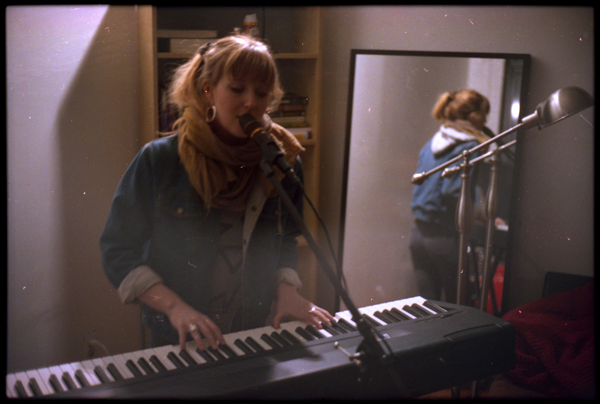
I feel like there are two ways of looking at creating: one way is that the artist isolates and tries to ignore music that’s already out there in order to avoid being too heavily influenced by a certain sound; the other way is to take as much as possible from other art in order to understand the history of your field and how you can fit into that history.
Rachel: I can’t imagine being a musician that’s not obsessed with the art of listening and wanting to know what’s going on in the music world, especially the most unique musicians – musicians that are hard to discover because maybe they’re not given that opportunity to showcase their talent, because they’re not appreciated. I think it’s so great being able to find them and support them.
Gracie: Rachel’s just the most dedicated music researcher I know – she’s got a very eclectic taste. I think a lot of it has to do with what she grew up with, the variety of classical musicians and even beyond things her parents introduced her to.
Rachel: Well it’s easy to say I grew up with Roy Orbison, Cindy Lauper, and Elton John, but I don’t attribute any of my talent – or the way that I play anything – to them.
Gracie: You have to.
Rachel: I just […] don’t. […] But I don’t see myself picking up on their trends as artists.
Gracie: Well you can’t really pinpoint it, because when I sit down to write, or when Rachel sits down, I don’t think that we sit there with certain sounds. I sit there with certain thoughts and ideas – maybe it’s a conversation I had that day, and it brings a melody line or a musical idea, but it doesn’t come from me any more than from musical things. I think that when I was younger, it did. I think that when I started songwriting, I really did stop listening to as much music. I don’t know why. It’s really bizarre.
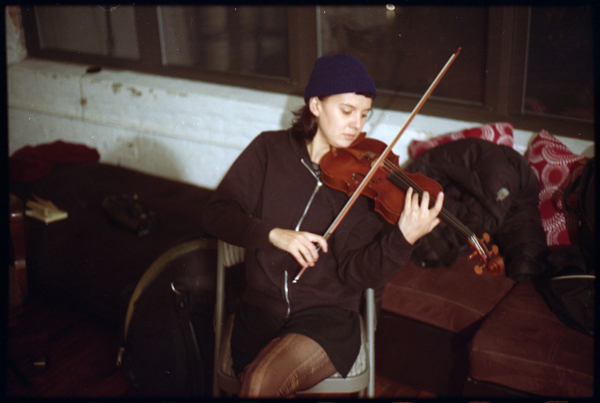
So as a classical musician, don’t you have some cultish relationship with your instrument?
Rachel: I don’t know – it’s kind of a love/hate relationship just because I beat myself up for not practicing as much as I should be. Like right now ’cause I’m not practicing […] at all.
Gracie: Well I know it’s relative, but where it used to be six-hour days, now it’s like two hours of practice.
Rachel: I had this battle in my head, like “It’s okay Rachel, you sound great! And you’re playing with Gracie, and people always compliment you on how you’re playing. “ Even my classical musicians tell me that I sound great, but it’s not technically difficult compared to what I was doing. I did spend a lot of my entire life going through certain training and programs, trying to perfect my art. Classical music is literally putting you in a box, and it can lack creativity. You’re not writing your own music – your playing somebody else’s music, so I do reward myself for kind of breaking those barriers. It is always going to be this duality of wondering if I am a classical musician or if I’m abandoning that and can just decide to do what I want to do. Either thinking for myself or not thinking for myself – honestly, I think that’s what it comes down to. Letting myself play the way I want to play and being okay with that, or wanting to have the justification and guidance of classical music.
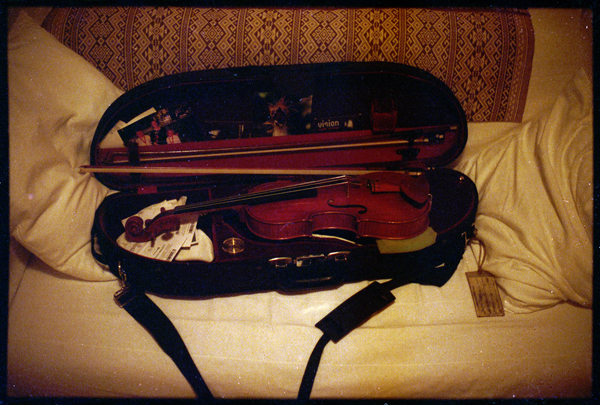
Well, this sense of rebellion and taking some leap into individuality is interesting. I think every kid has to go through it one way or another with parents – how to accept what is but also add and build around it. How did you girls deal with these issues specifically relating to your parents?
Gracie: Well, my parents are a completely different story from Rachel’s. I mean they both have their different things, but my parents have fully encouraged this lifestyle. I could say, “I wish they had been more rigorous about my technique,” but there are just things that are good and bad about both sides. I’ve been very lucky in the sense that they have even gone so far as to warn against doing anything other than this creative lifestyle. My dad brought me up playing games where I would get the answer wrong on purpose because he didn’t want me to get into this psychology of 1+1=2. He wanted me to get into the psychology of “we can create different answers,” and that was a really hard thing for me to learn at a young age because I’d go into a place with other people where that wasn’t what was being taught, and to me, that was foreign. I had a really backwards situation where I didn’t have to revolt to be an artist by any means – both my parents [are] artists. It’s been my life since the beginning.
Rachel: Well my answer is very simple: that’s still going on, that battle. My parents are old school. I think that’s why I’m a classical violinist – they wanted me to be, like, ”We’re going to put our kids in private school and have them take violin and piano lessons.” That’s a little bit… old school. I love them for it – I thank them for it – but they don’t understand what it is to not be a classical musician in the music industry. They don’t understand what the music industry is; they don’t understand pop music. They don’t even understand how to use their telephones really. I know they love me, but it is a constant struggle knowing that when I talk to them on the phone, they’re going to ask me “So when are you going to start auditioning for orchestras?”
Gracie: Like, “When is this over?”
Rachel: Right, but their dream for me is to be a solo violinist at Carnegie Hall. And then I send them my work – like this music video we shot – and my dad said it was done beautifully… something about “the softness.” But I sent it to them four days ago. I [asked] my mom why hasn’t anyone responded. I was like “Please respond!” – you shouldn’t have to say that to your parents! So I already knew something was up, and my mom was just kind of avoiding the question. I asked, “Did you like it?” and she said, “I didn’t understand it? Is Gracie sunlight and you’re darkness?” She didn’t understand what was going on, my dad thought that I was leaving and Gracie was arriving – or the yin and yang! Literally he thought we were talking about yin and yang. It’s just something that’s artistic and beautifully shot, and he’s saying, “I don’t understand how it relates to that song.” I just said, “Well it’s a story, and let yourself fall into the story.”
Gracie and Rachel
Facebook
Tumblr
YouTube
Story and Photos by Sam Margevicius