
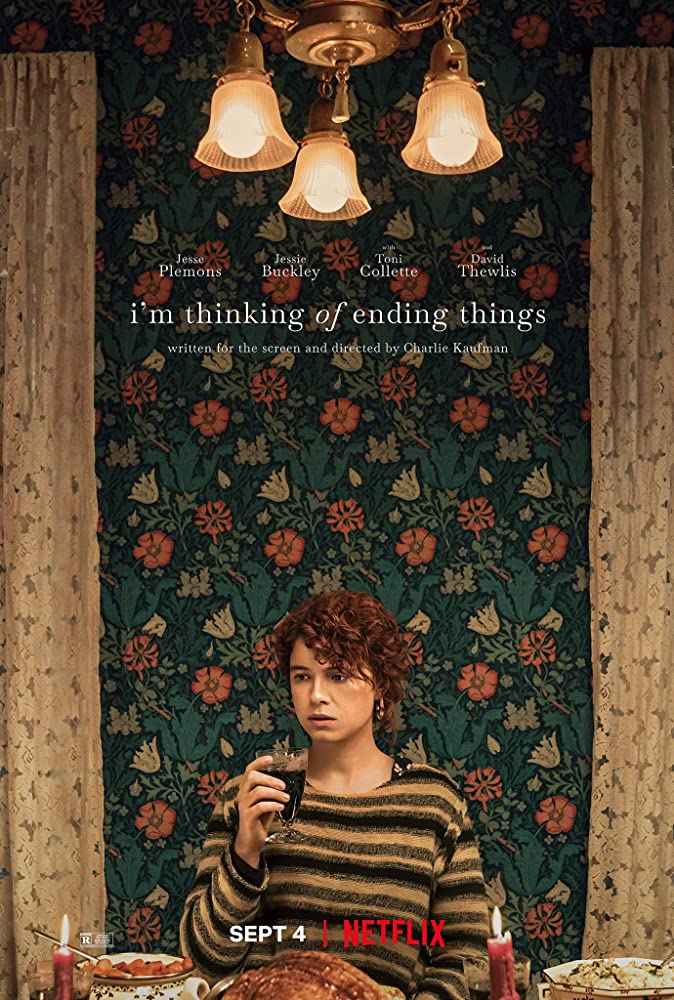
Review by Izel Villarba, find more of his work here.
I saw this movie when it premiered on Netflix a week ago and it’s still fucking me up.
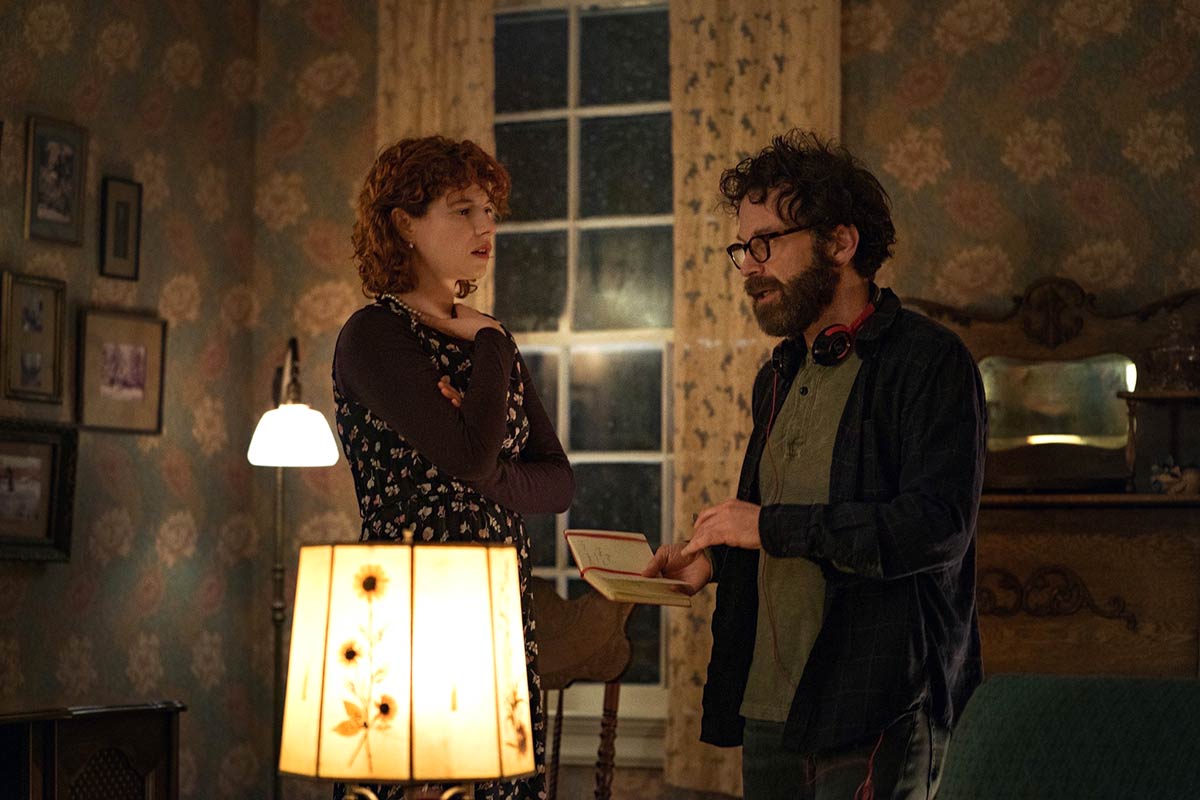
For director Charlie Kaufman, this is essential. You might be more familiar with the stories he’s penned for other directors: Michel Gondry’s Eternal Sunshine of the Spotless Mind and Spike Jonze’s Adaptation and Being John Malkovich. His mind-bending scripts in the hands of commercially accessible storytellers have captured acclaim from both regular movie goers and upper echelon film critics. However, when Kaufman takes the director’s reins for his own stories, the results (Synecdoche, New York and Anomalisa) tend to be much darker, deeper, a little more pretentious, and a lot more depressing. These personal efforts are generally richer in conceptual complexity and, although well reviewed, do poorly at the box office.
Kaufman doesn’t seem to mind. With each new release, he continues to execute his ideas by visualizing, in great detail, the surrealities of his mind as he ponders the metaphysical and existential conundrums we often distract ourselves from thinking about. His method of choice? Turn a simple premise on its head, run it through an unconventional framework, and ruin a viewer’s day by questioning what it means to be human. I rarely leave a Kaufman film feeling happy about myself. I guess the reason I’m always drawn back to them is that, despite knowing his MO for depressing self-awareness, I find them to be certifications that my life — with all it’s aches, pains, absurdities, sorrows, and feelings — is real; my scars are proof of my existence.
I’m Thinking of Ending Things takes “Kaufman-isms” to a new tier of twisted. It’s an adaptation of Iain Reid’s 2016 novel, but the director takes enough creative liberties to make a version of his own hyper-specific style — telling a story on screen only Charlie Kaufman can tell. I can’t even really begin to say what this movie is about but I can walk you through my experience and hopefully convince you to check it out. I think it’s a great introduction for anyone new to his work.
I’m going to skip a lot of details here. It’s best to go into this movie without knowing what to fully expect.
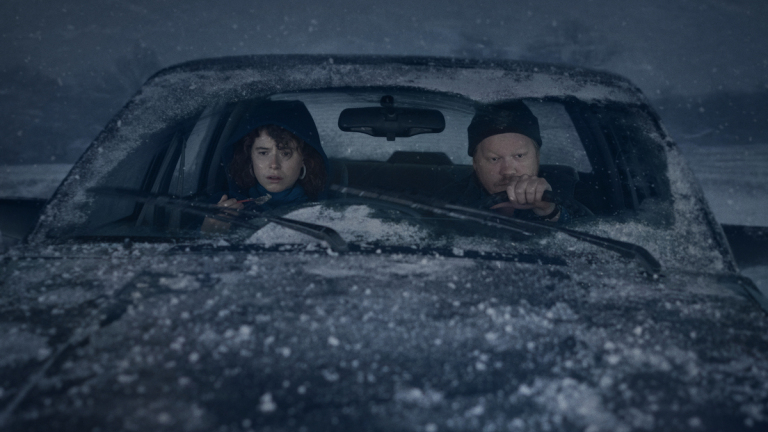
The basic plot follows a young woman as she prepares to meet her boyfriend’s parents, all while thinking of ending things. Immediately after she gets into the car with her boyfriend, Jake, the audience gets a taste of their relationship dynamic, one both tense and lightly balanced on highbrow cultural references. The entirety of this car scene pisses me off because of how unbearably excruciating it is to watch. It’s twenty minutes of one cringe moment after the next as Jake tries to impress his girlfriend but only alienates her even more.
Kaufman draws out this scene to feel like the literal length of a car ride, pulled off brilliantly by the two leads, Jessie Buckley and Jesse Plemons, in Godot-like existential banter. Known to play skeezy loser characters, Plemons maximizes these qualities in his role as Jake, who I’d best describe as a David Foster Wallace obsessed incel. Buckley’s character — a woman with many names, professions, and passions — proves how deftly cultivated she is, simultaneously matching and patronizing Jake’s intellect with her own.
They start to disappear into a blizzard. Their dialogue is equal parts revolting and alluring; you’re so focused on it, you almost forget their destination is Jake’s parents’ farmhouse. Her inner monologue seeps out occasionally as she returns to thoughts of ending things, reflecting her outward expression of misery. The scene dances in and out of an absurd plane as she recites a poem of hers — a cold delivery of words sharpened by her gaze out the window into the viewer’s eyes. It’s downright unsettling and is the first cue to us that something’s just a little off here.
Coming home is terrible
whether the dogs lick your face or not;
whether you have a wife
or just a wife-shaped loneliness waiting for you.
Coming home is terribly lonely,
so that you think
of the oppressive barometric pressure
back where you have just come from
with fondness,
because everything’s worse
once you’re home.
Finally, they reach his parents house. Much like how this woman feels, you’re really starting to hate this guy. The unsettling feeling only worsens as we learn Jake’s parents are every significant other’s worst nightmare. The mother, played hauntingly by Toni Collette, treats Jake like a child. Jake acts like a child, both embarrassed by and ashamed of his parents. The father, played by David Thewlis (you’ll recognize Remus Lupin), won’t stop creepily staring at our female lead. During their dinner together, Buckley’s character reveals that she’s a student of astrophysics as well as an avid painter. She shows photos of her work and attempts to explain it to Jake’s father but fails to win any appreciation. His parents just don’t get it, they don’t get her. But they’re happy for their son. When they ask how the couple met, Buckley struggles to remember the details of their chance encounter at a trivia night. Clearly it was far from romantic.
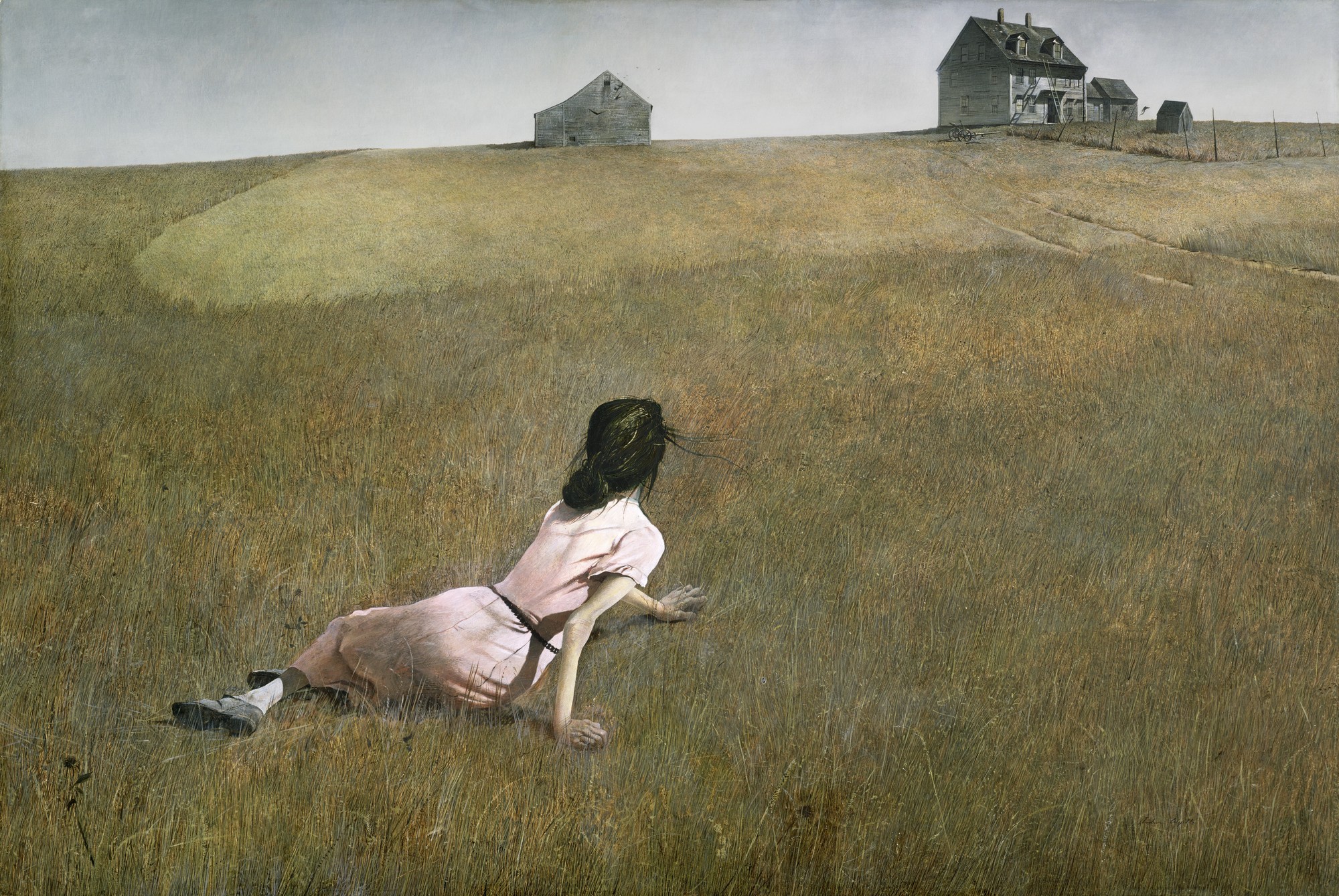
“Christina’s World” by Andrew Wythe. A painting referenced at dinner.
After dinner there’s another serious “what the fuck is happening” moment. Looking at Jake’s childhood photos, she recognizes herself. The camera cuts away, then cuts back to the photo, which has reverted back to Jake’s face. The four of them sit and chat in the living room. The young woman gets up to answer a call and upon hanging up, turns around to find the room empty. Like a switch, things turn fully surreal. Beginning to explore the house on her own, she ventures into Jake’s childhood room. It’s filled with books and movies, collections of various cultural ephemera. She picks up a poetry book and begins reading the page: “Coming home is terrible whether the dogs lick your face or not…..”. Haven’t we heard this before?
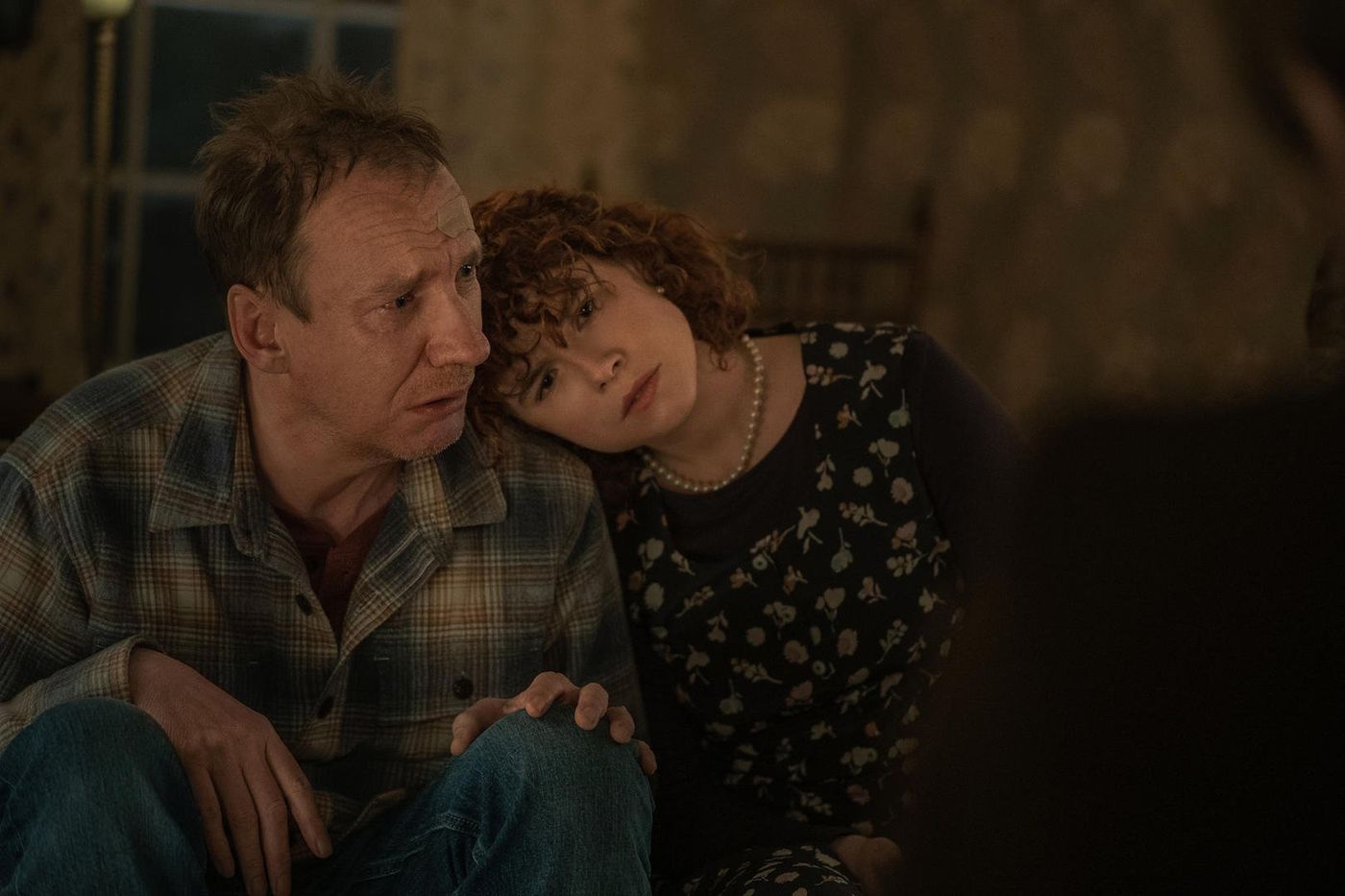
She continues exploring the house. We get glimpses of the parents flipping between old age and youth. Jake’s dad, fragile and riddled with dementia in the childhood room, is spry and limber soon after. Our female lead finds Jake talking to his elderly mother in a rocking chair, only to then go downstairs to see her young and full of enthusiasm. She tells Buckley’s character to go to the basement and “live dangerously”. For the audience and the young woman, the basement door has been briefly shown taped up and covered in scratches. Jake explicitly states never to go down there, but what could he be hiding? Eventually she goes, finding janitors coveralls (more on that later) in the washing machine and a room full of paintings, HER paintings. Only they’re captioned and titled with the names of other people, including Jake. She comes back upstairs and looks into the living room. Jake is holding his elderly mother’s hand as she lays motionless on her deathbed. During this whole stay, Buckley’s urged Jake that she wants to go, that she HAS to go. This time, Jake finally agrees.
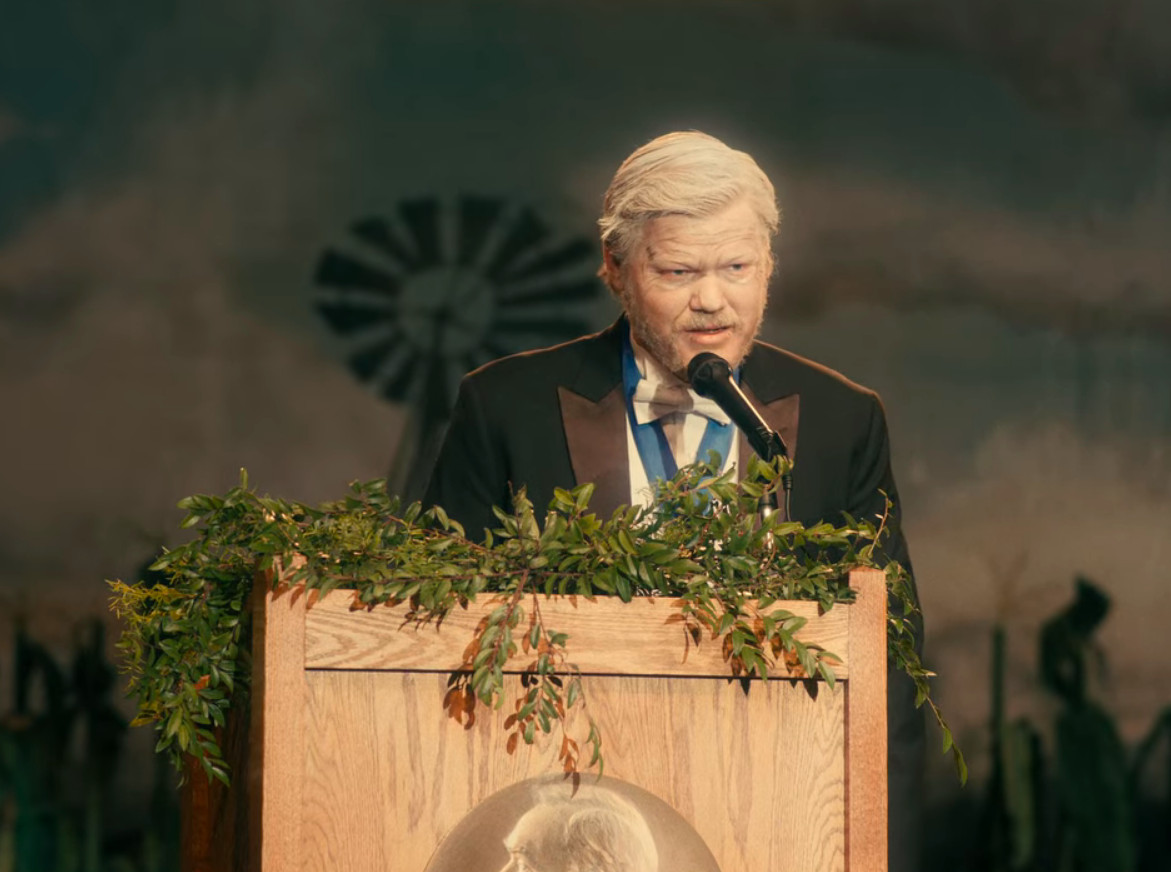
They depart. The car ride back is similar to the one prior, only the young woman seems to be more engaged and in control of the conversation. At one point she imitates Pauline Kael’s review of A Woman Under the Influence, cooly lighting a cigarette. There’s an off-putting visit to “Tulsey Town” — a Dairy Queen knock off which Kaufman admits is in the film because he couldn’t get the rights to use Dairy Queen. In the final act, the couple arrives at Jake’s old high school. Jake disappears and the young woman, Lucy/ Louisa/ Lucia/ Yvonne/ Ames, runs into the school janitor, the same one that we’ve briefly seen throughout the film. They share a warm embrace before the movie turns into a musical, culminating in an acceptance speech by Jake that’s oddly similar to the speech scene in A Beautiful Mind.
Here I’d like to say that this movie is incredibly frustrating to watch. It’s equally as hard to write about because I can’t mention clearly vital details without ruining the efficacy of the movie as a whole. If you’ve kept up with me this far, I suggest you actually just go and watch the movie now, then return to this when you’ve finished it and continue reading. If you’re so inclined.
I’ve seen this movie twice now and it’s far more straightforward the second time around, once you understand what’s really happening. I don’t believe great movies should require a second viewing in order to be great but this effort by Charlie Kaufman is the first I’ve seen in a while that really calls for it. Maybe this sort of pretentious mind-fuckery isn’t your thing and you absolutely hated it, which is fine, but you have to acknowledge the audacity of Kaufman to keep pushing the boundaries of his storytelling. On one hand, I think many will see this film as Kaufman masturbating to his own genius, presenting overly ambiguous ideas without explanation and calling it art. On the other hand, the book version of I’m Thinking of Ending Things tells the story in a similar way and he’s merely adapting it.
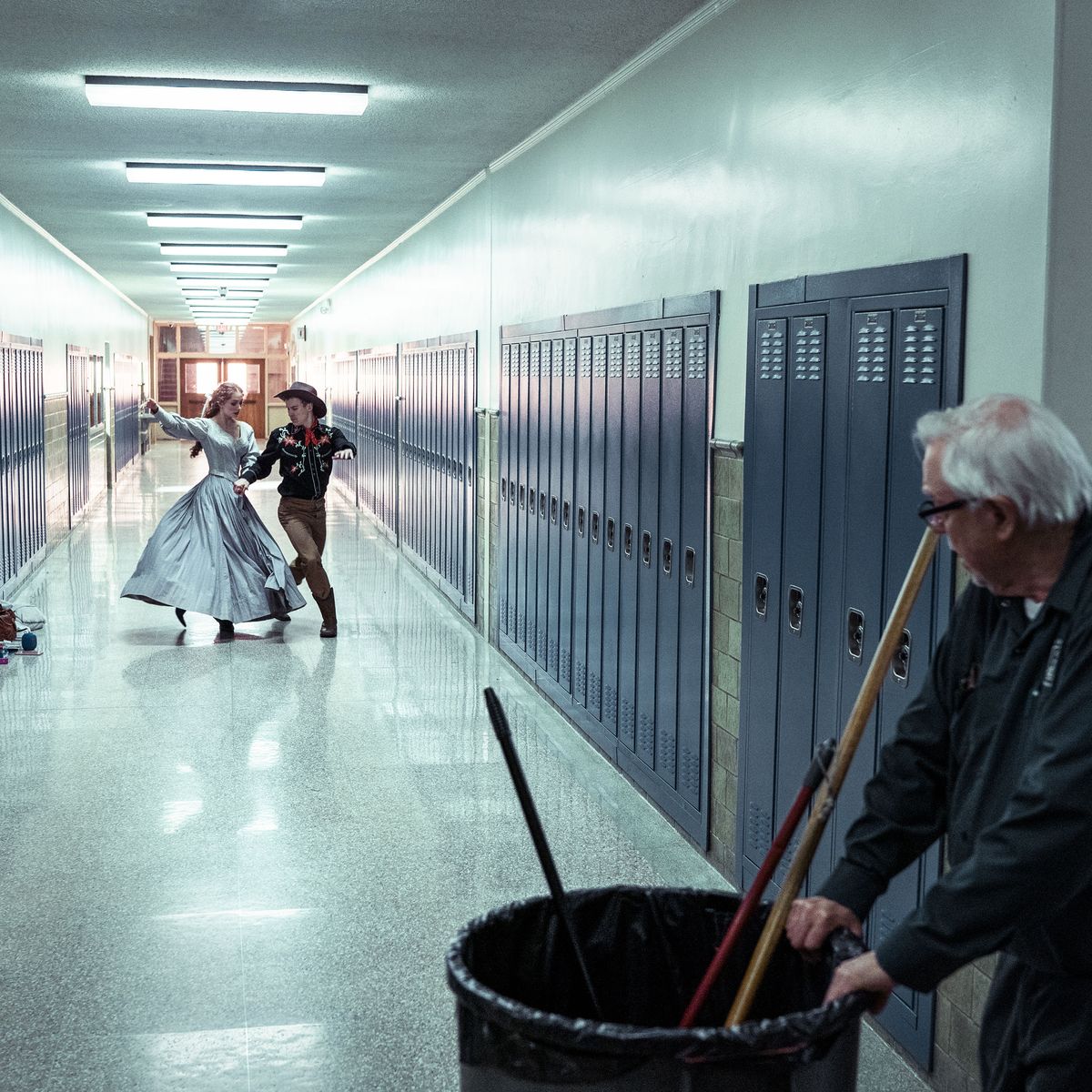
In both film and book form, the story presents everything in front of us as clear as day. It’s a story with a twist, except the whole story is a twist. We just don’t know it unless we start to really think about it. I’m Thinking of Ending Things reflects the interiority of the mind, similar to how Jake’s parents’ farmhouse is a literal manifestation of his own mind, filled with all the media he’s ever consumed and all the secrets he’s ever kept. The young woman is just a fantasy of the idealized woman he’s invented in his head. “I’m Thinking About Ending Things” isn’t just a reference to a break up, it’s the thought of a severely socially anxious, lonely, elderly janitor contemplating suicide. Now when you think of the girl hating Jake, it’s really Jake hating himself. Have you ever seen a stranger and fantasized what your whole life would be like with them? This movie plays out that fantasy, but shows the flaws of its existence. You can’t think through all the ideals of that fantasy but leave out the negatives. The young woman can’t exist in his farmhouse of memories because she doesn’t fit there. She never happened.
Something Kaufman falls victim to a lot is making films with male main characters suffering from fragile egos. He usually introduces a manic pixie dream girl to save the character from himself. Buckley’s performance in I’m Thinking of Ending Things highlights the falsehoods of such a trope. Her character has agency and even though she doesn’t technically exist, she lives entirely independent of Jake. With this film, Kaufman isn’t afraid to be critical of himself.

Like pretty much everything else I’ve said, I’m finding it hard to close this whole thing out. This movie left my brain all mushy. So mushy, I don’t know what’s real anymore. Did I ever?
Additional, helpful reads: