
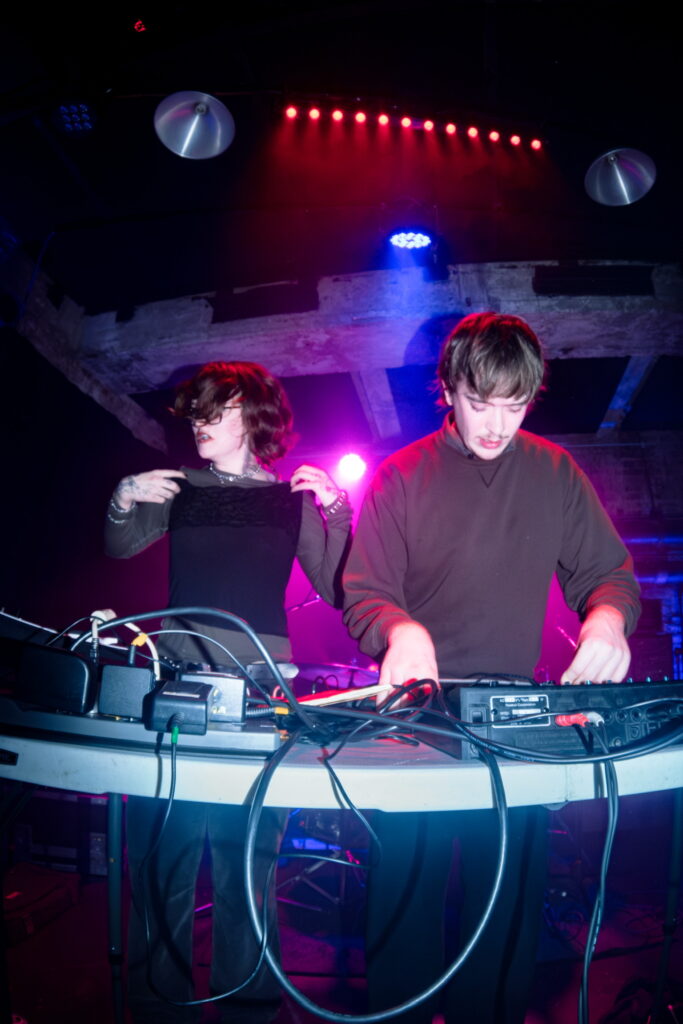
Photos by Elijah Wells, @wells_elijah.mp3
There are many lists in Mollie’s Notes app; one of them being “ideas for conversations.” When the party lulls, when you don’t know what to say to the stranger next to you, sometimes, you need a little guidance. The list also became the impetus for analog electronic music duo, ideas for conversations’, name.
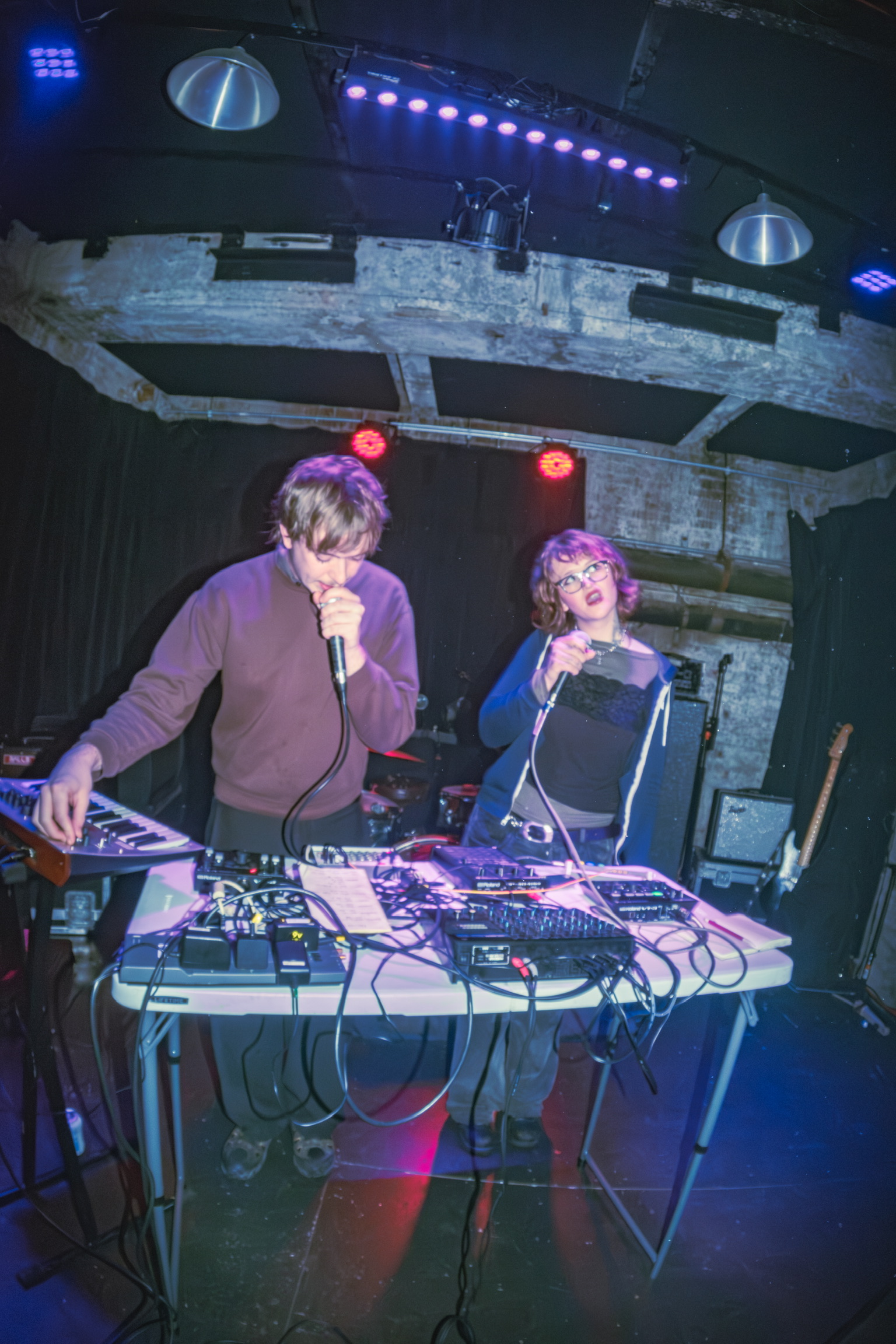
In a world dominated by DAWs and VSTs, Mollie Gilbertson and Emerson Fossett’s take on electronic music is refreshing. Using a sea of synthesizers and arpeggiators, everything the two create is analog-generated. ideas for conversations’ first EP No Bad Words is a testament to what hardware can do and how fun it can be. If there is anything you need to know about the duo, it is that they will get you to dance.
Can you introduce yourselves?
Mollie: Hi, I’m Mollie
Emerson: Hi, I’m Emerson. We’re in a band called ideas for conversations.
Mollie: Together.
How did you guys meet?
Mollie: We met at a sandwich store slash fancy deli that has groceries that are too expensive where we were both sandwich makers.
Emerson: We made sandwiches together for a long time, became friends through sandwiches, and then started making music together. Now, we work together at a different restaurant.
Mollie: I used to address Emerson as “best friend” at the sandwich place we used to work. He’d leave, and then I’d say, bye, best friend. I told him, you have to say it back. And now we’re best friends.
What got you into making analog dance music?
Emerson: Day one, probably the way the tools look. When I was a kid, I always thought that synthesizers and arpeggiators and sequencers and stuff with tons of knobs and wires looked cool. I sort of made it my life’s mission to learn about that and be as competent as I could be in how to play and mess around with them.
Mollie: Trying to enter a digital audio workstation can be overwhelming because there’s infinite VSTs that you can use. So, the parameters that are made by hardware instruments are helpful. You can’t download another hardware instrument onto your hardware instrument unless you really know what you’re doing. My mom bought me an OPZ when I was sixteen, which is still the instrument we use today, it’s the brains of the operation, everything goes through it.
Now that you make analog dance music and work more modularly, how do you feel about electronic music that’s purely digital?
Emerson: It’s sick. I think it’s awesome. I love everything. I love when people spend hours processing. I love when people do anything, as long as it sounds cool. Or even if doesn’t, that’s fine too. I think it’s great when people love computers. But, we were talking about this two days ago, if you are making stuff with computers and technology, you have to understand that there is an inherent evil to it. You have to take that with you in everything you make. Even what we’re doing…it’s not an escape.
Mollie: Art is good though.
Emerson: That is true.
Art is good, technology is evil, how do you reconcile the two?
Mollie: Dance party.
Emerson: Conversational dance party.
You play a lot in the screamo and emo scenes, what is it like to gig in a scene where genre is so specific, but yours is more amorphous?
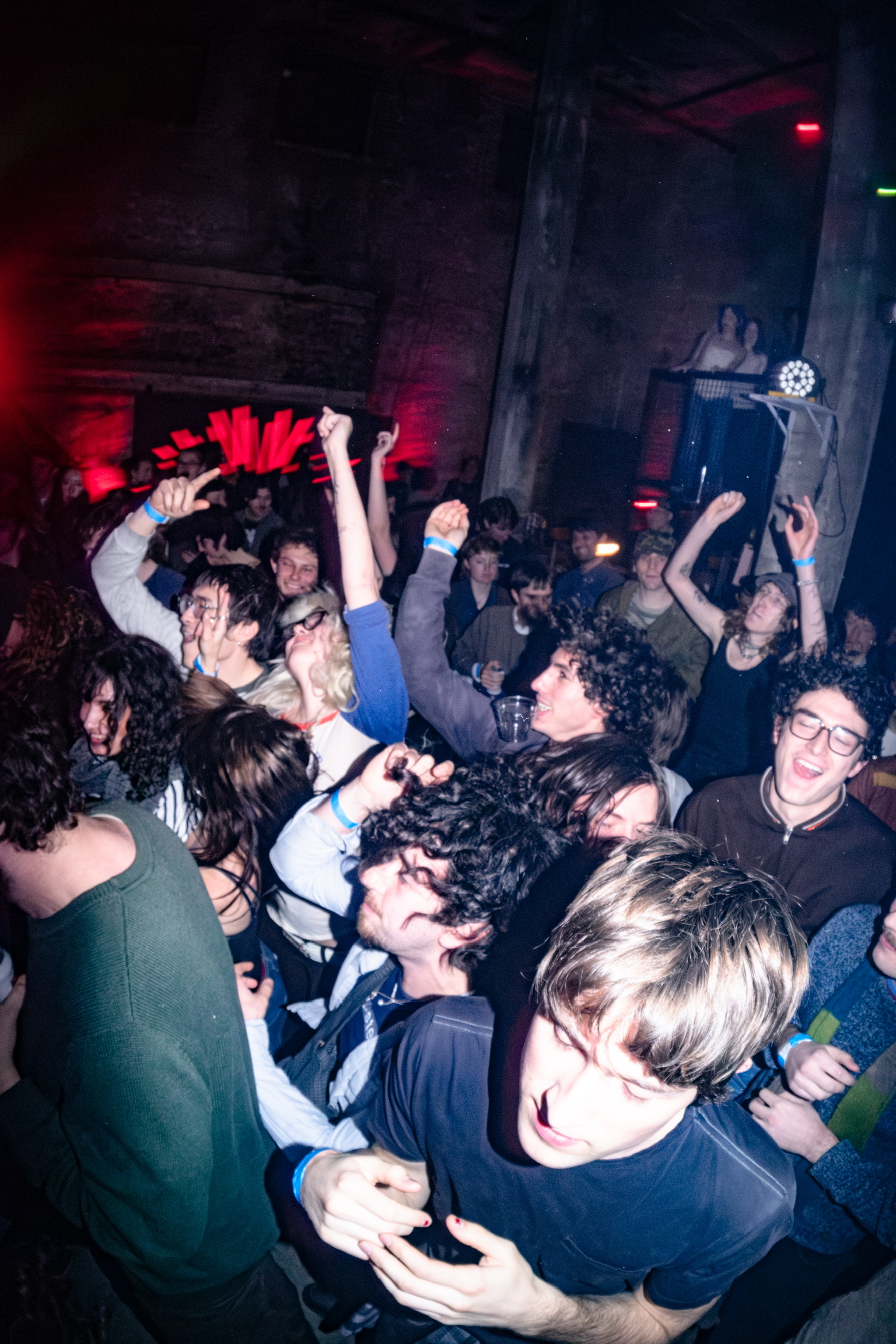
Mollie: I think we saved the scene because all the emo kids are so bummed out by the end of their shows. We have to keep the fanbase alive and dancing.
Emerson: We’re keeping them alive and dancing. Also, those bands have the most passionate fans in the world. So, if something’s good to them, they’ll recognize it immediately. That is a mathematical formula for an amazing show.
Obviously, your music is all about getting people to dance. How do you translate your music to respond to the crowd?
Mollie: I feel like we usually don’t look up from our instruments very much.
Emerson: It’s based off auditory cues. We both have a hard time making eye contact with the audience. When we play, there’s a weird force field between us and the audience. The thinner it gets, the longer I want to play that song. You know what I mean? If I can feel the energy getting in, then I’ll just be like, keep playing it, keep playing it, keep playing it, or Mollie will do the same thing. Every song we put out on the latest EP was a song made for performance, so it got edited and critiqued in that performance and that’s how the final product was made. Once the song was ready to be performed, then it was done.
Mollie: It was a little nerve-wracking knowing that all the songs we had made were going to be put through a DAW. I was more anxious about how it would sound processed versus how it sounds stripped down and translated into headphones.
Emerson: In the mixing process, I had to come to terms with the fact that it won’t feel the same as it does live, which is sort of odd for our genre of music because so much of it is translated from computer to live.
Mollie: In the initial stages of recording the album, we’re just playing a live set like we would. But then, with the limitless amount of options in recording, you can cut things apart and really zoom in, whereas if you’re playing live, it’s more flexible.
How integral is performance to your songwriting process?
Mollie: Me and Emerson come from two separate but symbiotic camps when it comes to songwriting. When I’m listening to music, I am a very lyrical listener. I feel like I’m looking for myself in the lyrics of other songs. I want them to sound like my inner monologue. But then, I’ll sit down to write a song and I’ll just be like, I’m so sad. Whereas Emerson has informed my songwriting process to think about bridging that confession to be more external and look at other things.
Emerson: Yeah. I hate explicitness in songwriting. That is to mean, when people say a literal sentence and they’re not explaining it.
Like M.J. Lenderman?
Emerson: Honestly, yes. We’re all on the same page. I think some songs of his songs are written very well, I just get bored easily.
Mollie: MJ Lenderman though, he’s the man. Our biggest inspiration.
From the shows I’ve been to, ideas for conversations is all about creating and building community. What role does community play in your music making ?
Emerson: Mollie brought me into this community of what you were referencing before, emo bands. These really talented, extremely tight- knit and specific group of musicians and friends and people that are so welcoming, but also particular about who they like to be around. Entering that world and meeting a ton of Mollie’s friends and seeing the way music was received, it completely redirected my entire understanding of community and the way music is experienced in community. I think it’s so important for there to be an alive thing around whatever shows are happening because it moves with it and grows it and it makes people feel the appreciation they actually need to feel to keep making stuff. I think that’s what’s most important about it. It’s a direct response.
Mollie: I agree and I haven’t thought about this until you’ve asked this question. So much of screamo is the moment of it being performed. People put it in their headphones, but they come to screamo shows to mosh and experience a lived, live, shared moment that the audience is just as much a part of as the musicians. Live performance and screamo are inseparable. I also think that community is integral to my existence and what makes me want to make art.
Listen to ideas for conversation’s EP No Bad Words