
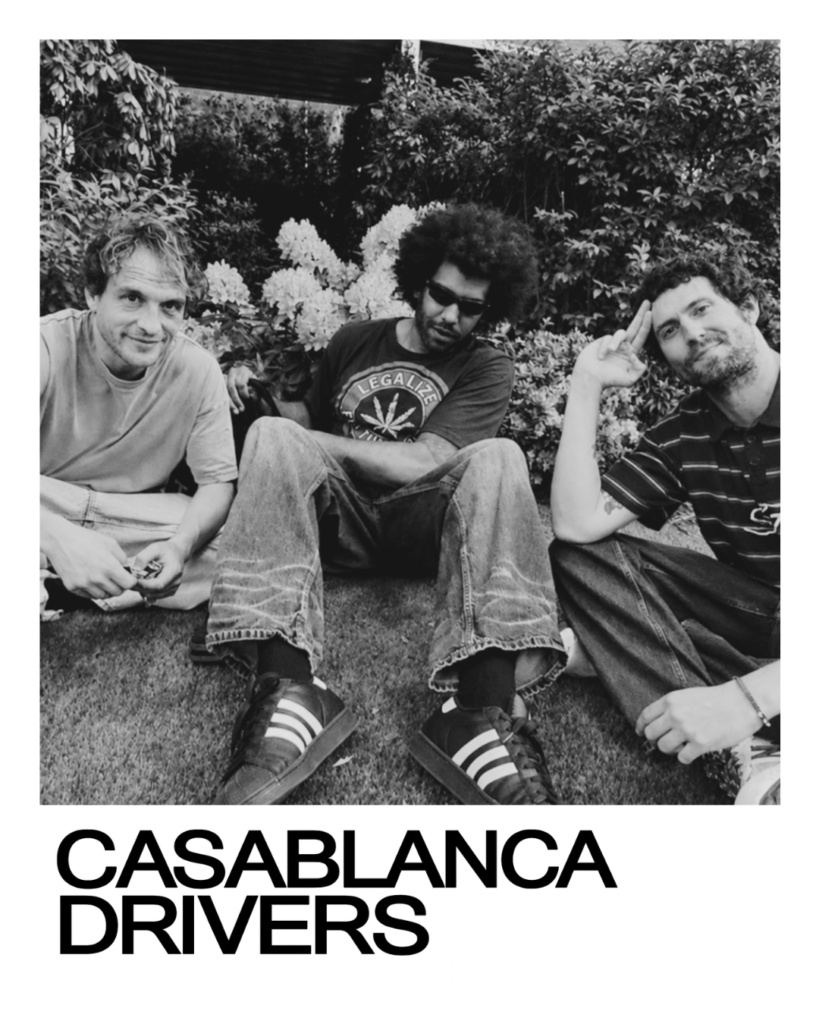
Despite the nicotine emergency, spirits are high. Casablanca Drivers are about to play their first official New York City show — a long-awaited landing for the Paris-based project, whose sound collides acid electronics, dirty guitars, loops, and rock vocals into something sweaty and cinematic.
“We’re promoting a new record. It’s called Protocol. It’s our best work to date.”
The band explains that this was the first time working with an electronic producer after previously collaborating mostly with rock producers.
“This guy nit is a French genius. He brought us to a new land. It’s electronic loops with guitars and dirty vocals — music we want to listen to until the end.”
The group ended up on the Club Chlorine lineup through a mutual connection with Orson, who they met at an afterparty in Paris at Motorbass Studio — legendary producer Philippe Zdar’s former studio space.
“Everybody was partying and drinking alcohol in the studio, but Orson was alone looking at the vinyls one by one.”
That shared obsession with music sparked an immediate friendship.
“We stayed there for an hour and a half talking about records.”
When asked about the current wave of genre-blurring music coming out of Paris, the band sees it as part of a larger shift happening everywhere.
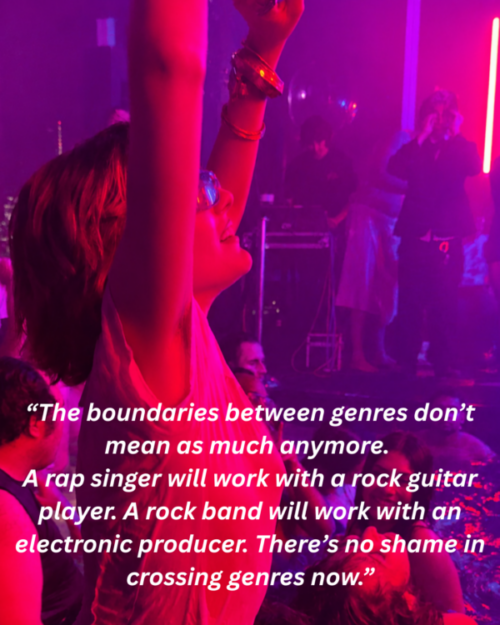
“The boundaries between genres don’t mean as much anymore. A rap singer will work with a rock guitar player. A rock band will work with an electronic producer. There’s no shame in crossing genres now.”
After New York, the band heads back to Paris before beginning a run of European dates across Italy and London.
“A lot of cool things are coming. We don’t seem very happy, but we are very happy.”
The conversation drifts from cigarettes to Corsica to punk history to pool parties in the span of twenty minutes. Casablanca Drivers speak the way their music sounds — loose, chaotic, funny, deeply romantic, and constantly changing directions.
At the center of it all is friendship.
Nowadays the band operates primarily as a three-piece, a shift they describe as natural rather than dramatic.
“We started the band as friends. We were in Corsica together.”
Growing up on the island meant isolation — both literal and cultural.
“It’s a small island. There’s nothing to do there. Literally nothing to do.”
Without much of a local scene or easy internet access at the time, discovering music became an act of obsession and imagination.
“We didn’t have the internet like today. Nobody could put good records in your hands. You had to experience stuff on your own.”
They describe feeling alienated in their own hometowns — kids obsessed with rock music in places where few people understood what they were trying to do.
“You always feel like an alien in your own city.”
As members slowly left the project to pursue studies, jobs, or simply different lives, the remaining trio became even more committed to pushing the band forward.
“The choice was natural. We were touring every day. Some people said, ‘Guys, go without me. I can’t take it anymore.’”
At the same time, the music itself evolved. The band wanted to move away from what they jokingly describe as the “indie rock boy band” wave that dominated everywhere at the time.
“There were boy bands everywhere — at the bakery, at the supermarket, everywhere.”
Instead, they leaned into experimentation: electronics, loops, noise, guitars, and genre collisions.
“The boundaries changed.”
Despite Corsica’s isolation, Casablanca Drivers insist there was still a strong underground energy bubbling beneath the surface — punks, outsiders, strange nightlife figures, and chaotic local legends.
The mood never fully settles. That’s part of the charm. The band exists somewhere between intellectual art-school experimentation and drunken rooftop philosophy.
Somewhere in the background, someone is still trying to light a cigarette.
“It was more than a show.”
The band is sitting somewhere between exhaustion and exhilaration before their New York set. What was supposed to be a quick one-off performance slowly has become something deeper: several days embedded in the city, meeting musicians, DJs, organizers, and artists moving through the same cultural ecosystem.
“We thought we were just coming to the United States for one show. Then we realized it was more than a show.”
Our low-key conversation quickly turns into a discussion about genre collapse, generational shifts, internet culture, and the survival of local music communities.
The most exciting thing about younger audiences is their refusal to stay inside categories.
“Gen Z doesn’t stand for one thing. They’re a rainbow of everything repackaged into something new.”
The band agrees.
“The boundaries don’t mean as much anymore.”
They talk about audiences changing city by city — how younger crowds in Paris engage with music differently than American audiences, how scenes evolve, and how internet culture has fragmented cultural discovery.
We discuss Patti Smith, artistic lineage, and the responsibility of introducing younger people to older cultural references they may have never encountered before.
“That’s why I’m committed to Alt Citizen,” I explain. “To show people what they don’t even know they already like.”
The discussion eventually lands on something every independent musician understands intimately: the impossible economics of live music.
People will spend hundreds on arena nostalgia tours, they say, but hesitate to buy tickets to carefully curated local shows featuring emerging artists.
“It’s hard to sell a fifteen-dollar ticket now.”
The frustration is palpable. Independent scenes survive almost entirely on belief — belief in discovery, in showing up, in supporting artists before they become institutions.
“You have to build markets everywhere. You have to go to those places and build them.”
Still, despite the exhaustion, despite the uncertainty, despite the endless touring, the band remains deeply optimistic about contemporary music culture.
“When we discover music we love, we message the band directly. It means a lot.”
The final mood of the conversation feels less like an interview and more like a manifesto for cultural participation itself: show up, support your local scenes, care about artists while they are still becoming.
“Take care of your local talent,” I say.
“Amen,” they answer.
Catch Casablanca Drivers in Paris June 2 for their homecoming show. Then head to Gigi’s Paradisco for their unofficial after party with us. Details here.