Interview by Jacob Seferian. Follow him on Instagram and Twitter.
It’s hard to identify the quality that will make an artist successful. However, a general indicator is hearing their potential, instead of just imagining it. Warren Wolfe is a rarity that when you listen to his brooding pop/synth/R&B confections, you hear the artist he is rather than the artist he could become.
Born in a suburb of Reading, Pennsylvania, he began making music in 2014 while attending New York University. Wolfe’s earliest released work is mostly electronic compositions, but when he adds his voice to the mix something special happens. His layered and dreamy production juxtapose his fragile, and at times choked falsetto. An affectation that gives his vulnerable lyrics all the more weight. Past singles “Take the Fall” and “Make Me” come gift wrapped as finished products, equally compelling melodically as well as vocally. Virtuosity is one thing, but wrangling every component of your music and making such complexity seem natural? Well, it’s what made artists like Björk and Kanye West (who Wolfe admires) who they are today. “I can lie / but I rather tell the truth” Warren Wolfe sings on “Make Me.” Maybe one day he’ll join their ranks.
Warren Wolfe identifies as queer, and on his latest release, “Stranger” he explores the dynamics of Grindr and casual sex.
Can you talk about your latest single “Stranger”?
I started writing that track a year ago actually. That summer was a really pivotal time for me. I had only come out and experimented with queer relationships the year before—so that summer I was kind of getting into this whole circuit of dating and hook-up apps. It was just a very eye opening experience. There was also this kind of undercurrent that I was observing with the encounters that I had that was not always positive, and very removed and anonymous.
Was there a specific hook-up experience that inspired the track directly or was it a culmination?
Definitely a culmination. I was just so new to the experience in general that I put myself in situations that were really alien. I couldn’t imagine ever meeting up with this person that I never knew, and sharing something that’s really quite personal with them. And then maybe never speaking to them again—that was really surreal for me to experience firsthand.
Surreal is the word I always return to, and that’s why I wanted to write it from this pop perspective. When I was creating the track I wanted it to be pop leaning sound, otherwise it would be so dreadful to listen to. Because I’m very sensitive, and the way I wrote it was definitely supposed to be very melodramatic, almost lamenting. But I wanted to contrast it with this pop production so people didn’t really understand—or maybe it could be more relatable to everyone.
So you do consciously pair raw, direct lyrics with electronic, synth, or, as you say, surreal production?
I love really direct lyrics, and love actually learning something from someone when I’m listening to their music. I thought it would be a cool contrast, kind of jarring and confusing, but also more entertaining than a piano ballad.
When did you start making music and did that pre-date the discovery of your queer leanings?
Basically, I started two and a half years ago but I was still at odds with my queerness when I started. So I would obscure that aspect of my life in my writing. Very ambiguously, kind of writing romantic songs… it’s hard for me to listen to my older music sometimes, because it’s clearly not as focused—you are having this internal struggle where you’re like, “what do I want to reveal and am I ready?”
How did you music change when you became more comfortable with your identity?
It’s become more freeing and easier to create what I love to express, because you’re not inhibited internally. Whether it’s lyrically or vocally, I’m not thinking, “Oh if I sing in this really high register, is that going to come off as really feminine?” That’s not something I’m uncomfortable with anymore. I actually really like blurring the lines of masculine and feminine with my production and my voice.
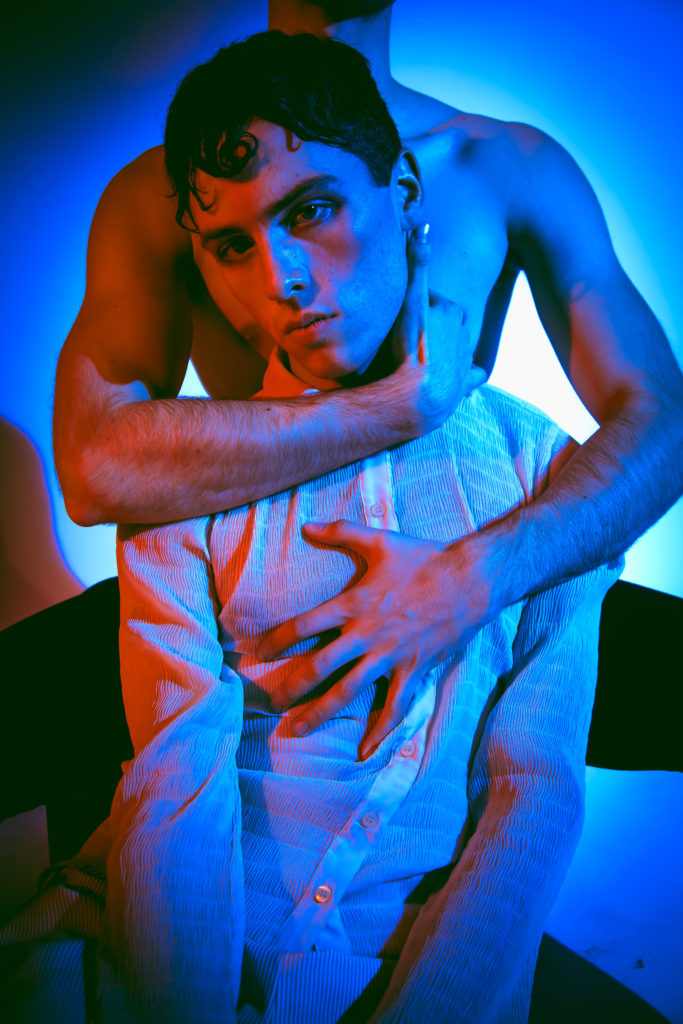
I’ve noticed on your Instagram and in your the OUT feature, you’ve been leaning towards presenting more femme. A lot people feel as though they need to present as stereotypically queer to be considered queer enough.
Yeah, I definitely was considering not trying to fall into this trope of commodifying queerness in general. The imagery, the music, the press—it’s definitely not something I want to do. I think everything that I’m doing is something that I truly feel comfortable with. A lot of times how I present myself in these features and when I put out a new song, is how I wish I was comfortable expressing myself on a daily basis. I think it’s helping me move towards expressing myself more authentically in the real world.
So your music is like a manifestation?
Yeah, I think it’s been really helpful for me to push myself, with just expressing myself, and being comfortable with things I originally suppressed.
As the national conversation shifts towards identity politics, do you feel an added pressure when expressing yourself, an added responsibility?
I don’t feel a responsibility, but I want to reach people, and if what I’m doing can potentially help anyone, or like just add a new perspective to something—I feel like right now we need as many voices as possible, as many stories from all backgrounds. If I can even be one singular perspective that clarifies or adds a counterpoint, I think that’s a good thing. It’s not necessarily a pressure though—I’m not like, “Oh I need to express myself this way or be visibly this or that because we need it.” I need to be myself.
Can you walk me through what that looks like when you write a song?
Most of the best stuff comes in a flurry, and I make 75% of it in a day or two. But it always starts with melody. I have a kind of backwards approach that I’m always trying to fix. I’m still very new as a songwriter, and it’s difficult. Sometimes I’ll start with words first and add melody to them, but the overwhelming majority of the time I hear a melody and I already know what chords I want to put with it. Then I sew it together.
Have you featured male pronouns in your songs?
Yeah, in a song called “Take the Fall” I briefly threw it in.
Do you think that would cancel out the universality?
I would like to think that people can look past that. And I think people do, at least our peers. We’re kind of past this binary of what relationships are. The takeaway is hopefully the emotion in the song and not the specificity of “he” and “she.”
If you could describe yourself somewhere down the road, further than now, how would you be satisfied with your work?
I want to push myself and not be tied down by certain genres. I see myself moving more into composing rather than songwriting. I just love compositions rather than songs. A milestone would be scoring a film or video game.
Listen to Warren Wolfe’s music on Spotify or SoundCloud, and you can follow him on Instagram here.