
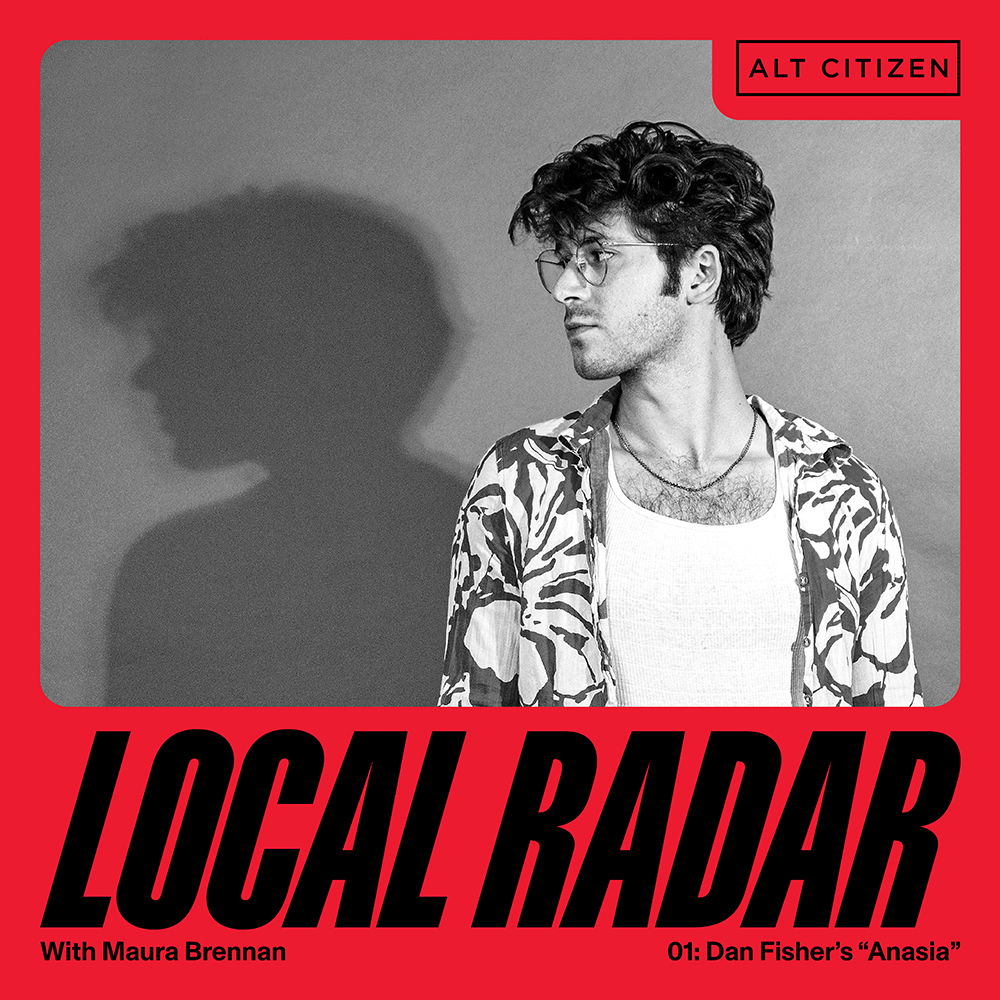
Local Radar with Maura Brennan features interviews with New York based musicians about their recently released singles as well as their interests and skillsets in hopes of furthering music discovery and connecting New York’s music community. This Local Radar is a discussion about “Anasia” with Dan Fisher at S1 Studios in Williamsburg. Dan is a singer-songwriter and producer based in Williamsburg, Brooklyn.
Maura: When and how did the song come to mind?
Dan: The name “Anasia” actually came in a dream.
Maura: Are you playing on the words “I wanna see ya?”
Dan: Yes, I woke up in the middle of the night and wrote half-asleep-nonsense lyrics, which did make it into the final song: “Anasia. I wanna see ya. But they won’t give me the right.”
So yeah, it definitely started with more nonsensical lyrics coming from a dream state. I think sometimes the meaning of a song happens after the song is done. The song can tell you what it means, as opposed to you, the artist, trying to inject (meaning) into the song. I think it’s a really nice process of discovery because it’s still coming from inside yourself, but from the more subconscious parts of your brain.
Maura: That’s cool. I enjoy when anyone does anything that’s just a little bit more up to the user/viewer/listener’s interpretation when it comes to art. It’s clever. I like it.
Dan: I just wanted to make a funny song. I was reading about the structure of Grecian tragedies (at the time). I was rereading The Tale of Orpheus and was fascinated by the structure that every single tragedy follows. So along that line of thinking, I thought “What if Anasia is an oracle? And the protagonist in this story, in the song, who is a regular Joe/Josephine, isn’t even important enough in the story to get an audience with this oracle?”
That became the point of the song: It’s this character, whoever you want it to be, stuck outside the gates of this temple and doing some ceremonial peacocking to try to get an audience who is this “Anasia” character, this oracle. He/she is trying to find some kind of meeting in their life but ultimately never gets it. I don’t know if that’s a metaphor… maybe it’s a metaphor.
Maura: [laughs] It’s seeking attention?
Dan: Well, it’s, you know, just like, I really want to see you. “I’ve been out here all night. I’ll do anything for you. I’ll cook your meat. I’ll rub your feet.”
It’s kind of a pathetic character. But it’s funny.
Pathetic is also pathos. It’s a feel for the character. It’s not about me. It’s about this fictional character.
Maura: I’ve been there… Wanting and willing to prove yourself for someone else…
SZA, for GQ I think, spoke about how the bar is really low for new music because people aren’t yearning enough. And I’m sure that’s probably in relation to technology having to provide quick, immediate satisfaction. Think about it in terms of AI: People aren’t even waiting for the right thing. People are finding romance with AI (to meet their immediate, individual demands), which is absolutely wild to me. It’s really depressing. I was thinking about it this morning and just like, “oh, my God, people are losing the beauty of patience and the beauty of compromise.”
Dan: The beauty of waiting.
Maura: Everything! Or… how are people ever going to become better people without patience?
Dan: Waiting is doing nothing with a purpose. I think we should bring back yearning.
Maura: The human need for yearning is hot.
Dan: I’m yearning for yearning. I want that on a t-shirt.
Maura: I want it on a bumper sticker.
You brought up that the title and the meaning of the song came (to you) in a dream… Is that where the sound came from too? Did you wake up, compose the lyrics based upon that story or did the sound come first? What is your writing process typically? How did it occur for this song specifically?
Dan: I don’t have one specific way of writing a song. In this case, I woke up in the middle of the night, furiously scribbled some stuff down on my phone, went back to sleep, and saw it the next morning. Sometimes the music comes first. For “Anasia,” I leaned into the silliness of the lyrics, which informed me what kind of instrumentation should be behind it. I immediately looked to sillier LCD Soundsystem songs, a little bit of David Byrne – that kind of driving instrumentation ship with talking over it. Because I wanted to make the song kind of conversational.
Anyway, “Anasia” came from a dream, which not all songs do. [laughs] Not all songs do that at all.
I think the song is kind of like James Murphy meets Talking Heads… There’s definitely a little bit of influence from The Dare…
Maura: You are citing everything I thought of… I wrote down “Anasia is reminiscent of The Dare, LCD Soundsystem…” I also wrote down Cake.
Dan: Cake, I love Cake. I used to love Cake.
Maura: What did they do to you? How did they hurt you?
[both laugh]
Dan: Yeah, I loved “The Distance”. It’s hilarious. They were great, man. I used to really like them so perhaps there’s a little bit of influence somewhere deep down from Cake.
But yeah, definitely The Dare… Talking Heads-ish, but that might be a bit of a stretch… It’s kind of all mixed when it comes to the chorus, a combination of funk and 2010s alternative rock.
Another influence for “Anasia” specifically is early Soulwax. I love pretty much everything Soulwax does.
There’s a bit of Vulfmon’s “Disco Snails”.
Maura: Your song doesn’t sound too far away from the album Wide Awake Parquet Courts.
Dan: I love Parquet Courts. I used to have that (album) on repeat in college.
I think I listened to a lot more music in college… It’s a little weird: sometimes—I don’t know if other musicians feel this way but—when I am writing and bouncing back and forth between two dozen songs, or whatever it is that I’m working on, it’s tricky to go off and listen to other people’s music. It’s a good practice that I force myself to do to refresh the ear. Otherwise (if you don’t practice listening to a variety of music) you get stuck in that Alice and Wonderland Rabbit Hole.
Maura: As someone that works as a producer and is creating your own music, are there times where there is a day for no music because you simply can’t keep listening to something without analyzing the means of production? What do you do to find absolute silence?
Dan: Meditate. I am a BIG fan of white noise. I feel I always need something playing, you know.
Audiobooks are great. And podcasts. Sometimes I zone out and play some chess. That’s sort of how “I find silence,” but silence is never really silence, especially not in New York or Brooklyn. I’m pretty sure everybody feels that way.
I also like listening to ambient music. I just saw John Carroll Kirby in concert. It was an incredible, incredible show. So inspiring. At some point, after I’ve worked through all the [laughs] rock stuff , I would like to play around with more ambient instrumental tracks and see what that brings out in me.
As a producer, I get pretty obsessive with sonic textures. It’s like automotopia: the word sounds like its meaning. I’m very interested in how the sound sounds like a meaning, in a way. How it actually feels when it hits your eardrum. You could have a track with potential to be a great song with great structure, great lyrics, great bass, but (in my opinion) a production can make or break the emotional impacts that a song has on the listener.
Sometimes perfectionism is the enemy of progress, but I really enjoy the explanation aspect and coming up with new ways to record the guitar tone, like in that track (“Don’t Throw Rocks” by Westside Cowboy), in any track that lights my ears up.
So, yeah, there are perks and pitfalls to being a producer. I have more colors in my palette to play with, more that I technically understand (when creating for myself), but sometimes the most effective paintings are also the ones with the least colors. It’s walking a tightrope.
Maura: So your main gig is a producer. Who are you working with right now? What are some specific capabilities of your studios?
Dan: Yeah! This (where we are sitting) is S1 Studios. This is the “Rock Room,” also called “Parasol Studios”.
It’s a fully functional studio, a hybrid digital analog workflow. It is inspired by how studios in the 70s would record but with a more efficient modern workflow. We can do full bands at one time. We have a really, really nice drum kit (here). [Pointing through a glass window to the adjacent recording room] We get some incredible sounds in there.
I recently started working with Abbie Roper again, who I was their bassist on tour for a while. She’s very rock. We just started recording some new stuff. I helped Bec Lauder with a track on her most recent album. I’m working with Sid Simons. I am working with a really talented songwriter Aria.
I think the difference in this studio compared to other studios is definitely what I like to call “Ear over gear.” I’m a big proponent of experimenting with sounds. If you were to ask people I’ve worked with (about their experience working with me), they may say I make them do some pretty weird sh*t… Like standing up on a chair blindfolded to sing their vocal take. I’ve yet to tape somebody to the door, but I’m working towards it…
“Even though my stuff is definitely definitely different, I am very much inspired by my friends and the New York community: Richie Quake, Nikita obviously Sid (Simons), Telescreens, Torture… It’s just really nice to be in a community with so many talented and different people. And I’m looking forward to kind of throwing my difference in the ring.”
Going back to inspirations… It’s probably a symptom of this being my job, but I’m often more inspired by the people behind the records than I am by the records themselves. I love Shawn Everett. His sonic signature has been across so many records. I love Alabama Shakes. He worked with Brittany Howard as well. Everything he does is kind of unconventional.
Or (I love) Tchad Blake—he has a good sonic signature. He did the early Arctic Monkeys.
I’m just as inspired by the sonic signatures of producers as much as I am by the artists themselves.
Maura: I’m a big Brian Eno head.
Dan: Yeah, exactly. Even Kevin Parker, you know, he definitely has a sonic signature. He is both an artist and a producer. That’s something that I’m trying to do myself.
Maura: Very cool. Do you find almost more passion producing and assisting? Or is making your music something you want to put at the forefront?
Dan: No, making art, making music has always been where my heart lies.
And it is not about importance, it’s about how I could do that all day, every day, for the rest of my life and be very happy. Producing, using the stuff that I learned from making my own music, the struggles, the challenges that arise while making music—I love using those lessons learned to help other people so that they don’t have to go through those same challenges, you know?
It’s nice being a songwriter myself because I can relate to artists not just as a producer. I’m not just the guy behind the screen pressing record. I enjoy working with people in an artist-to-artist capacity, not just as a tech guy. We are after the same thing: getting to the heart. Music needs to go to the head, the heart and the hips. It’s helping people hit those three “H’s.”
Maura: You were saying something before about making sure “a song’s sound” hits the person in a way that evokes the emotion…
Dan: The person as a drum.
Maura: Right! I was sitting down and eating food a few hours ago and—it always happens with them—Grizzly Bear comes on and… I got f*cking chills.
Dan: It’s the thing that gives you goosebumps.
Maura: Another one that will never fail to not do it is “Gimme Shelter”… When Merry Clayton hits that one note… and you even hear Mick Jagger “woo” in the background… It’s like I can’t breathe for five seconds.
Dan: Exactly. I am not pretending that any of my work is recorded to perfection. That doesn’t exist. I would like it to be imperfect. I want it to be imperfect.
Maura: Well, perfection can’t exist within art, technically, because not all art is going to appeal to everyone. There needs to be room for experimentation. And even if someone thinks that’s not perfect, who gives a f*ck?
Dan: Yeah, perfection doesn’t mean it’s comfortable. Imperfection in music is actually something that perks you up in a way. For instance, a pop record could be called perfect, right? Where it’s mixed in a way that’s the industry standard, the gold standard. It makes the listener or the ears complacent. That is not what perfection is. “Perfect music” stands out. Within the most memorable stuff that I listen to, there’s always one or two elements which are almost purposefully imperfect.
Maura: Right. I enjoy music that is a little bit off-putting (to others). I can’t play LCD Soundsystem in the car because my mom thinks she’s going to have a seizure. (Sorry, mom.)
[Dan laughs.]
Or in the same way that Vundabar could be considered off-putting, but I think it’s as simple as math rock isn’t for everyone. I (personally) think Vundabar is brilliant.
Dan: Not everybody likes six, seven minute long songs. I love six minute long songs.
Maura: I want songs to be that long. If it’s that good, it should be that long. There’s a reason I’m obsessed with Stone Roses. There’s a reason I’m obsessed with Ride.
I think probably the easiest modern example of something being pretty uncomfortable, and yet, they’re probably the best young band right now is Geese… Cameron Winter sounds like someone shoved jumbo marshmallow down his throat and he’s trying to sing… But it’s, like, perfect.
Dan: [laughs] He sounds like that when he’s talking as well.
Maura: I know. It’s just his voice. He’s been choking on a marshmallow since he was eight years old.
Dan: It’s going to come out one of these days.
Maura: There’s an interview with Zane Lowe in which Cameron is saying his dad even said to him something like “This sounds really weird, and this song sounds really awkward… Like, are you sure?” And it’s, like, uh yeah, uh… this is it. Mind you, this conversation (between Zane and Cameron) is taking place when the record’s already out.
[Both laugh.]
Dan: My parents would tell me the exact same thing if I sent them my music. [Mockingly] “You know *clicks tongue* I really think the vocals should be louder…” And I’m like, thanks for that…
Geese is a pretty good example. I was also thinking of Broken Social Scene, talking about an imperfect sonic signature, but it’s very honest! We as people are not perfect. We have flaws and we have imbalances within us. And that all being represented in the music, in the mix, in the production, I think adds a layer—even if you don’t think about it or you don’t hear it—makes the body remember in a way that the brain can’t, you know?
Maura: This makes me think of how sick I am of hearing Jack Antonoff’s signature…
Dan: [laughs] Listen, listen! I’m not saying all signatures are good. In the same way that not all handwriting is good!
Maura: Right! And I’m not saying Jack Antonoff is not talented! All of those songs (Jack produced) are going to get nominated for Grammy’s, like always, which goes to show there’s no such thing as perfection in terms of art because I wouldn’t agree with these nominations, but that’s okay! I just don’t like that kind of music.
Dan: I’m very willing and very excited to find people that really don’t like my music.
Maura: That’s fun.
Dan: I want to have a reaction of whether it’s good or bad. The most depressing thing would be for people to have no reaction.
Maura: There’s no such thing as bad press. Just look at our president.
[Dan laughs.]
What other artistic mediums do you find inspiration from? Mention nothing sonic!
Dan: I have jumped around a lot throughout my life. I didn’t know what I wanted to do. I was a painter for quite a few years. I made some pretty big paintings which are now probably scattered around the commonwealth.
Maura: Landscapes? Portraits?
Dan: [laughs] Other. Abstracts. Freaky characters. I was inspired by Venetian Carnival masks and stuff like that. I did animation for quite a while.
So, I’ve sort of always said this: I think all mediums come from the same source. I’m not sure what that source is.
Maura: Ah, it’s like a tickle spot in your brain.
Dan: Yes, that or it could even be a bit more “woo woo”… I believe it is a bit more “woo woo”. It’s like downloading, you know, downloading something true from somewhere. Whether you express it in different mediums, whether it be a painting, a book, or a poem, it’s all coming from that same creative universal source. That’s what I believe.
The different mediums are expressing the same idea. You can write a song like a painter, using sounds as color. I like to think I approach my songs visually in a weird way: I can see how the structure and how different colored sounds fit together to create this thing.
Maura: As someone that only operates visually, I get it. Nothing occurs to me creatively beyond that.
Dan: I don’t do visual stuff that much anymore. I mean, I did draw the single cover for “Anasia.”
Maura: Oh, cool! I was wondering who made that.
Dan: Yeah, I did that, a little pen and paper thing. The cover was kind of inspired by the movie “The Point.” It features Ringo Starr and Harry Nielsen. It’s this old, trippy, very “Yellow Submarine”-esque… Ringo Star does the voice of the dad (in the film). I was watching that and was inspired by the art direction of it and I started drawing.
Maura: Very cool. What’s next for you?
Dan: Two more singles!
Maura: Nice. Thank you, Dan.
Check out Dan’s “Anasia”, his most recent single “Cricket King”, and all artists and songs discussed in this Local Radar interview on Spotify. Another single releases this coming Friday January 16th. You can find Dan on Instagram or catch him on stage playing bass with Sid Simons. Thanks for tuning into Local Radar.