
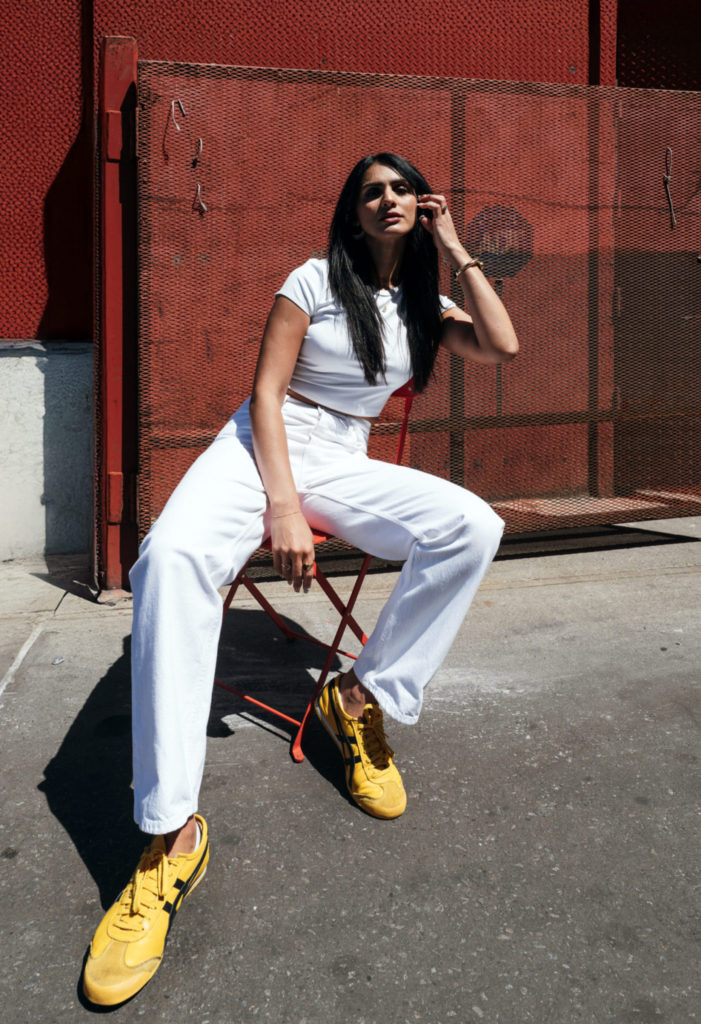
Words by Sophie Abeles. Photos by Jenna Murray.
Sitting at her desk in the marketing wing of Spotify’s New York office, a woman pores over profiles of emerging artists. She develops creative briefs, analyzes social media analytics, and captures performance data, brainstorming ways to boost emerging musicians’ online engagement so their music can be heard around the world.
There’s just one problem: this job is about making her dream come true – for someone else.
Naturally, she gets fed up. So, she takes a leap of faith. Well, more accurately, Spotify gives her the boot. Our unsung hero sees this obstacle of unemployment as an opportunity: she would leave the confines of her office desk for good and become a DJ.
Originally from Lahore, Pakistan, and raised on Long Island, ZEEMUFFIN – born Zainab Hasnain – grew up playing the viola and drums while attending concerts with her siblings, an upbringing that revealed both the collective joy of live music and the solitary satisfaction of creating art. ZEEMUFFIN divulges that the first band she fell in love with was Green Day. From an early age, she wanted to affect audiences like the 90s pop-punk phenom, but in her own way. ZEEMUFFIN continued to seek out the thrill of attending concerts, of losing herself in music. After scoring tickets to attend Ultra Music Festival, one of the biggest electronic music festivals in the world, she was hooked. She knew DJing was her calling– she just had to figure out how to get there.
It took ZEEMUFFIN some time to overcome the fear of veering from the straight and narrow, that is, the traditional career path her parents had always envisioned for her. In college, she rarely drank, partied even less – but one common denominator remained: her passion for music. After graduating from New York University, ZEEMUFFIN, who also goes by the nickname Z, still didn’t feel ready to change course. She scored roles at top tier financial firms, start-ups and established tech companies, but hopped from office to office, never feeling truly at home amongst her fellow nine-to-fivers. “I knew I was never going to fit in in that repetitive environment; I constantly wanted to be learning and growing, not climbing a corporate ladder,” she confesses. “And I get bored really easily.” Luckily, it turned out that home wasn’t all that far away. After work, Z began attending classes at DubSpot, a DJing and electronic production school in the Meatpacking District that helped her cultivate her craft. In addition to taking classes at DubSpot, ZEEMUFFIN spent late nights and weekends training in the field. She took gigs at sketchy nightclubs, weddings, and even frat parties – any event you can dream up, ZEEMUFFIN has likely DJ’ed there. No work was beneath her; every sweat-soaked basement or empty venue was an opportunity to learn how to cater to different musical tastes and audiences. “Multigenre DJs are becoming increasingly popular because people don’t want to listen to one genre the whole night anymore,” she says. “I’m grateful for those gigs because they really taught me how to play to any kind of audience.” At DubSpot and these after-hours gigs, ZEEMUFFIN’s corporate seams began to unravel and in their absence emerged the magnetic DJ we know today.

After years of spending days in the corporate glass castle and nights in dimly-lit dance parties, ZEEMUFFIN bet on herself. Z firmly planted her feet in the music industry, realizing that she could use the same skills she had used to promote other emerging artists to give herself and her music a platform. Since then, ZEEMUFFIN has played Coachella, sold out Elsewhere, contributed sets to Boiler Room and On the Radar, and toured with Palestinian-Chilean enchantress Elyanna. A champion for female DJs and artists, ZEEMUFFIN said in her recent “Women to the Front” episode with Serato, a company renowned for its DJ and production software who chose to spotlight her for Women’s History Month, that she hopes to show other women of color that nothing is impossible. That sometimes, taking a risk can actually bring you closer to yourself, your culture and your values. For ZEEMUFFIN, DJing has helped her connect deeply to her South Asian roots and tell stories of her heritage in new ways. She believes that a woman’s ability to understand others makes them uniquely qualified to be DJs. “At the end of the day, DJing is an act of empathy. It’s about understanding people.”
Follow ZEEMUFFIN’s journey on IG. Check out her curated Serato “Women to the Front” DJ Mix on Apple Music here.
