
In 2022, I moved away from New York after having lived in the city for five years. I kept in touch with my people in the Big Apple over social media, watching through Instagram Grid posts and Stories as the years passed by, my friends got older, and culture changed. One of the accounts I used to vicariously keep tabs on New York’s vibes was @codmart, the account of Cody Mar. His story posts were vignettes of his daily observances, digital ofrenda candles lit as a sort of mood board to the magic in the mundane of the city. I became a regular member of the @codmart Stories audience, and I watched over the course of 2023 and 2024 as the Stories became more entrenched in a distinct voice, more regular in their frequency, and more interactive with the audience of Instagram followers. It was a different kind of experience on social media than the traditional script, and I was drawn to the posts in a way that I couldn’t quite articulate at the time.
I moved back to the city this past winter in time to see that Cody had compiled the Instagram story project into a book titled No News Today with indie publisher Tiny Cutlery. I decided to go to the launch party, and I caught up with a few friends who were also mutuals with Cody on Instagram during the live experiment that was No News Today. During the event, members of the audience got up in front of the room and did show and tell. We watched and listened as strangers explained why they kept certain sentimental items before Cody went up and made his big book launch speech. After the formal event itinerary had ended, I asked Cody if I could interview him about the book. He agreed, and we made plans to sit down at a cafe under the M train and talk No News Today. Here is our conversation.
N: So I moved to Nashville, it would have been summer of 2023, and then I just got back. So a year after No News Today finished.
C: So you were sort of virtually connected the whole time even though you couldn’t be physically connected, that’s awesome.
N: You’ve used the word “Codyposting,” I think that’s the best way to describe what you were doing, is that you just started “Codyposting” on your Instagram. What does “Codyposting” mean to you?
C: I mean, I didn’t coin the term, people kind of put it on me when I started just doing the unfiltered voice. It’s definitely a genre. I’m definitely not the only person doing it, but I coined it after myself… People define themselves as “Create Mode Posters.” I started doing this partially because it was in the downfall of Twitter and my voice on there was very well defined. I joined [Twitter] in October 2012.
N: So you were early on Twitter.
C: Yeah, and I shouldn’t have been on there at the time. But since then I have a very Tweet-defined voice. I was on the alt-lit side of what they called “Weird Twitter” back then. It’s kind of cringe to look back on now, but it definitely gave me that voice. So in the downturn of [Twitter] moving to Instagram and trying to figure out how to bridge the gap I was like, “oh man, I’m losing my platform.” I was coming up with this thing, I really wanted to use [Instagram] for all that it had as far as the Create tools.
N: You used the term “Create Mode Posters,” like all this content is what the native tools on Instagram let you create?
C: Yeah, it’s like a very mundane voice. It’s pretty much like people Tweeting in real-time, you know? There’s a couple really good accounts I follow that have really good voices. Another person using Instagram as a medium really well right now is this graphic designer I like called Mira Joyce. She does these Create Mode emoji collages. Those are really cool. I didn’t set out to make art or even do anything a certain way, I just needed to do it and needed to challenge that sanitized voice that I had.
N: So you had a Twitter following, so to speak.
C: That’s kind of what it was. I didn’t have an audience in a sort of “fan” way. I was engaging with people, in a public comments way. And that view is limited in a Story way. Stories are not algorithmically boosted. Not really discoverable after 24 hours. It’s very ephemeral.
N: When you Tweet it’s like you post to a ledger in a public square. Instagram Stories it’s like, you’re either there for it or it’s gone.
C: Right. And I used to love going back [to Twitter] and being like “oh man, this banger from 2018 is so funny still.” It naturally archived. So it was funny to do all these [Codyposts] and be like throwing trash out the window on the highway. I have no time to look at it. Until we started working on the book I had never looked back at any of the Stories. By the end of it my publisher was like, “this is a body of work.”
N: So you’re calling [No News Today] “a book,” you said you have “a publisher.” But it’s not, like, a novel.
C: It’s like somewhere between an art book and visual poetry. I call it visual poetry at times, but I think that is almost too high-brow for the way it needs to hit you. If you were introduced to this like, “it’s a book of visual poetry,” you might not pick up on the everyday, mundane, absurd, shitposty elements. I’m not putting them in the book to be like, “look, shitposting is art,” it’s more like I think it’s this fun thing. [The book] is also a level of experiential art. I treat the book as the second party experience. The first party experience is, like, being there.
N: Having been there for the Stories, having been the active audience.
C: Yeah, [the book] is sort of the archive. I probably posted sixteen-hundred times that year but the book is like 460 pages after six months of editing and curating. This is the period from when I first stumbled into it until I took my first break. In this whole time, the 24-hour cycle never lapsed, there was always something up.
N: So this is a compilation of the first major period of Codyposting?
C: Yeah, exactly. First volume. Originally it stopped at one year but around that one year mark is when I started working on the book and looking back. That last three months I had some very inspired stuff and I was like, “we have to put this in there,” because I could reflect on what I had done previously and grow from it whereas before I was just tossing it out there. So [No News Today] ended up being 461 days and it’s 461 pages. I kind of stumbled into that the night before the launch.
N: It feels very serendipitous and very in the spirit of Codyposting. Just noticing things, the small minutia.
C: Yeah, the noticing. Part of the whole “encounter with the everyman,” which is what I’ve subtitled [the book], it’s very much playing with the voice of the mundane. I’m playing with a lot of archetypal voices. In the intro I identify three of the voices; a self help guru, a stoned philosophy undergrad, and then someone’s overly conspiratorial uncle. There’s a lot of different voices throughout. Some of [the posts] I would process multiple times to make it look like I screenshotted it or even made stuff in the TikTok editor to make it look like I encountered it when I was scrolling through TikTok.
N: You’re using “this is a TikTok post” as a voice?
C: Yeah, exactly. I wanted it to be like a certain type of person. All of the visual poetry elements play into that. You can get a lot more subtlety and nuance and style in that than just written language. I thought that was really fun.
N: I like that idea of the medium as the voice. If you think back to the internet 10 years ago, things you would see on Twitter had a different feel than things you would see from Reddit. Every platform had a voice and every medium had a voice.
C: It’s still sort of that way as far as you can boil down the user habits that have been set generationally.
N: Twitter is where people argue because Twitter used to be the platform where people could say anything, Instagram is where people make “artsy things” because it used to just be where you post pretty pictures. They all kind of have a legacy.
C: I think even the feature set and how things are presented to you pushes you that way. You’re also in the same way pushed to, like, “here is how people do things here so here is how I will speak here,” and that is what I was combating. I was feeling so much shame posting on Stories or even on Grid. I had a very “Aesthetic” Instagram grid all through like high school and some of college and then I stopped doing it because I was like, “I don’t want to do this anymore,” and [Codyposting] was the only thing I could do. It was a lot of disobedience. You know. Kill the cop in your mind kind of situation.
N: It feels like Instagram becomes your public persona. Like how your Instagram appears to a stranger is how your public persona is perceived.
C: Especially in art spaces. People are like, “what’s your Instagram?” This was really inspiring to me, I was leaving early from a birthday party and [some people there] were like, “shame you’re leaving so early, let’s exchange Instagrams!” And someone was like, “okay, I have to tell you before I do this that my entire Instagram is me taxadermizing rats.” I was like, “fuck, that’s so cool!”
N: That’s actually who you are and not just, “I need your social media business card.”
C: Right. And that version of you is also curated and skewed for an audience. I find that messiness really fun. That disobedience. A lot of people, their version of that is, “oh, I’m not on Instagram.”
N: It feels like there’s a subliminal style guide of Instagram. Like the style guide is you post your major milestones, your big updates…
C: We’re in a “curated monthly photo dump” world right now.
N: Photo dumps are huge. 2016 recaps. You participate in the big moments, the big events.
C: When you go to a wedding people are gonna be like, “where’s the wedding post?”
N: If you measure your life just by those big milestones that you’re supposed to on social media, you only see like, this is my vacation, this is my family gathering, this is my graduation. You’re not seeing the-
I point to page 148 in the book.
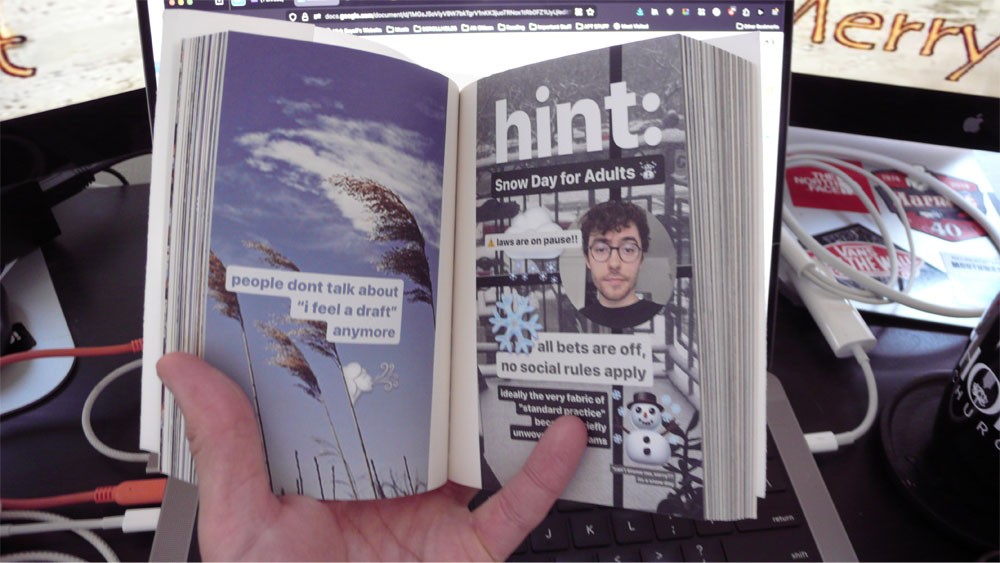
N: “Hey, I thought for a moment that people don’t talk about drafts anymore. What’s that about? Where did drafts go as a concept?”
C: You’re right. [Codyposts] are all the interstitial, the in-between parts. Some of them were put-on a bit. It might not be about what I was doing that day, but it’s what I was thinking that day. I have the sort of “tenets” at the start of the book which I made for myself as I realized that [Codyposting] was a daily practice. I do this thing where as soon as something becomes real I’m like, “how can I make this more intentional?” So this was all about letting the impulse fly and then not taking it down. Letting it live for 24 hours and being like, “that was today!” And if that sucked, I have tomorrow. That was enough to motivate me to think deeper there. But there’s several patches in here where I was phoning it in. I wasn’t being as soul-baring.
N: Meeting your quota.
C: Exactly. And like posting the “No News Today” pages was like, I didn’t want to phone it in, but there had to be something up. So it’s like, okay, everyone pause for a day. I was very often making these things and tweaking them for an hour on the train. I wanted it to hit a certain way. I was tweaking it so it looked more effortless. I had to put myself in a character. Like the text might clip off the side of the screen, and maybe if it’s a meme the resolution would be lower, or I put this emoji, and that’s borrowed a lot from meme content. But I spent a lot of time on [the Codyposts] for them to look like I didn’t spend a lot of time on them.
N: I like the distinction. The thoughts are unfiltered but the presentation feels very curated. It’s like the intersection of high-concept and low-brow. The lowest common denominator of creative platform available to everyone is Instagram Stories. Anyone can use it. How do we use it intentionally?
C: That’s the way to put it on like the larger art scheme of things. It’s sort of a found footage thing but I’m the one finding the footage. A lot of this is just me working with myself to not just create a new style guide. There are also times where I get too trapped with what I’m doing and feel stuck. So removing any obstacles in order to cut through. If I’m doing the same thing expected of me it loses the point.
N: It becomes predictable. The book is called “No News Today,” and one of the things I liked as I was experiencing the posts live was that it was like a daily dispatch. For me, not living in New York at the time, I was seeing the @codmart story say, “No News Today,” and it was like, “no news from the front.” And it’s like, “ that’s great!”
C: It’s a sigh of relief. People need a break too. Without those [Codyposting] would have fallen off. Especially at the early times, people were like, “yo, never stop doing this. I look forward to these every day.” And I don’t do them every single day right now. But it’s all about living in tune with myself and not living in tune with expectation.
N: No one’s dictating your output. Not to get philosophical, but it feels very Emerson, very Walden. Like “oh, the impulse of your own individual genius,” kinda thing.
C: Yeah. People were asking me about stuff I’ve read. I was thinking about any meditations on the mundane that I’ve loved. I was looking through my bookshelf and I remember reading One Way Street by Walter Benjamin and it’s just very observational. Taking that observation and spinning it into a larger thing about anthropology, or he can spin it so big that it becomes little and kind of absurd.
The interview is interrupted by a friendly dog.
N: Right now, in this moment we’re living in, you go on social media and look at the news and the news is not all that great. But we’re seeing this terrible stuff because it’s meaningful. It’s news…
I point to page 149.
N: But it’s also meaningful in another way to be like, “actually, here’s the news: it’s a snow day, the laws are on pause.”
C: That one I tried to take out of the book. My editor decided to keep that one in so I’m glad it resonated with you. But I’ve always just said that you can cancel any plan and be like, “oh, the weather!” But low-key the streets are clean, the subway is still running, everything is still open, but you have that social grace of a snow day. That’s also like why I love when it rains. My expectation falls apart. I can do anything. I can still go outside, but no one’s judging me if I stay in. It’s the societal expectation of a shared weather experience, you know?
N: I feel like you’re gesturing at the beauty of small talk. Having just moved back to the city, you talk to a lot more strangers here just out and about than back in Nashville, just ‘cause I’m out in the city more. And one of the things we all experience that unites us is the weather. Like today we just had a blizzard and all you hear is people talking about the weather, but they’re also like, “are you okay? Do you have power? Is your street plowed?” We talk about the weather, but also this mundane thing we all take for granted is also an opportunity to be like, “what’s your experience?”
C: There’s a story in the book when we had that solar eclipse and aurora borealis in the same month. I remember feeling so deeply connected to everyone because it’s like we all experienced that. For the goodness of all people we need a cosmic event each month.
N: It’s unifying. It felt that way for me right before I moved back when Zohran won and I saw all my friends in New York have this collective moment of celebration and I wasn’t there for that. But I was watching through Instagram Stories and I was kind of cheering it on. It was this bigger thing we were all witnessing.
C: It’s bigger than us. It’s shared. There’s all these different perspectives.
N: Like you can say a snow day is just snow and Zohran becoming mayor was this huge political victory, but a value in both those things is that we experienced them together. There’s some value to that shared collective thing.
C: Totally. And it’s felt more than you can articulate.
N: It’s certainly felt more than when you see someone’s vacation photos on Instagram. It’s like, that’s good for you, but Instagram is for us.
C: It’s a shared joy, at best. Like, “I’m so happy for them,” but it’s not a celebration of everyone. A celebration of life. A lot of [No News Today] is celebrating the silly. Like, I had one in here like, “did couscous fall off?”
N: No, I had couscous all the time as a kid and then I feel like I haven’t eaten couscous a lot.
C: The Ancient Grain marketplace was an arms race. They had quinoa pop off.
N: I feel like lentils are back.
C: Totally. Lentils is hot right now. [No News Today] is a celebration of life but it’s also a celebration of these past things that were once so monologic and were there that are no longer there. That’s an ongoing theme in the book. I had the idea of having a thematic index in the back of the book like, “for thoughts on friendship, page 1.” We ended up not doing it because it didn’t feel like the whole “news” thing. If I ever do a volume two, I would like to include that.
N: That feels very Bible, though. I grew up Christian and I have all these kitschy Christian mugs that are like, “Tired? These verses. Stressed? These verses.” Are you familiar with the Book of Psalms or the Book of Proverbs?
C: Yeah.
N: Like, they’re folk wisdom. They’re attributed to a lot of authors, but among them are like King David and King Solomon. You know, the guys. And it’s like, the guys were musing and they wrote this down so we could have their wisdom. And those books are cited a lot in indexes like, “if you’re stressed; this Psalm, this Proverb, if you wanna celebrate; this Proverb, this Psalm.” And [Psalms and Proverbs] was just, like, kings being at home between wars or whatever in their chambers by the fire with papyrus like, “God told me this today. God put this on my mind.” And some of it’s like, “fellas, happy wife happy life,” type shit. But others are like, “gray hair is a crown of splendors.” And some of the poetry you’ve included in No News Today is of a similar gesture. Like, you say at one point, “the body is like a fine garment.” And it felt very Psalms. Just musing on age. Like, it happens, it’s natural, it’s a good thing to have age.
Cody turns to page 445, a picture of The Serenity Prayer.
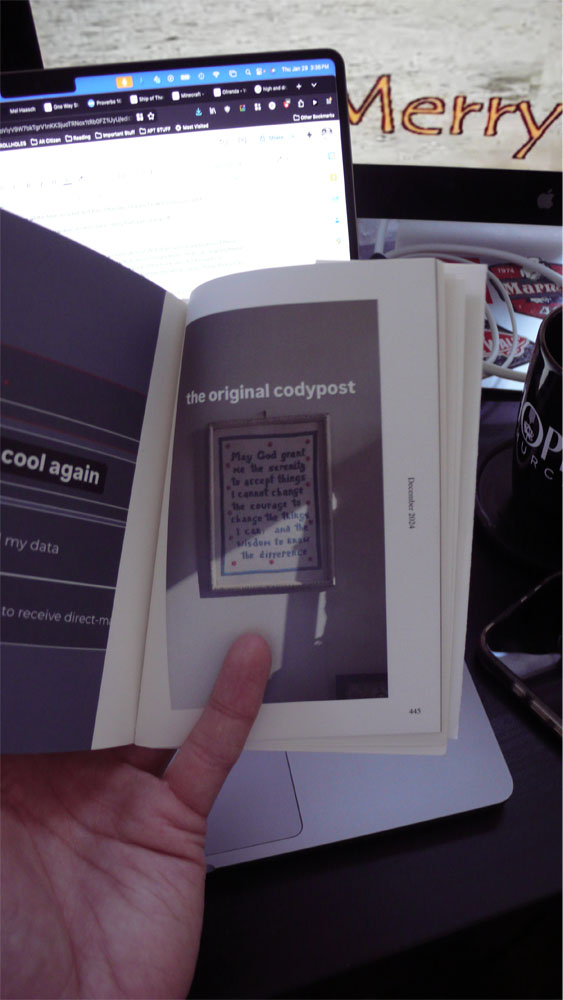
C: I have this one on my wall. It’s kind of written in my voice. Something that was really inspiring to me was the church on my corner that puts up these signs. I went in there one day to talk to the guy who does the signs because I’ve been loving them every week for years. He says it’s, like, redacted poetry from their readings. And he tells me that he likes to take the darkest, most poetic bits. And right now the one that’s up is like, “Knit Together.”
N: Just says, “Knit Together?”
C: Yeah.
N: And it’s not attributed to anyone? It’s not attributed to a verse?
C: No, it doesn’t have any of that. It’s like a sign board. Old school.
N: So there’s a church in Ridgewood that’s doing like, fridge magnet poetry collages?
C: Yeah, based on the readings. And Pastor Tom there was telling me that he’s been doing it himself this whole time. I started going. And he has chickens, and now when he leaves he puts me in charge of the chickens.
N: Oh, wow! You and Pastor Tom are tight now?
C: Yeah. I watch over his chickens. They’re named after Friends characters. All the living Friends characters. There is no Chandler chicken.
N: There’s not a Matthew Perry chicken?
C: No.
N: RIP.
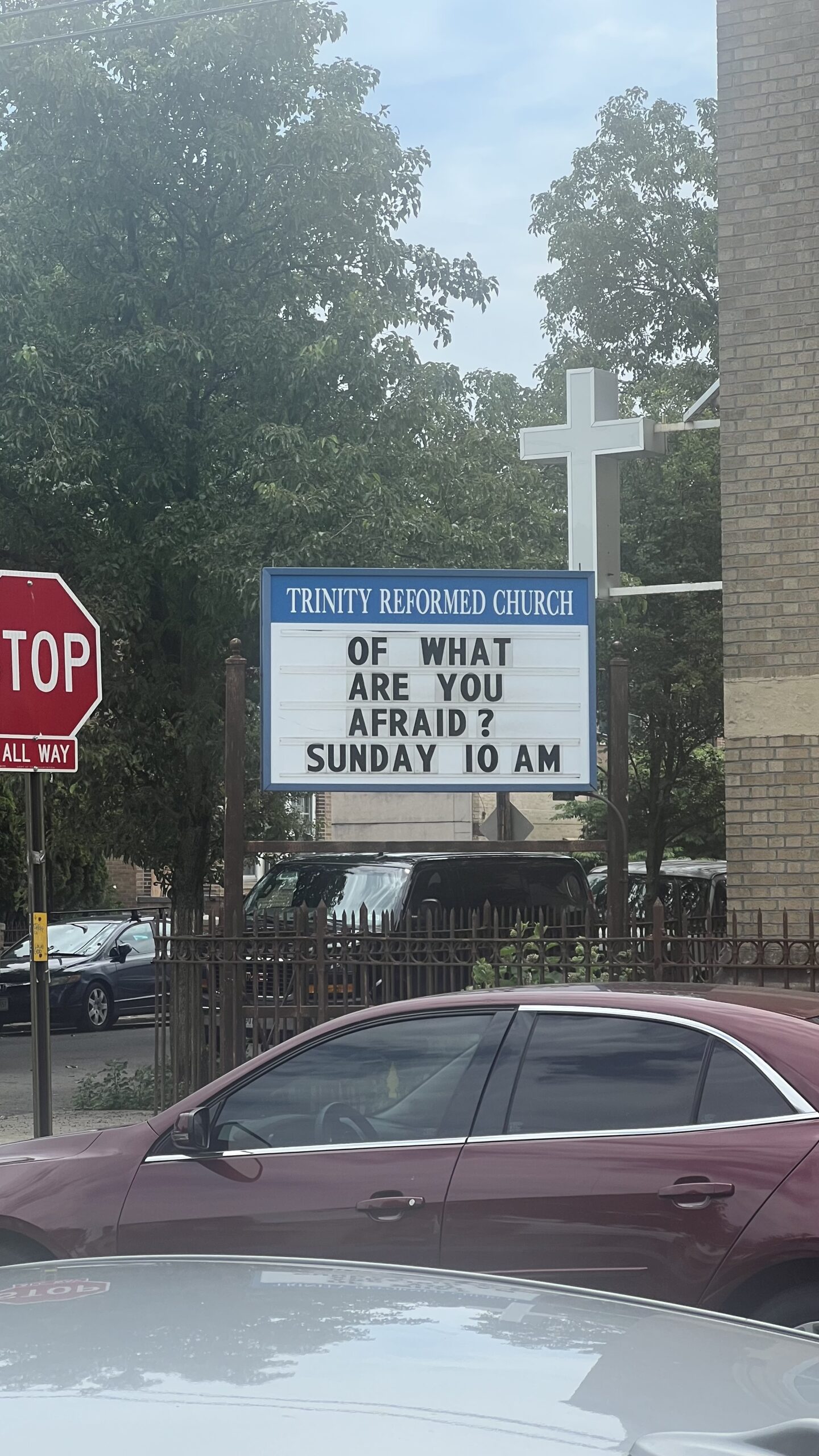
C: But it’s all because of the signs I loved so much. There is definitely voice influence in these Pslams-style stuff. It’s like channel-writing. My dad so many years ago wrote this book Pearls of Cemmptaa, and he says that he wrote the entire thing in channel-writing during deep meditation over the course of so many years. He would meditate until he said he would, like, transcend, and then he’d write what he’d found. It was like a daily thing. So when he read No News he was like, “this is kinda like Pearls of Cemmptaa vibes.”
N: And he calls it “channel-writing?”
C: Yeah, he calls it channel-writing. And my mom’s been a yoga teacher my whole life. So when you were talking about religion, I went to a lot of hippie churches growing up in the Pacific Northwest.
N: Like Unitarian? Quaker? Wicca?
C: No, like, Trans-denominational. It’d be like, one week from the Bhagavad Gita, one from the Quran, and they had white people playing soul music. So a lot of the “channel-writing” thing comes from when I was with them and I’d be writing songs, and I still feel the same way when I’m writing songs, just standing aside from impulse and letting it flow through me. And my framework of understanding that definitely comes from, like, my mom talking about being a channel.
N: So if you say you’re a channel, it implies that the Self is some kind of medium to something else that is being channeled through you. What would you attribute that other side of that to? Is it just your inner voice? Some external being?
C: It’s definitely something. I don’t know if it’s a higher power, but it’s definitely a higher something. I wouldn’t say I ever attribute it.
N: Is it worth attributing? Is there even an entity to attribute it to?
C: Not really. I wouldn’t. Yeah. Just like, greater consciousness, I guess? But that seems a bit heady for the way that I conceptualize it. I think it could be an internal feedback loop. Who knows? It’s like, where do ideas come from? I don’t know. Thinking about all the things that go into the style of this book, it’s really just an amalgamation of all the things that I’m consuming and everything that I’ve lived, and the exercise in itself was like trying to find a voice.
N: And it seems like you first felt that on Twitter?
C: Yeah.
N: What brought you off Twitter?
C: That was around the same timeline that it became X and my friends left the platform and it was no longer… I couldn’t reach anyone anymore.
N: And you were mostly interacting with friends or people you considered peers on Twitter?
C: A little bit of both. I was no longer seeing the kind of stuff I want to see. A lot of my friends are people I met on there, but they’ve sort of jumped ship. There’s some that got left behind probably. Fell through the cracks. I sort of shifted my main platform [to Instagram] because I was like, well, at least there’s people here.
N: It seems like your online audience is kind of a Ship of Theseus. Like, you had people on Twitter who you felt like you were talking to and now you switched to Instagram and it feels like you’re talking to different people, but maybe there’s enough carryover of the authority that Twitter granted you to speak because now you have the same ears on you with Instagram.
C: It’s never really about the ears as much as it is about… Reaching people.
Cody turns in the book to the credits section, where a list of his Instagram followers’ handles is listed.
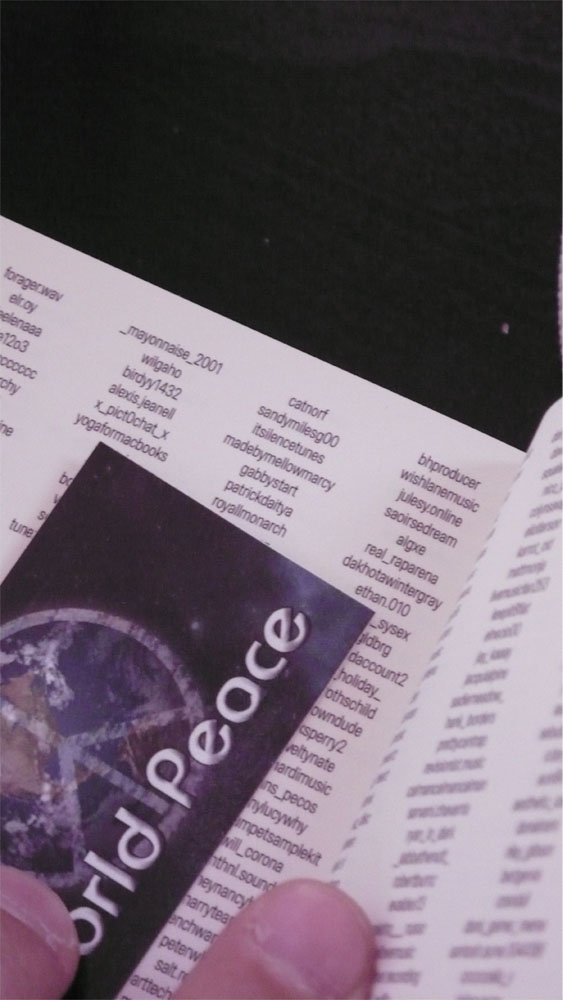
C: So this is in reverse chronological.
N: So the last person listed is the first person that followed you [on Instagram]?
C: Yes. And this was so surprising because the second person here is my brother, everyone else I know, that’s my cousin-
N: You don’t know your first follower?
C: No idea who this is. I went to the account and it’s clearly someone that’s been locked out of their account since 2013.
N: Some ghost along for the ride.
C: Yeah, some kid. I was a kid then, too, so it made sense. I don’t follow them back. I have no idea who it is. They definitely don’t know that they’re printed in a book. And before my own brother. But it is a real person.
N: It seems like a small thing to acknowledge, that people’s digital ephemera is littering your record of followers. But you’re memorializing them anyways.
C: Well, yeah, they were the first ones!
N: Your first listener. Your first dollar you ever made is a customer you don’t have anymore.
C: There’s a lot of people in here I don’t know. It’s reverse chronological, so when you see yourself you’re going to see all the people that we know together. You see the different pockets which is kind of fun.
N: As different people come and go from your followers list. I think of Minecraft servers when you see the, “this person logged on-”
C: Yeah, the feed.
N: The feed of how many friends are in your gang. This is the feed of who was in your party for No News Today.
C: Yeah.
N: So you said you no longer enjoyed the Twitter experience after X? Like, there were material changes to the platform that were made that made your experience as a user worse?
C: But, also, the feeling is beyond material. Like, you go there and it’s no longer warm, it’s no longer inviting.
N: The vibes are rancid.
C: Yeah, the vibes, intangible.
N: I’ve been thinking about the idea of hygge but in a digital space. If we’re on these feeds and we’re scrolling all the time and it’s making us feel bad, what do we put on there to make it feel good? Like, No News Today I would put in the category of, “I saw this on my screen, it made me feel warm and cozy,” and like, “Instagram can be safe again, I can scroll on Stories and everything I see isn’t a headline inducing panic at the state of things.”
C: There’s one at the start of the book that’s this picture of a traffic cone stuck in barbed wire-
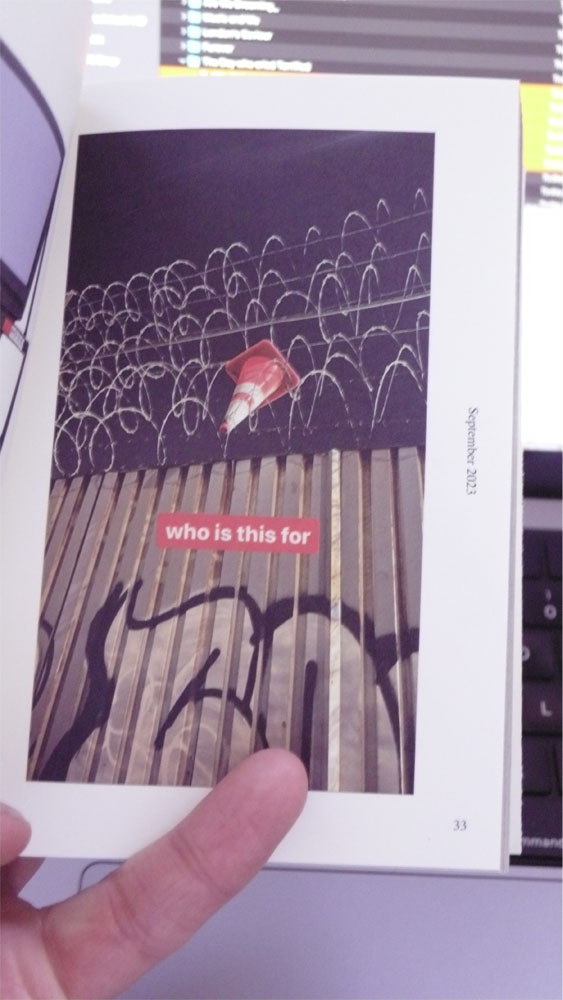
N: I love that one.
C: At the launch party someone that I did not know came up to me with their own picture of it. I was like, “no way! This is in Gowanus, right?” And they were like, “I took this picture, I didn’t know who to send it to, I thought it was hilarious.” There’s connections I don’t even mean to make [in Codyposting] that are inviting a lot of the hygge of it all. It’s about shedding all the layers that are in the way of closeness. To make it a more social media you have to take off those filters. I can’t bring you closer if I’m not opening my heart.
N: I like that, though. That the musings are a jumping off point for deeper connection. Like, “hey, I saw this cone.” And you post it to your story like, “y’all seeing this?” And then people can be like, “oh my gosh! I saw it too!” And it’s a little moment. But suddenly you’re all sharing it. And it’s like, “wow, there’s something here.”
C: Yeah. And the part that the book can’t capture, that nothing can capture, my favorite part about all of these is that they were conversation starters.
N: I like that you included the messages.
C: The messages were funny enough to repost after. I would post them and start, like, four different conversations. This all started because my phone was dry and I decided that it was easier to post to everyone instead of like, texting these things to twelve different people.
N: Or like, curating the close friends list. Like, oh God, what defines “Close Friend?”
C: And then, why? It’s like, if they’re my follower then you should understand this.
N: If you’re here for my vibe, you’re here for my vibe, period.
C: I’d start so many conversations about the same thing and they would all go different ways and I’d be like, this is what it’s all about. Talking to people. Being social.
N: At your launch you also hosted a show and tell. What was the motivation behind doing show and tell at your book launch?
C: So glad you asked this! For a while I was trying to figure out what type of performance would make sense before I go up there. At first I was going to read from the book but it’s a weird book to read aloud from. People are not going to be sitting around listening to me read a chapter. I want it to be fun, I want it to be light. I have a lot of musician friends, I’m a musician myself, but if there’s a performance then that’s going to be way cooler than whatever I go up and do after that. I was talking to everyone about this. Like everyone who would come into my life when I was ruminating on this in like December or November, like “what type of event should I do?” And my friend Maddie helped me realize that the event needed to be thematically connected to the themes of the book. So talking to all these people we figured out that we should engage people’s observational muscles in the same way that I had during the book.
We are interrupted by the dog again.
C: I gotta shout out Emily Conklin, who was the editor and who is the head of Tiny Cutlery, my publisher. It was her idea to make the book. I was just posting and she reached out to me and was like, “you gotta do this as a book.” Shout out Mel Haasch who did the cover and the editorial illustrations throughout. I did the newspaper print. But the inserts are all collages that Mel did.
N: It felt very newspaper. If people want to keep up with the news, where can they follow you? On your Instagram?
C: If they want to keep up with the news, that would be the plug.
N: While you were writing this, were you listening to music? While you were compiling it, were you listening to music? Or was there any point in the process where you were influenced by the music that you were listening to?
C: Because I was making [Codyposts] on the train, I was always listening to music. As a musician, music is very important to me. Like, one of the problems about being a musician is that I can’t listen to music while I’m making music. So when I do my graphic design stuff, the posts and things, being able to listen to music is so fun. But actually my cousin is a playlist curator so I had her make a No News Today playlist for the launch party. She has great taste. She posts stuff like “playlist for standing still.” She knows what I listen to so I sent her a bunch of stuff that I was into.
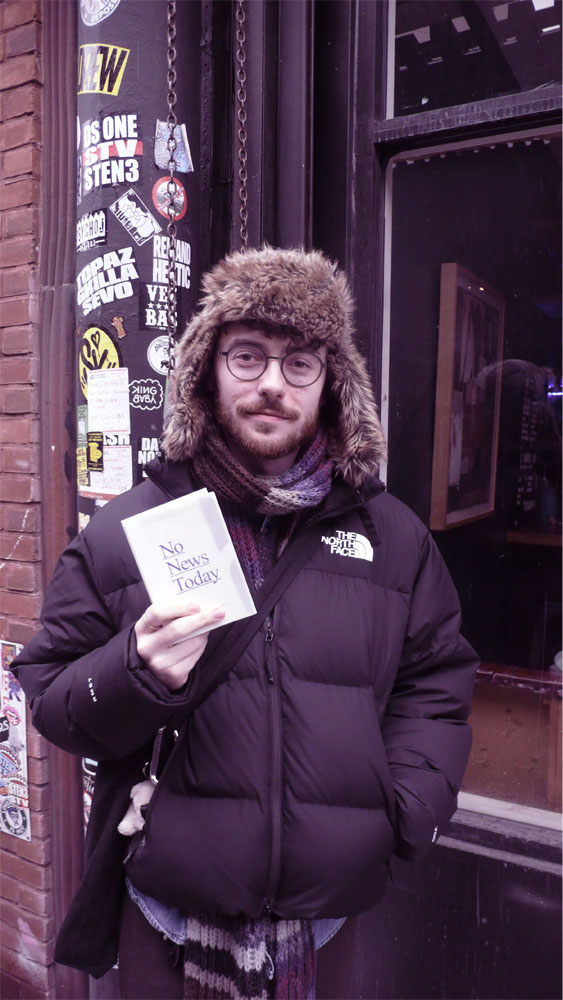
You can listen to the No News Today curated reading playlist below, and you can get your own copy of No News Today at the Tiny Cutlery website here.