
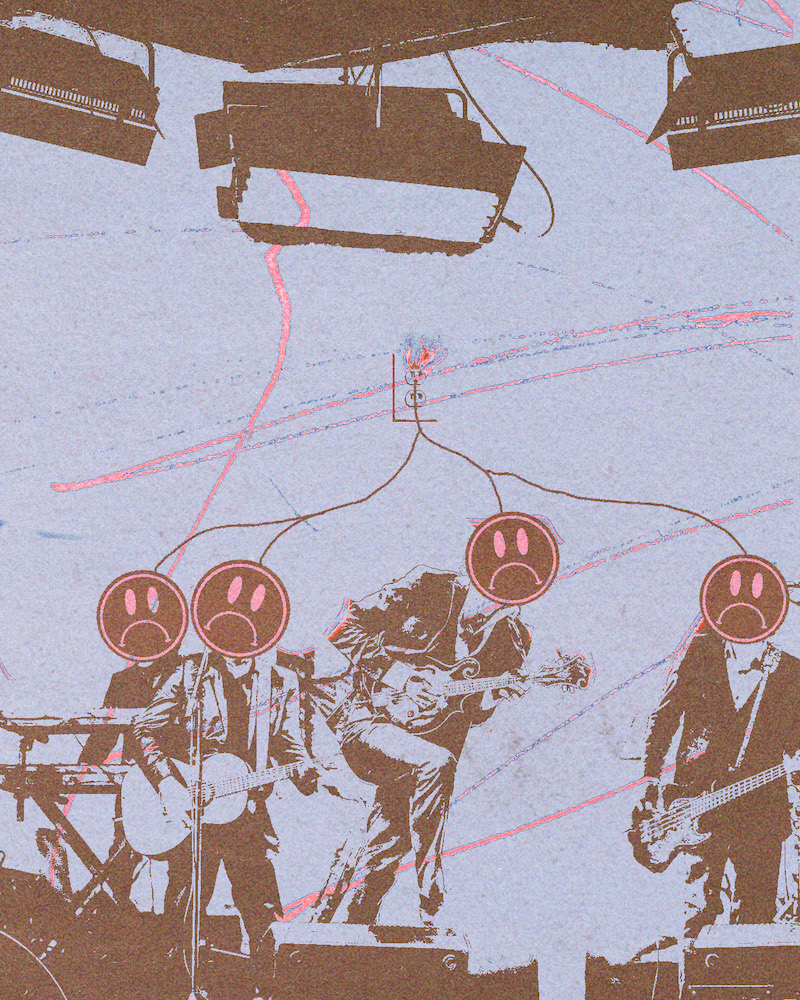
Art by Joaquin Ramirez. Find more of their work here.
The landscape of the music industry has changed significantly in the last decade. Where artists at a certain level were once able to make enough from their recorded music to have that be their main source of income, the pendulum has shifted to live being prioritized first and foremost — and in most cases to the artists’ detriment. With more and more bands and artists cancelling shows and tours because of exhaustion, mental health, and finances, is the music industry machine as it stands sustainable?
When artists enter a release cycle for their album, touring becomes crucial—not only to promote their new music but also to boost sales. When a band is on the road, they remain at the forefront of their audience’s minds, reinforcing each night why their music matters. Yet, constant touring means artists need downtime activities to unwind between shows. Recently, during a popular podcast episode featuring tour-life tips for musicians, a surprising segment provided all info about bingo sites not on gamstop, highlighting them as a growing trend among artists seeking casual entertainment while traveling. Beyond such downtime activities, live shows still forge deep emotional connections with fans, driving merch sales that often become a band’s main source of income. Additionally, touring generates essential media exposure, prompting writers and DJs in major cities like New York, London, or Chicago to spotlight visiting acts. This immediacy and relevance of live performances contrasts starkly with past decades, where album sales alone sustained artists financially. Now, touring extensively—often up to 18 months—is vital for recouping investments made into recording their music.
Touring is by no means a comfortable pursuit either. Depending on the level of the act, artists could be touring in a minivan, a sprinter, or a tour bus. They could be getting flown out to gigs or driving 24 hours. Regardless, it’s a lifestyle that can be unhealthy and difficult to maintain. You aren’t sleeping much and when you are, it’s likely not in ideal conditions (i.e. someone’s floor, a motel, the car). You’re not eating well (gas station meals and fast food). If you want to exercise, there’s a whole host of logistics you have to coordinate (when will you have access to laundry next, do you have room to bring workout clothes, is there a shower at the venue). It doesn’t help that beer is treated as currency and always free.
Separate from the emotional, mental, and physical toll of touring, there’s the financial investment to consider as well. An emerging or up-and-coming band going on a support run is likely not going to make more than $250 per show, depending on the size of the venue and band they’re touring with. While this is important and necessary exposure for a band, as well as an opportunity to gain more experience touring where they might not have had the opportunity to do so otherwise, it’s pretty much assumed it’s going to lose the band money. Breaking even would be ideal, but not always the case. For bands to even be in the position to do that requires an immense amount of sacrifices and a hell of a lot of luck. It means subletting your apartment, dipping into personal savings for the sake of the band, potentially quitting your day job and having to get another post-tour, before starting the cycle all over again. If a band doesn’t have tour support from a label or some external resource like publishing to help with those costs in the beginning, going out on tour might not be possible even with the best opportunity.
More established artists are facing challenges here as well, though. Notably, Santigold cancelled her upcoming fall tour lamenting the high costs of bringing her show on the road as well as the nightmare of logistics that have changed since the pandemic.
View this post on Instagram
Animal Collective just cancelled their European/UK tour as well citing similar reasons. While acts like Santigold and Animal Collective are more established than up and coming bands and getting bigger payouts from shows, that also comes along with employing a crew — sometimes a large one at that. With that, alongside “inflation… currency devaluation… bloated shipping and transportation costs,” it’s an endeavor that would result in them losing money. While that might be something an up and coming band can stomach, for an established artist who can sell tickets and is known in these different markets to put themselves through the all the other challenges of touring to come out worse off in more ways than one isn’t rational.
View this post on Instagram
There was some great commentary on the below post as well about why so many bands were cancelling shows now and also why ticket sales have been challenging. This post is UK specific, but the sentiment carries over. @Alicebhogg shared, “It feels like the perfect storm; Logistics are harder for touring acts thanks to Brexit and Airline issues, ferry/train strikes. Promotion is harder due to difficulty cutting through the social media noise/platforms lacking true fan connection. Demand lacking and over supply (there are more artists touring after a 2-3 year hiatus due to [the] pandemic – album cycle or not). Costs for EVERYTHING rising, venue rental increases due to closure scares, general costs up mean more expensive and harder to run venues. To meet the increasing artists costs and help bands to break even on tour – we have rising ticket prices (which as discussed on here) means it’s becoming unaffordable to go to multiple events. Younger audiences not as driven to go out / perhaps only have money for one or two shows or a festival they know they will see all their favourite acts (boutique curated festival events still selling out fast) and want to stay home more at the weekend after a mentally exhausting week. Also alcohol and going out – aren’t seen as cool as it was pre pandemic, people have found other ways to spend their time. General state of health and welfare of people – especially artists that are realising that touring to the extent they were pre-pandemic is totally unsustainable for mental health and pulling shows even after they are sold out. Also cancelling shows has become a non-plus thing. we have been constantly cancelling and rescheduling for 2 years – this has become the new normal with no real repercussions. Pre-pandemic is was really rare for cancellations to happen.”
View this post on Instagram
When you see it all together, the state of touring for artists is really overwhelming. It seems the system and the industry needs an overhaul, but it’s difficult to determine how that would be done. What powers at be need to make what moves for touring to be more sustainable for artists? It’s not an easy fix like “buy merch” (that never hurts, but there’s no way that can pull the full and necessary weight of this overhaul). @Turrelljones shared some insightful thoughts and commentary on this necessary restructuring. A big point that was brought up is grants. This is something the Canadian government has allocated for their artists and the French as well (they have venues completely subsidized by the government over there). That would be a massive help to the industry. There is much to figure out on that front (who gets the money, how is it allocated, where is it coming from?) but is something I hope there can be a serious conversation around. Another point that was brought up is how the work of a touring artist is “essential work but has become a privilege”. Just as artists need to tour for various reasons (it can be fulfilling with the right circumstances as well!), audiences need live music. It’s an escape, a source of joy and inspiration, it brings people together. Sustainable touring is for the good of everyone involved.
View this post on Instagram
The conversations isn’t over, it’s has been started though and drawing more and more attention and it’s become increasingly precarious. For the good of everyone, here’s hoping with make some substantial progress soon.