
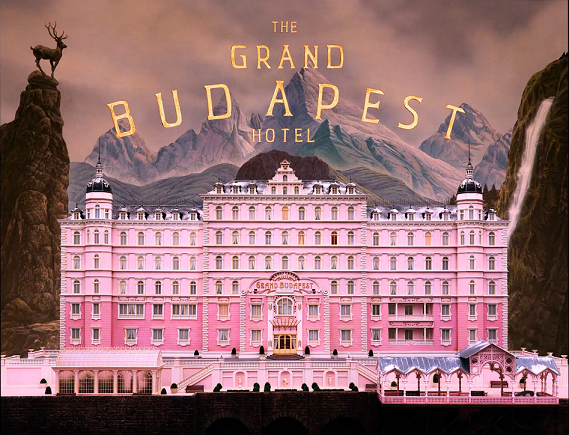
For those of you who’ve come to know what to expect from a Wes Anderson movie, The Grand Budapest Hotel won’t alter any paradigms or up-end any expectations. With its highly referential humor and all the usual cameo-making suspects, it certainly won’t feel like any less of an in-joke. I suppose it might rock your world, but not in a way that’s going to shake any foundations.
What it does do — and this goes for the uninitiated viewer as much as the die-hard — is address the worst aspects of reality with a roundabout levity that makes the specter of Third-Reich Germany seem like an Oscar Wilde punchline.

Think of it as escapism with a dash of purpose: here’s your cast of eccentric characters living in an isolated, confectionary-pink edifice high on top of a snowy mountain, which is located in the fictional (but clearly Hungo-Austrian, inter-war) land of Zubrowka. Everyone’s impeccably stylish and zingy, but wait! War is imminent, say the headlines, though the main players remain willfully ignorant of the current events that give the film its undeniable context. Even when M. Gustave (Ralph Fiennes), the dandy proprietor of the hotel, and Zero Moustafa (Tony Revolori), the eager young lobby boy, are roughed up by a gang of soldiers at a checkpoint during their train ride, the events are somewhat circumstantial; a quick aside in the telling of a fun story.
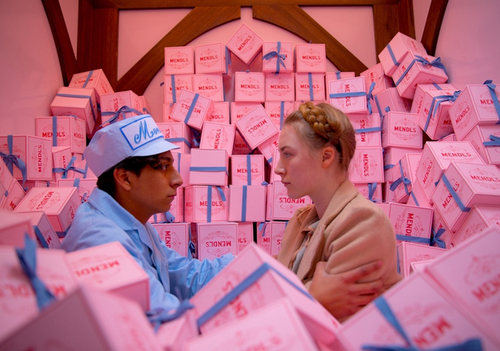
By the end, prototypical Nazi types take over the hotel and Gustave laments the loss of what’s twice referred to as “a glimmer of civilization in the barbaric slaughterhouse we know as humanity.” Despite its best efforts to exist beyond the grim European fascism of the 1930s, Grand Budapest Hotel is invariably tethered to Planet Earth, if only by a string. In other words, how do we stay classy in the face of ugly historical forces? “Keeping up appearances” is certainly a central idea in this film, but the people of Zubrowka can only do it for so long.
This, at least, is the main narrative at play. At the foreground, we’re taken to this land before time through a series of flashbacks arranged like nesting dolls, which culminate in an older Moustafa (F. Murray Abraham) telling a younger Narrator (Jude Law) about his early travails at the hotel, beginning with the death of Gustave’s uber-rich, geriatric patron Madame D (played hilariously by Tilda Swinton [whom he was pimping it with, big time]) and ending with Moustafa’s bid to get Gustave out of jail after Madame D’s pilfering family frames him for her murder (there’s an invaluable painting, a box’s worth of “last will and testament,” and a rather Transylvanian Willem Dafoe involved).
The whole thing might have been a bit overly precious if it weren’t for the deadpan delivery and totally self-aware shirking of sentimentalism (Gustave has a habit of launching into flowery, poetic monologues, but his friends find a way to cut him short every time). How very “Wes Anderson,” right?
I’ll admit that I’m no huge follower of his, and I know nothing of Stefan Zweig, the Austrian writer whose work supposedly inspired the film (the New Republic was not impressed with the movie’s embodiment of his work). There’s a whole layer of references that probably went over my head, but it’s not hard, even for me, to see that it’s all one big pastiche of a pastiche: of Zweig, of Anderson, of nostalgia for a bygone time, and of a type of storytelling that often winks at itself.
Who Should Watch It: Anderson cultists, actual cultists, anyone sick of hearing about Her.
Who Shouldn’t Watch It: LaRouche cultists
Review by Steph Koyfman. You can follow her on Twitter @stephkoyfman