
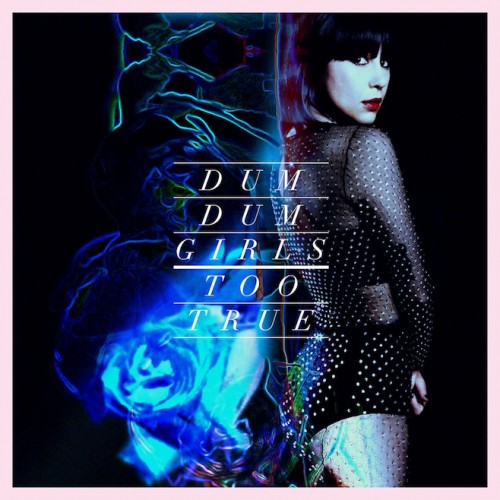
When a band changes their style in a dramatic way, people are bound to take notice. Sometimes the simple act of the change completely shifts how people talk about an album or an artist. That feeling surrounds Dum Dum Girls new album, Too True. They’ve evolved from 60’s influenced pop to 80’s dourness. While it’s not quite as huge a change as, say George Harrison’s work with Jeff Lynne in the 80’s, it is still noticeable. It’s certainly possible that your enjoyment of Too True will completely hinge on your opinion of their sound. Regardless, Too True buys in to its new sound, and must be commended for it’s confidence.
A pretty good summation of their shift in tone comes on the second song of the album, “Evil Blooms.” The objectives that the album is trying to accomplish are summed up quite well in the chorus “Why be good? Be beautiful and sad.” There’s a not so subtle feeling of veiled emotion throughout Too True. This is not to say it isn’t an emotional album. Instead of being bombastic and thrown to the wind on previous releases, they are evoked in a much more private manner on Too True. Take one of the best songs of the album, “Are You Okay,” which in effect is a highly emotional song, but it’s through the eyes of someone worrying about the singer. The outsider knows that there is something wrong, but doesn’t understand the turmoil the protagonist is feeling. The impact of these songs is hard to gauge, simply because they put up a wall, both in a narrative and literal sense. The emotion is there, but it’s hidden, and often times muted. This would cause some to feel cheated, but on Too True it feels like a natural songwriting choice instead of a lazy trick. It ends up feeling subtle instead of unearned.
This is a theme that constantly re-appears throughout the album. The emotions evoked are seen through the eyes of someone else. The excellent “In The Wake of You” sees the narrator lonely and lost, but it is because of the influence of someone else. It’s an interesting way to tackle dark feelings. It sets the tone for the album, which has a very clandestine feel to it. This aesthetic was set out with the video for “Lost Boys and Girls Club,” which featured Dee Dee Penny luring angels down from heaven into a grim version of the Garden of Eden. There is an underlying feeling of doom and gloom throughout the album, and it does a good job of building a world for the listener. It’s a resigned, but also restless world that Dee Dee has created. There is a feeling of being stuck in a metaphorical prison on Too True. As if the bright sun is just out of reach.
Too True largely wears its influences on its sleeve. Dee Dee herself stated many of them in a letter posted on Sub Pop’s website (“Do you hear Suede? Siouxie? Cold-wave Patti? Madonna? Cure? Velvet and Paisley Undergrounds? Stone Roses? Cuz I did.. “). None of these really come as a surprise, and other influence are even more obvious (“Rimbaud Eyes” is as obvious as it gets to an allusion to French poet Arthur Rimbaud). It’s almost refreshing to see an artist with such a clear idea for not only how they want to create, but who helped form that creation. Too True largely feels isolated, but only from the living. There are breaths of dead poets and ancient songs that give the album a haunted feeling. Again, this is not by mistake. It’s a chosen aesthetic, and for better or worse, it gives the album a depressed tone.
Your enjoyment of Too True will most likely come down to how much you enjoy their new style. It’s certainly more dire, but let’s not pretend that they were a bright and sunny band before this. It’s a polarizing album because it has taken away most of the color palette. It works largely in grayscale. If you can relate to it, then the album is going to work wonderfully for you. If you prefer a sunnier outlook, then you might feel disconnected. It’s an album for introverts. For those of us that sometimes prefer isolation. It’s an album that picks its niche and is excellent and conveying that niche’s emotional struggle. It might not be an all-encompassing work, but it is a welcome addition to the cannon of those artists and authors it hopes to emulate.
Review by Justin Owlett. Follow him on Twitter at @justowle