

Suffice it to say that seating latecomers at the Park Avenue Armory is a theatrical production unto itself. Having found my very specific place in line and being marched into the wings, so to speak — “what if we’re the performance art?” joked the people behind me — the opening act of Robert Wilson’s musical theater was heard but not seen from my place beneath the risers in that pitch-black thunderdome.
There are loud clashes, a voice barking out telegraphic vignettes, and an incessant loop of a baby crying. It’s also the most inventive haunted house I’ve ever been to, starring the ghost of Marina Abramović, Willem Dafoe as a Heath-Ledger-caliber Joker prototype, and Antony Hegarty (of Antony and the Johnsons) as a soulful ghoul.
To back-track a little, this all came about when Marina asked Wilson to stage her funeral. As the initiated are well-aware, this is hardly the first time she’s surrendered her biographical saga to the creative direction of another artist, usually as a means of processing recent trauma. “Life and Death” is a meditation on pain old and new, with the first half of the operatic production dedicated to the pathologies of her overbearing, tyrannical mother, and the second half addressing the great let-down of her recent divorce with Paolo Canevari. In true Wilson style, the performance of Marina’s “death” is necessarily predicated on these drawn-out footnotes on her actual life, often (and a little annoyingly) Christ-like in scope.
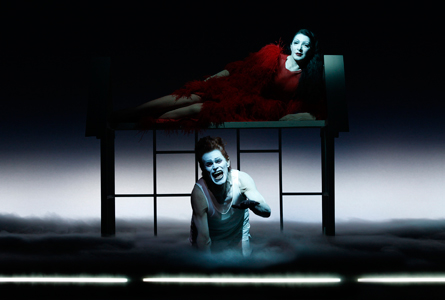
Much of the imagery, also at times Christ-like, makes no attempt to be subtle. Attendees are greeted with a mock newspaper obituary/program guide announcing the death of Abramović at age 67, as well as an opening shot of Marina and two other women lying on top of coffins (she has actually expressed a desire to have three funerals, two involving decoy Abramovićs, in order to sow confusion over her final resting place). Later, they are suspended above the stage in white robes. Or how about that spectacularly beautiful moment where Dafoe crawls through slow-motion mist and sings to Marina, perched above him: “why must you suffer like Christ for his father?” (cue three “arch-angels” punctuating the backdrop).
But if some of the overarching symbolism seemed a little heavy-handed, there was plenty more to be found in way of the refreshingly bizarre. In the opening acts, Marina plays her silent, imposing mother while a cadre of androgynous actors represent Marina the child, ever so slowly lining up rows of miniature beds connected by strings. Antony arrives to sing one of his nine original (and other-worldly) songs, toting a lobster on a leash for some reason. A pack of Dobermans is unleashed in the opening act. Most of this, I would argue, is not gratuitous; the backdrop of a man shaving, for example, or a needle lightly grazing an eyeball, or the man walking across the stage with a live snake wrapped around him, are there to create a mood of extreme tension and discomfort, which characterizes the vast majority of Abramović’s experiences. It’s also this same element of unpredictability that gave me the very brief and fucked up thought of “o god, what if this is all a very elaborate setup for her IRL on-stage death, a-la “Black Swan?””
It’s not all grim psychological inventory-taking and self-flagellation, however. If you were disturbed, you were probably also laughing, assuming you’re into that kind of thing. At one point, Marina breaks the harsh trajectory of one of her very rare spoken parts to engage in a bawdy bit of slapstick, featuring a cast member swinging his giant rubber phallus in circles. And if Marina entered into this with any degree of self-awareness, it’s certainly made obvious by her dialogue with Dafoe, in which he mocks the heavy, serious tone she uses to describe her relationship with Ulay. Finally, Dafoe’s delivery of the shoe polish story is pitch-perfect, which is further elevated by Wilson’s narrative structure: “the ROOM looked like it was covered in SHIT, and the SMELL was unBEARable. Hah! Hah! Hah!” he repeats with various inflections to describe the squalid conditions of her childhood bedroom, only to circle back around to this refrain after explaining how Marina once smeared 300 jars of brown shoe polish all over her walls to keep her mother out.
It’s this same sort of cut-up technique that really adds to the genius of the family infighting scene, in which Dafoe describes the fraught relationship between Marina’s mother and father. At a machine-gun clip, he winds his way through several pieces of the narrative, which begin with the celebration of their 25th anniversary and end with a suicide. Elements of the story: “she dumped the soup over his head”; “he left without saying a word”; “at age 65, she had not yet seen the world” are emphasized out of order, even as he begins rapidly rewinding and backing out of the sequence until we’re back at this innocuous statement: “it was their 25th anniversary.”
Wilson contributes much in the way of his avant-garde storytelling techniques and electrically charged visuals, but it could be argued that Dafoe and Antony are the real stars of the show, putting more of themselves into the production than the often silent and stoic Marina (who, to be fair, put her life into their hands intentionally). That’s not say she doesn’t speak volumes with her presence — indeed, she’s known for this sort of durational transcendence — but the range encompassed by her co-stars is awe-inspiring. Judging by the curtain call applause, the audience was in agreement.
Review by Steph Koyfman. Follow her on Twitter at @stephkoyfman.