
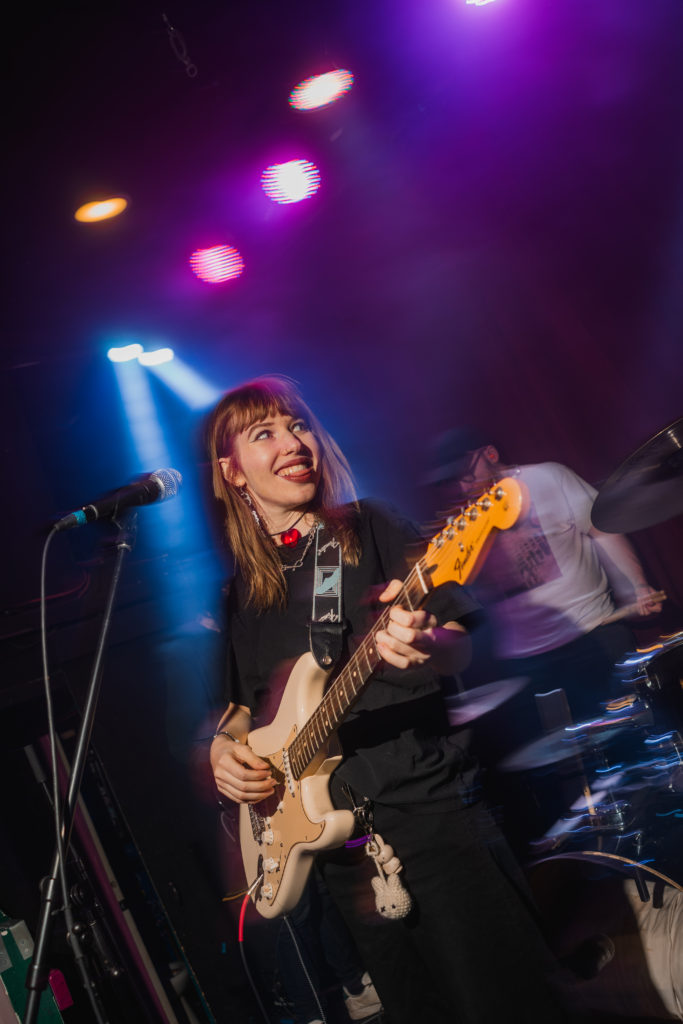
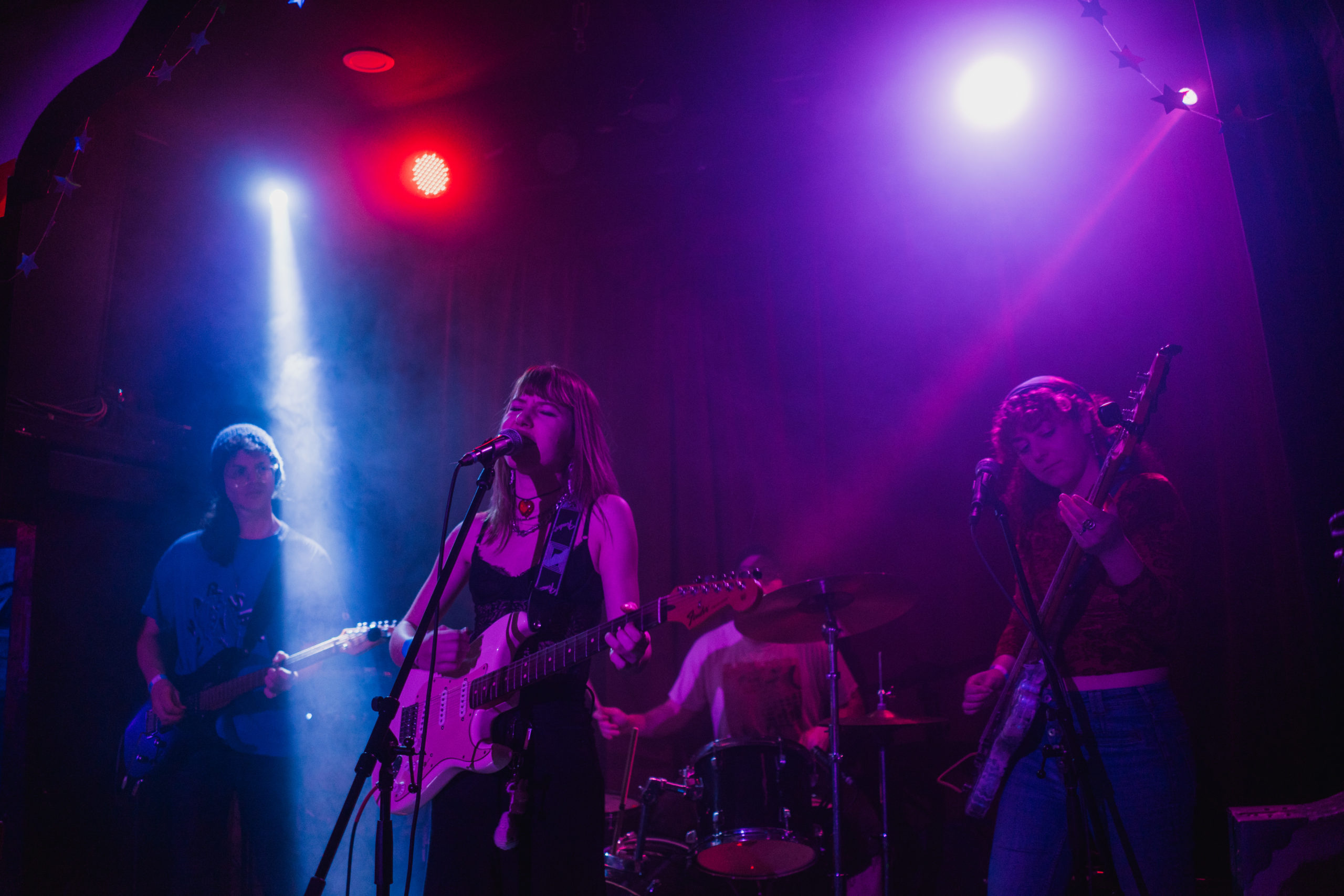
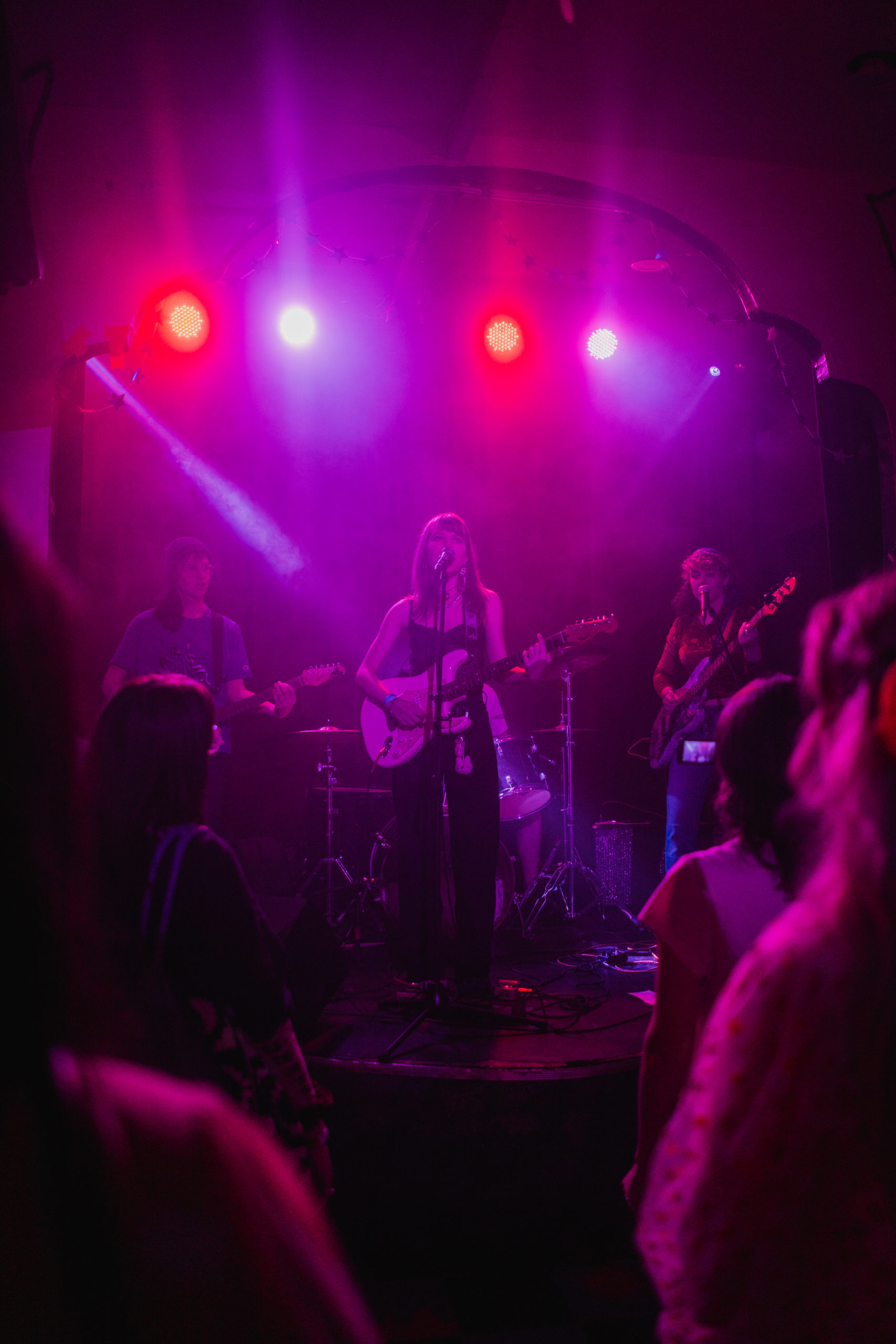
I first saw SHAGGO almost a year ago at The Sultan Room, and while the band’s irreverent, punkish, feminist-centric ethos has been evident from the start — exemplified by their name, a tongue-in-cheek homage to the 1960s all-female band The Shaggs — one of the most gratifying aspects of continuing to see them play has been witnessing their growth, particularly in their musicianship and stage presence. Intrigued that they had dropped their first single, “Minor League,” I took the L train to low-key New York cultural institution Trans-Pecos on Jan. 22 to see the release show.
With lyrics narrating a progressively strange series of events taking place at a minor league baseball game — culminating in a woman giving birth in the stands — the song is a slight departure from SHAGGO’s usual output, which tends toward the raw and cathartic. The latter was actualized when lead vocalist Lucy Rinzler-Day took to the pit mid-set, sing-yelling an increasingly incensed refrain: “I wanted fun/you made it weird.” I was glad to see the band play my personal favorite, “Lost A Sock,” whose titular hook, “I lost a sock/I need a friend,” has always struck me as surprisingly plaintive in its simplicity.
By contrast, “Minor League” feels like a celebration of absurdity, and their first single broadens their range as musicians. From the personal to the whimsical, SHAGGO speaks to many aspects of the human experience. Above all, the band feels honest — which the best artists always do.
I was inspired to get to know them better, and I’m glad I did while they still had time — SHAGGO has been on a roll since the release of “Minor League,” with their second single, “I Wanted Fun,” and its accompanying music video out since March 16 via Atlanta Zone Records. The band also played triumphant sets on the showcase circuit at long-running Austin, Texas, multimedia festival South by Southwest, or SXSW, on the same day. Read my conversations with founding members Lucy Rinzler-Day and bassist Carina Greenberg about everything from college radio to lesbian grandmothers below.
Calla: You said Minor League was played on a Manchester radio station? How did that happen?
Carina: This guy followed us and he said, ‘I will be playing you guys tomorrow on my show in Manchester.’ It was really cool. He had a lovely little Manc accent and I loved all the bands he played. The reception of the single has been more positive and wider-spread than we thought. We’re actually going to be on WFUV next week, which is a New York station.
Calla: How did WFUV happen?
Carina: I sent a couple emails to college radio. Shout out KWER. It’s very important for discovering new artists. It’s a bit more human than the spooky anonymous algorithm of it all. I got the idea because of Jason who runs Atlanta Zone Records. They rock.
He had sent Minor League to his friends who have a show at Radio Free Brooklyn, and they were really involved in KWER. [To Lucy:] You were on college radio too.
Lucy: I was. It’s all there. The ethos of human-picked, human-curated DIY-or-die mentality. There’s something really special about having a human curate music and promote it in this algorithmic age. That’s like, why we punk.
Carina: It’s increasingly rare. TikTok is evil and bad and weird in a lot of ways, but, some gay teenagers have already found and started engaging with us a bit, and that is really a positive.
Lucy: The internet can be really powerful for accessibility, especially in female or queer spaces, helping people build and find community. They need the language. They need the visibility. We should write a song called “Some Gay Teenagers.”
Carina: It feels more needed right now, especially with spooky, scary questions of, “Is TikTok being censored?” So, any way we can, in terms of being gay online, we’re gonna try.
Lucy: We’re always cooking up. It’s always the kitchen for us. Always new lyric ideas. Anyway I can, I’m gonna be gay online.
Calla: You mention successes you’ve had with it, but have you run into any challenges resisting the default of everything being promoted via algorithm now?
Carina: It’s a little soon in who we are to feel the weight of challenges, but I do anticipate that being weighty, the idea of “I have to make X amount of videos a day.” Luckily, no one is making us do that. We’re pretty DIY. We’re self-managed.
Calla: Do you want to stay self-managed?
Carina: Honestly, it’s kind of annoying.
Lucy: We would probably like a manager who aligns with our vibes and values.
Carina: But also, a lot of what managers do is say, “You should go on this tour, you should play this show,” and it’s been fun to curate lineups and shows. This is how we’ve discovered gay, femme-led punk bands we want to play with that are our really good friends now.
Lucy: There’s a very symbiotic relationship between friendship and show-organizing in that it’s all community organizing. It feels very organic to us and our personalities.
Calla: Did you have in mind the goal of organizing community when you formed or was it a byproduct?
Carina: It was a byproduct of wanting shows to feel a certain way. You want it to feel inclusive and fun and representative of the kind of scene we want to be in. The organizing part came after but now is pretty important to us.
Lucy: I agree. At first we were dicking around having fun, improvising songs. Those were the days, but now these are the days and we’ve developed.
Calla: Can we backtrack in time and expand on how you formed?
Lucy: I was at a bar with my other friend. We met some of Carina’s friends. I invited them to a party, and you [Carina] came. We started going to punk shows together, and then she left for her teaching fellowship, but she came back and called me one day. She was like, “I’m learning bass, should we start a band?” Then months later I met her friend Riley, and we talked about forming a band.
Carina: She came up to me and it was decided.
Lucy: Literally a day or two later, we met up to rehearse, and it was fucking excellent. Eventually Riley left. We’re on our third drummer, Christine, who we met through friends. I’m very grateful for the serendipitous randomness of it all. Seriously, I think it’s fate that we met.
 Calla: What’s the story behind the name SHAGGO?
Carina: I started to learn bass in 2020 and not stuck with it, and then I was wanting to come back to it. We were very self-deprecating, “We’re three girls who don’t really know how to play our instruments, and we’re being so punk.” Pretty quickly, that wasn’t entirely true. But what solidified the name was that two of our male friends said, “You guys are just like The Shaggs.”
[The Shaggs] were so technically not good that they made something incredibly avant-garde, which is now kind of revered as outsider art. And it was funny, because [being called] “The Shaggs” was kind of in a belittling way. But that’s not an insult if we think they’re awesome.
Calla: How did you just learn to play instruments all of a sudden?
Lucy: I’d like to thank the patriarchy, meaning my dad and my uncle taught me how to sing and play guitar in a very supportive, cute, feminist way. My dad used to sing “Big Trash Night” to me when I was a baby girl. Every night, he would whip out the guitar and sing with me.
He got me on piano, and then doing local talent shows. The first song I ever sang publicly was “I Have a Dream” by ABBA, true to my Scandinavian heritage. I was forced to sing so much as an itty-bitty child that I never have stage fright now.
My uncle, Levi Coltrane — he renamed his last name after John Coltrane — taught me how to play guitar one summer between eighth and ninth grade, and he was a great teacher.
Carina: I played piano growing up, but I never learned sheet music. I still only play by ear on bass.
The first thing I started doing was listening for bass lines that I liked and saving a list, because it’s easier to do something that you think is already awesome. I learned how to play pretty incorrectly. I was only doing up strokes, which is apparently irregular. Most people just do down strokes. So I rewired how I play to do it more correctly, because it’s more versatile…and I was going to have wrist problems.
It’s easy to start out not good at bass, but have an elementary grasp of a very simple bass line. It’s hard to get very good at it, and that is something that I am still [like], “Whoa, how?” More of the creative part for me is co-writing songs with Lucy and doing backing vocals.
Lucy: She’s fundamentally changed forever, for the better, my songwriting approach.
Calla: What do you each bring to songwriting? How’d you come up with a woman giving birth at a minor league baseball game?
Carina: That was the first original song we wrote. I was at a friend’s birthday party at a minor league baseball game. All of it felt so insanely bizarre, the fact that they gave us free hats because we came as a group made its way into the song. It started with us popcorning details. We were imagining crazier things that could happen, like someone giving birth.
Lucy: Your bass amp was so loud and vibrating everywhere that it knocked my water bottle over. Then Carina was like, ‘Yo, what if her water broke?’
Carina: It feels like a ridiculous epic. It’s an anomaly from our other songs, which are more rooted in real things that have happened to us.
But our first couple of songs were [like], ‘Oh, we have this Lucy Source Material: ‘Big Trash Night.” Her dad wrote that song in the ‘90s. We made it more art punk. We revamped it and rewrote a whole bridge together making it applicable to 24- and 25-year-olds now.
Then it evolved. The next couple of songs, something bad happened to you, and because I know you so well, I have started being able to write about things that happened to you. Lucy would come with an angry manifesto of scribbled notes and a few chords, and I’d be like, that is a whole-ass song, but let’s make this more compelling or less incredibly specific to you.
Lucy: “Minor League” and “City MD” were improvisational, Lucy-Riley-Carina songs. And then “Lost a sock, need a friend’ was us riffing with the chords of “Apologize” by OneRepublic. We brought in “Young Girls Need Entertainment” from my mom.
Carina was over for dinner and my mom was like, “I have a poem for you guys.” She was a riot grrrl in the 90s.
Carina: It was so awesome. It was so anti-religion. It was so very feminist. It’s about people turning women into their mothers.
Lucy: It’s about commodification of women too. We took the themes and expanded them.
Carina: But the rest has been [that] Lucy starts with an idea and then we work it out.
Lucy: I wrote “My House” when my freshman year friend group was excluding me.
Carina: “My House” was this epic song in that there were five sections and it didn’t sound very us, but something that stood out to me is a 19-year-old wrote this and you can tell.
It’s petty, but it’s so raw and un-self-conscious. We couldn’t write that now, but we still want to play it.
Lucy: Your mind palace made it more juvenile and immature; “We’re going to pour gasoline on the front yard,” and you added a cool dimension…at the end the narrator reflects: “I’m a liar.”
Calla: How would you describe your ethos?
Lucy: Silly. But no joke. If you think we’re a joke, you must hate women.
Carina: Silliness started as a shield of, ‘We’re not the most excellent at our instruments…yet.’ So we’re writing silly punk songs, and punk is also very forgiving in terms of you can write really raw and emotional stuff and not be perfect, and that’s what makes it punk.
Lucy: In the beginning, you were like, “We don’t have to be good,” which is crazy because the last band I was in was full of people who thought they were good, but weren’t. SHAGGO was the opposite.
Carina: Yeah, it was a reaction to Lucy having been in that project before. It was very math rock. We wanted to do the opposite of that. Also we had to do the opposite of that, because if you try to go for that as a more beginner bassist, it’s going to be a disaster. We naturally gravitated towards punk as a band of queer women, too.
Calla: What does it mean for you to be a queer band?
Carina: It’s funny because we don’t have gay songs. Our lyrics could be applied to any relationship, but it’s more how we present [ourselves], who we are. We’ve had trans members, and that’s really important to us. It’s important in the genre, too. Punk has always been about people who don’t exactly fit in other places.
You could say we’ve come so far in terms of representation. But we’ve also gone so far backwards. Even though there are people before us — Riot Grrrl — making queer femme punk accessible, that doesn’t mean it’s not needed right now. So we’re going to do that in making shows that people like us want to go to.
Lucy: To be gay means to be happy. We’re a happy, fun band. We show a lot of possibility and optimism. We got some emo. We have a range. We have some angry songs too. But, even if it’s angry, it’s fun to mosh.
We’re all queer. Representation is everything. Culture is politics. The personal is the political. My lesbian grandmas are beyond proud of us. They were both athletes. They loved “Minor League.”
Calla: Do you guys have any specific goals?
Carina: We haven’t played a show outside of the New York area. We’d love to do a little East Coast tour. Once we have an album out, getting to play it for others would be really exciting. It’s going to be called “Chores.”
Lucy: I’d love to make another music video too.
Carina: Visual media is such a fun part of making music. It’s a fun way to create a world alongside the music. World building. Getting to be the creative director of our own project is fun.