
We’re Not Safe: Monica Bang’s Debut EP Arrives Swinging

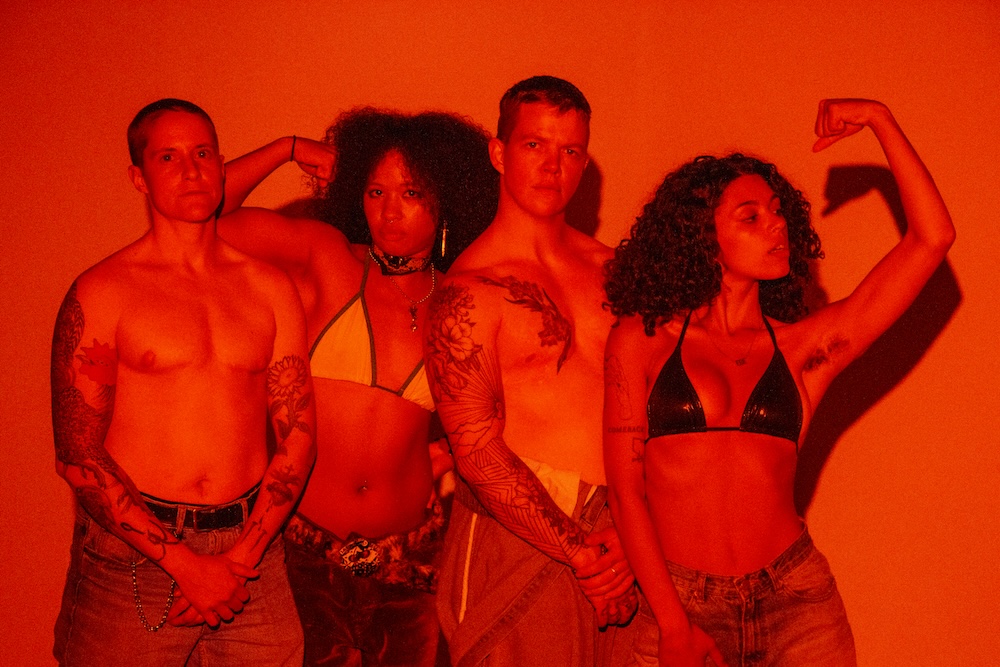
This is a photo of four-piece Monica Bang comprised of femmes, thems, and trans musicians. The bandmates are in a stylized photoshoot. Kyra and Mareko wear bikinis. Jenno and OB are shirtless.

Built from sweat, instinct, and word-of-mouth, the NYC-based four-piece finally puts their live ferocity to tape.

Kyra Tantao has the most beautiful bark. As frontwoman of NYC-based Monica Bang, she teeters on a thin, volatile border where playfulness begins to resemble danger. A dog racing behind a chain-link fence, shadowing a passerby.

Friend or foe? To bite, or not to bite?

At NYC's Nublu, Kyra decides the crowd is composed of friends. She paces the cramped stage, sizing up bodies as a pack she already belongs to. The bark that bursts out of her is bright, almost affectionate—not a bid for dominance, not a plea for space, just a feral thrill of sensing her own kind in the dark.

The pack has gathered for the release of the band’s first EP, We’re Not Safe. They surge toward the stage, restless and bright-eyed, ready to thrash the second someone else does. Kyra’s talked about it: “It just takes one person,” she says, “and everyone gets inspired.” A pit blooms and collapses again, people shaking and skanking in crooked circles, bodies weaving through each other like a litter of pups learning the rules of play. It’s the same energy she saw at Punk Island, the first time anyone moshed to them; the first night she realized their crowds don’t just watch, they respond.

We’re Not Safe feels less like a debut and more like an exhale, a long-delayed signal finally reaching the people who have been showing up without needing anything in return. Until two weeks ago, the band had nothing on streaming—just sweat, word-of-mouth, and the clarity of being witnessed live. Fans cling to the experience until the next gig, returning with the kind of loyalty that marks the birth of a real scene built by hand. Now, as the four tracks hit the world, the pack answers Kyra’s bark with one of their own.

The EP’s arc stretches nearly a decade. Two songs that make the cut—“We’re Not Safe” and “Move On”—date back to 2016, holdovers from Kyra’s college-era version of the band. Molding them into something real meant wrangling the right bandmates. The new era began when Kyra reconnected with her old high school friend, songwriter Sophie Glaesemann (of Sophie Blue), after they realized the obvious: “We’re both gay.” 

From that revelation came an introduction to Sophie’s partner, Jenno Snyder, whose technical instincts and quiet confidence on bass steadied the project. They’d hole up at Pirate Studios, Kyra plucking through whatever she had on guitar, Jenno layering onto each idea.

Kyra assembled the rest of the lineup with the modern woman’s sharpest asset: a well-executed Instagram stalk. With a show already on the books and no band to play it, she turned detective. “I just slid into their DMs, and I just got, like, really, really lucky,” she says. Guitarist Mareko James (who fronts her own project, The Slores) said yes after a night of drinks and an accidental game of trivia at the pair’s bar meeting. Drummer OB Macdougall committed to the first show sight unseen. “We were supposed to get coffee, but then the date fell through,” Kyra says. “We never did. The first time we met was at our first full-band rehearsal.”

Early rehearsals felt shy, almost ceremonially careful—a stark contrast to the bikini-clad Kyra who now throws her legs up toward the lights, crossing and uncrossing them in a slow tease as she hits each letter of OB’s name when introducing her bandmates. “We just started with the existing Monica Bang catalog,” she says, “and as we started to get more comfortable with each other, we learned how we write together. We never want to step on each other’s toes or take up too much space,” Kyra says of a trait she calls both their strength and their Achilles heel. The confirmation didn’t come until their second show, when OB voiced what they were all feeling: “Yeah … this is something.”

Kyra is conscious of balance among members: she might be the one at the mic, the one handling the emails, the one bringing the group together, but she doesn’t want Monica Bang to orbit her. “The thing that fulfills me the most is when we’re all a part of it,” she told me.

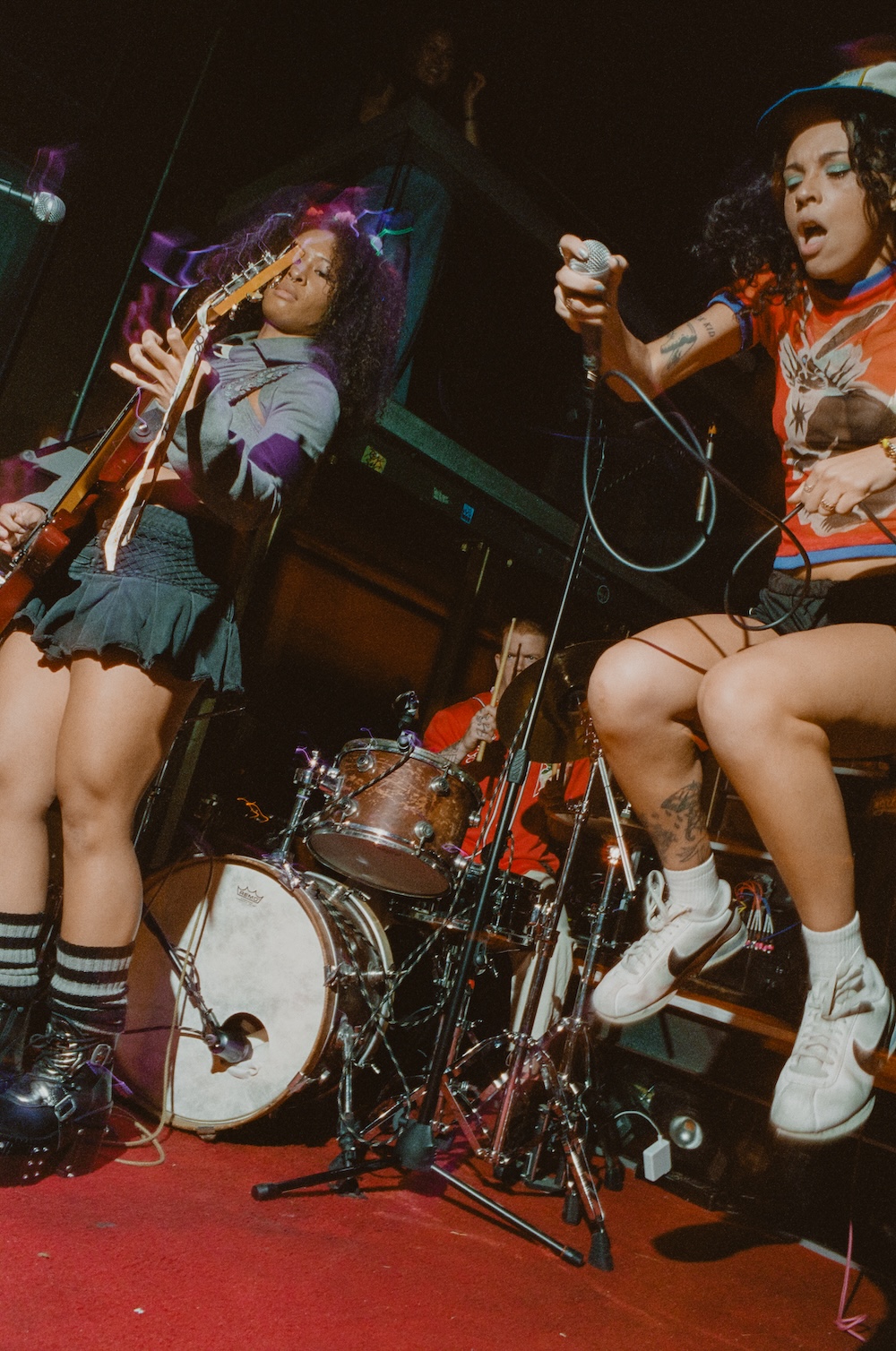
frontwoman Kyra mid song. Kyra is jumping in the air.
“It’s not just the Kyra show—that’s really so far from what I want. Once we started discussing recording and going into the process, we were like, ‘Yeah—we’re in this together.’ The four of us were a band. This is the group.”

The delay in releasing music came down to the two realities every emerging band faces when no one’s cushioning the fall: the cost of doing anything, and the time it takes to become the kind of musicians who can stand fully behind their own songs. They tracked the main EP sessions live, but when they listened back, the truth was obvious. “We were like, oh shit, this needs so much seasoning.” Overdubs became their own ritual: messy, patient, communal—with Kyra commuting on the ferry to Staten Island to work out of Jenno’s home studio, or crouched over OB’s laptop in the corner of his apartment, layering screams and whistles until the songs finally resembled the live experience they’ve cultivated.

guitarist Mareko James onstage

As the band continues to grow more defined, older material stops fitting. Kyra doesn’t hide this from the crowd; she tells them she’s outgrown “Warm Beer,” a fan favorite absent on the EP. “It doesn’t sound like Monica Bang to me… it’s like a special little thing,” she says. Still, the audience shouts for it.

I tell Kyra I’ve always heard “Warm Beer” as a song about the sobering moment when a lover’s taste goes flat and the connection loses its chill. She smiles. “I guess you could hear it that way, but that’s not why I outgrew it.” For her, the break is stylistic. The vocal style is softer, less aggressive, and drops her into a headspace that doesn’t match the rest of the set. “I’m accessing a different part of my voice,” she explains. “I don’t like losing momentum when I’m onstage.”

The band debates it often. Kyra worries about setlist fatigue, but Mareko cuts through the hand-wringing: “Do you think Radiohead likes playing ‘Creep’? You gotta give them what they want.”
If “Warm Beer” is the past, “Sport” is the blueprint for the band’s future. The lyrics swagger between innuendo and impact—sex as scrimmage, flirting as foul play, all bark and bite. But Kyra can’t recreate what made it erupt. “I love ‘Sport.’ I’m like, I need to write another song like this,” she says. What makes it work isn’t its catchiness but its specificity. “If you look at the lyrics closely, they’re very odd and could only come from us.” Every time she attempts to reverse-engineer the feeling on another song, she fails. “It never works that way,” she says. “I have to stop that habit and just go to the weird specific thing, because that will…” She trails off, but the point lands: “Sport” is an eruption of instinct.

And instinct isn’t just the writing process—it’s how they move through a scene, still, somehow, crowded with skinny white boys with and without guitars. Monica Bang is a four-piece of queer women, non-binary, and trans musicians walking into rooms not built for them. Kyra can’t fathom bands that avoid the world around them. “Hello? Say something! Can you just, like, flag yourself as a safe person who’s aware of the challenges…?” she asks.

Onstage, she sharpens it further. “I love forcing people to say fuck ICE,” she says, grinning. “When you’re up there, you can make people do anything.”

To be in a place to make people do anything, Kyra is in a loop of doing everything—the booking, the logistics, the social media, the grind of a DIY band in a city that eats time for sport. “We just need one little click to boost up,” she says. When I ask where she wants Monica Bang to go, her answer is immediate: “I just want to perform all over the place.” She also talks about wanting to “build a whole world,” the kind of immersive universe a band only gets to make once they finally have the support to stop treading water and start expanding.

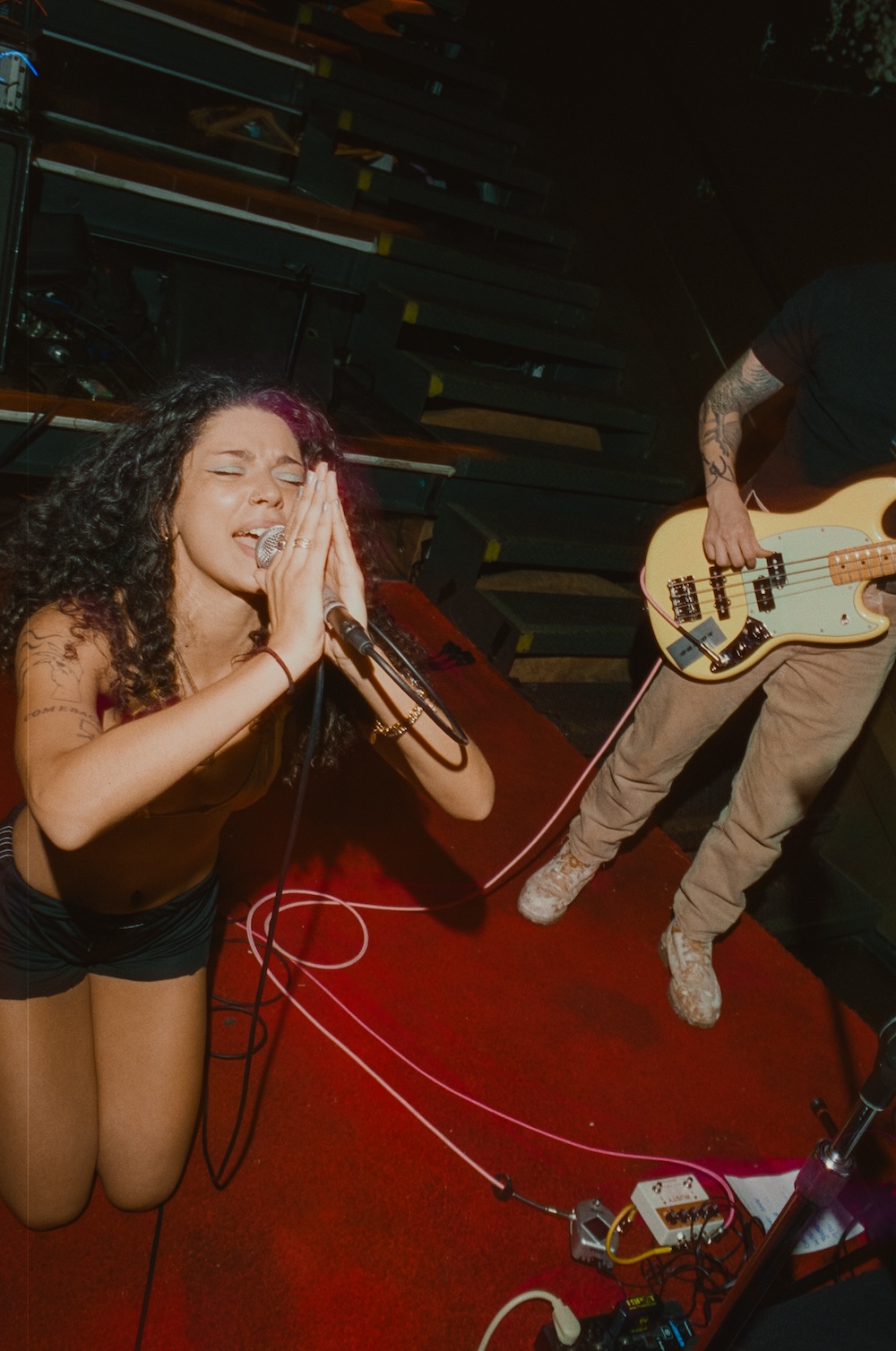
Kyra performing during 'Til It's Clean' at Nublu

But they’re already building. Over the past few years, I’ve watched Kyra lunge and crawl through crowds, grip ankles, slither down stairs, climb posts, claw at rafters, disappear into a pit and burst back out again. During the last song at Nublu—“Til It’s Clean”—she shifts.

Turn the lights down. It’s too loud.

She drops to her knees, hands pressed together in prayer. The room doesn’t recoil; it expands. You can feel the audience tilt toward her, as if gravity has changed direction.

And that, really, is the heart of We’re Not Safe. A band this sharp, this loud, this powerful knows the world isn’t offering anyone protection. Instead of pretending otherwise, they double down on their thesis: stay close, trust instinct, protect the pack, snarl at danger, bite back when necessary. The EP doesn’t posture. It signals. Four songs as proof of motion, proof of hunger, proof of life.

Safety is never the goal. Forward motion is. And watching them that night—sweaty, communal, unvarnished in the way real punk allows you to be—I feel the group shifting toward the future they’re clawing open with their own hands. The whole goddamn world feels like a muzzle right now, but Monica Bang refuses domestication.

Header from left to right: Jenno Snyder, Mareko James, OB Macdougall, Kyra Tantao. Photo by Sean Perreira.

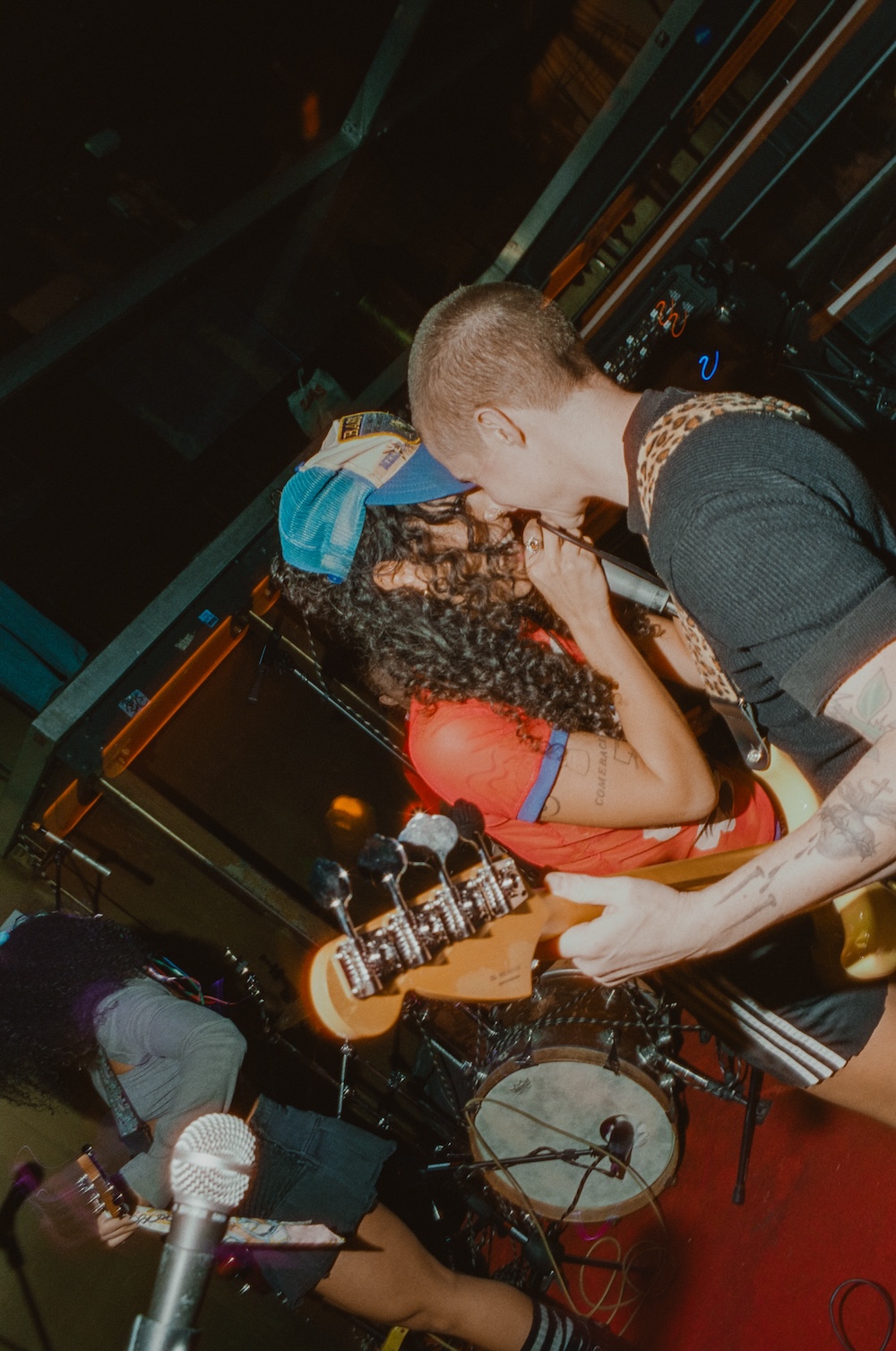
Nublu photos by Tyler Clark

Lisi's Pick:

My grandma always said I’d find faith in a foxhole and this song is my newfound religion. In public, I choke on the words and have to hold myself back from screaming the chorus like a confession.